Can logistic growth predict the carrying capacity of the U.S. population?
In a groundbreaking paper published in 1920, Pearl and Reed examined the fit of several different mathematical models to U.S. census data for the period 17901910. Several of the approaches they tested did a good job of matching the historical data, but none included limits to the eventual size of the U.S.
population. To address this shortcoming, they derived the logistic equation, which, unknown to them, had been first described in 1838 by the Belgian mathematician P. F. Verhulst. Pearl and Reed argued that the logistic equation provided a sensible way to represent population growth because it included limits to growth. When they fit the census data to the logistic curve, they obtained an excellent match, from which they estimated that the U.S. population had a carrying capacity of K = 197,274,000 people.The logistic curve estimated by Pearl and Reed provides a good fit to U.S. population data through 1950. After that time, however, the actual population size differed considerably from Pearl and Reed's projections (FIGURE 11.15). By 1967, the carrying capacity (197 million) they had predicted had been surpassed. Pearl and Reed intended their estimate of the carrying capacity to represent the number of people that could be supported in the United States in a self-sufficient manner. They recognized that if conditions changed—for example, if agricultural productivity increased or if more resources were imported from other countries—the population could increase beyond 197 million. These and other changes have occurred, leading some ecologists and demographers to shift their focus from the number of humans that make up the
carrying capacity to the total area of land required to support humans (the “ecological footprint,” discussed in Connections in Nature).
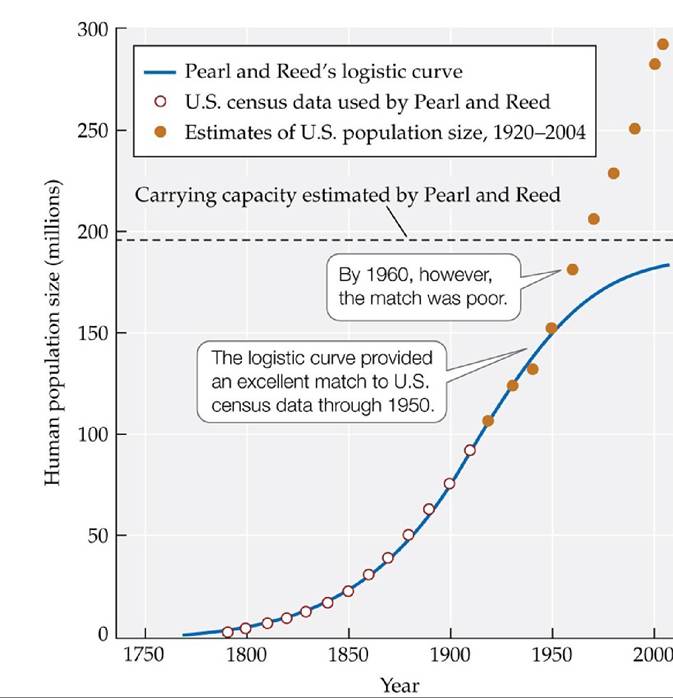
FIGURE 11.15 Fitting a Logistic Curve to the U.S. Population Size In 1920, Pearl and Reed fitted a logistic curve to U.S. census data for 1790-1910. They estimated the nation's carrying capacity (K) as 197 million people. (Data through 1910 from R. Pearl and L. J. Reed. 1920.
Proc Natl Sci Acad USA 6: 275-288; other data from Statistical Abstracts, U.S. Census Bureau.) View larger image
More on the topic Can logistic growth predict the carrying capacity of the U.S. population?:
- Some populations exhibit logistic growth, a pattern in which abundance increases rapidly at first and then stabilizes at a population size known as the carrying capacity, the maximum population size that canbe supported indefinitely by the environment
- CONCEPT 11.3 The logistic equation incorporates limits to growth and shows how a population may stabilize at a maximum size, the carrying capacity.
- In logistic growth, the population approaches an equilibrium
- The logistic equation models densitydependent population growth
- CARRYING CAPACITY
- Carrying Capacity of Molochna Pasture Lands
- Consequences of non-logistic resource growth
- 2. Models that predict small policy effects on growth
- Logistic Growth
- Patterns of Population Growth
- 11 Population Growth and Regulation
- Human Population Growth: A Case Study
- CONCEPT 11.4 Life tables show how survival and reproduction vary with age or size structure, influencing population growth and size.
- Working independently of each other, A. J. Lotka (1932) and Vito Volterra (1926) both modeled competition by modifying the logistic equation.
- Theoretical models that predict strong policy effects
- Species distribution models can be used to predict a species' geographic range
- The modern approach to growth, often called “new growth theory,"really consists of two quite distinct theories.
- CHAPTER V. COLLEGIA AND CORPORATE CAPACITY
- Bladder Capacity