Carrying Capacity of Molochna Pasture Lands
Animal husbandry requires little labour, and it is thus a common agricultural adaptation to conditions of labour scarcity such as those in the Molochna region in the early nineteenth century.1 Sheep breeding in particular was important because of the region’s isolation from markets.
The nearest ports were Mariupol, which was 170 kilometres to the east, and Feodosiia, 250 kilometres southwest. The costs involved in transporting agricultural products over such distances were an important strategic consideration for settlers. Wool had a high ratio of value to weight, while being relatively impervious to the rigours of slow travel over poor roads, making it a natural choice for commercially interested Molochna settlers.2 Also, catde and horses were important in Molochna. Oxen were the draft animal of choice for Orthodox and sectarian state peasants, while for Nogai ownership of cattle played a cultural role in defining social status. Horses were important both as draft animals and as status symbols, and Nogai in particular kept large horse herds.The carrying capacity of range lands became a vital determinant of socioeconomic development in Molochna. What does carrying capacity of range land mean? Some sources report that pastoralists in New Russia kept as many as ten sheep per desiatina, which represents an enormously high ratio of livestock to pasture land.3 Others suggest that even the richest hay lands in the irrigated flood plain, which constituted but a tiny proportion of the total pasture and hay land in the Molochna River Basin, could only produce enough hay to feed about five sheep per desiatina per year.4 On the less arid range lands of Dneprovsk uezd, north and northwest of the Molochna River, owners of large private herds seldom achieved a ratio of more than two sheep per desiatina, while Mennonite colonists kept not more than 1.2 sheep per desiatina on their communal pastures (and this figure dropped temporarily to 0.48 sheep per desiatina after the severe winter of 1825).5
The discrepancies between such accounts make it necessary to look elsewhere for guidance.
Modern agronomists conventionally measureAdaptation on the Land-Rich Steppe, 1783—1833 47 carrying capacity of range land in animal unit months (AUMs), the number of months a given unit of land will support one 450 kilogram cow or horse or six sheep. This calculation is based on an average daily consumption of twelve kilograms of dry matter.6 Cattle and horses in New Russia were small, averaging only about 200 kilograms each, although sheep achieved approximately the modern weight norm of about eighty kilograms.7 Hence, for Molochna one nominal 450 kilogram animal unit (AU) was equal to about 2.25 cows or horses or six sheep.
Arid natural pasture lands like those in Molochna produce, at best, just over 1,200 kilograms of dry matter per desiatina.8 This could be improved substantially by irrigating or growing specialized high-yield fodder crops. By 1835 only 1,385 desiatinas of hay land were under irrigation in the Molochna region, while specialized high-yield fodder crops were first introduced (on an experimental basis) only in the 1840s. Using a figure of 1,226 kilograms yield per desiatina, the AUM for one desiatina in Molochna was 3.35. This means that one desiatina of land could support one animal unit for 3.35 months and that about three and a half desiatinas were required per animal unit per year. Thus, in the Molochna region each desiatina of range land could support about two-thirds of a small local cow or horse or about one and three-quarter sheep.
Sometimes livestock populations temporarily surpass the carrying capacity of their pasture lands. Herds expand beyond the limit of carrying capacity, and die off from starvation and disease during droughts and epidemics. Among undernourished, livestock epidemics are all the more frequent. Eventually, populations stabilize again - at a lower level, determined in part by degeneration of pasture land caused by overgrazing and in part by human adaptation to agricultural systems that are less dependent on livestock.9
This process of animal population growth, decline, and levelling is known as an ungulate irruption.
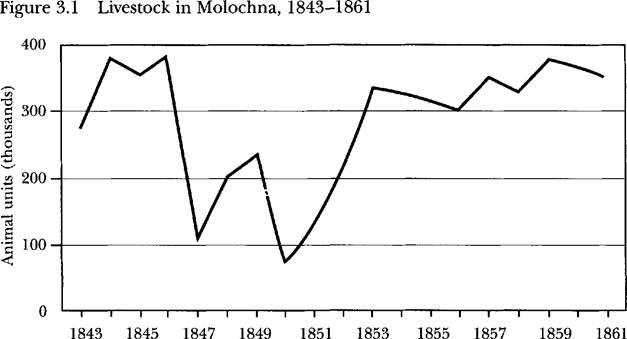
It often repeats itself in an irruptive oscillation, a cycle of livestock population growth and decline with a reciprocal decline and recovery of the pasture lands, albeit at a lower carrying capacity each time.10 The severity of irruptive oscillations lessens as a balance is achieved. Typically, the entire levelling process takes thirty-five to forty years.11Appendix Table A.2 shows total livestock in the Molochna region between 1805 and 1861 in real terms and in animal units. At their highest in 1846, the roughly 1.1 million head of livestock in Melitopol
Sources: 'Otchety tavricheskikh gubernatorov,’ 1841-61,/ 1281, op. 4-6.
and Berdiansk uezds would have required an estimated 1.33 million desiatinas of grazing land. According to the calculations of the Land Survey Department there was a total of just 1.49 million desiatinas of useful land in the entire Molochna region including arable land, village sites, and waste lands. Thus, total livestock must have been pushing close to the limits of the region’s carrying capacity. As will be shown below, for some Molochna setders the limit had already been exceeded.
The fluctuations in total livestock holdings after 1843 (the period for which there are adequate data) are portrayed graphically in Figure 3.1. This pattern is typical of an irruptive oscillation and tends to confirm that by the 1840s the pasture lands of the Molochna River Basin were used up and were probably experiencing ecological degradation from overgrazing.