Adapting to the Land: Nogai and Orthodox State Peasants
Nogai and Orthodox state peasants came to Molochna from utterly dissimilar environments. The adaptations required of them were likewise dissimilar. Orthodox peasants arrived from overcrowded interior guberniias where arable husbandry predominated.
They found a landscape vastly different from the one they had left behind. The frontier was arid, treeless, and isolated from markets, and demanded a change to less intensive forms of agriculture than they had previously known. Nogai came to Molochna as seminomadic steppe pastoralists, fully accustomed to the environmental demands of their new location. For the Nogai adaptation meant a transformation to more intensive agricultural practices as the Molochna became more and more densely populated. Both groups found a common solution to their needs in the transition to sheep breeding, but as they adapted, the functional roles of their traditional administrative systems were undermined. The success of their adaptations would ultimately rest upon their ability to develop new administrative structures to replace the old.Nogai Adaptation
There is little direct evidence about internal administration in the Nogai community in their first years in the Molochna region, but studies of Central Asian steppe nomads provide guidance. Nomadism placed limits on political authority, for nomads spent much of the year in small groups beyond the direct influence of political leaders.12 Central Asian nomads lived in auls, which were mobile villages composed of as few as two and seldom more than ten households, each consisting of a man, his wife, and their unmarried children.13 An aul was typically made up of households headed by close relatives and forming a primary kin group, which was led by the eldest male, who was advised and supported by the heads of other households.14 Groups of auls often formed confederations known as hordes with common territorial rights.15 All members of a horde traced their descent through the male line to one common ancestor, often Chingis Khan (Ghengis Khan), and such descent myths provided ‘a theoretical foundation for social integration.’16 The Nogai descent myth included Chingis Khan, but extended back to the biblical figure Ishmael, son of Abraham and Hagar.17
The leader of a horde was the bey.
His sons and close male relatives formed a hereditary nobility known as murzas, who led their own auls, which were often larger than the norm, containing as many as fifty households.18 The murzas’ control of the horde was based on their senior genealogical position, and it was ‘frequently the aristocracy... which [cultivated] knowledge of genealogies and [manipulated] them so as to give an ideological basis to their ruling positions.’19 Beys and murzas were responsible for the allocation of key resources, the establishment and regulation of migration routes, the defence of the horde’s territory, and other common interests.20Beys, murzas, and leaders of auls gained economic advantages from their positions. They could arrogate to themselves the best grazing territory and exact labour services - particularly livestock supervision - from other clan members.21 However, nomadism placed limits on economic differentiation, as well as on political authority. The most basic limitation was that the means of production, the pasturage, was held communally.22 A second important constraint was that nomadic households required a minimum number of livestock to subsist. That placed a lower limit on the size of a viable household’s herds, whereas the need for mobility and the environmental limitations of pasture lands placed maximum limits on herd sizes. Many of the trappings of wealth in sedentary society were simply impractical for nomads, who had to limit their personal belongings to what they could carry with them.23 The stability of nomadic societies was ensured in part by the safety valve of surrounding sedentary societies, which provided an outlet for those whose herds grew too small to be viable, whether through misfortune or mismanagement, and for those who found the attraction of greater wealth irresistible.
As detailed in Chapter 2, the state’s first administrative objective with Nogai was to end their nomadism and force them to abandon pastoral- ism in favour of arable husbandry.
In 1825, when Cornies credited Demaison with arousing the Nogai ‘to the work of agriculture with great zeal and profit,’ it was Demaison’s success in forcing Nogai to grow grain that he was referring to.24 As Appendix Table A.3 shows, Nogai grain production increased sharply in 1816 and continued to show high yields for the following three years. Demaison achieved this by denying travel passes to Nogai men who did not first sow at least two chetverts of grain.25 This restriction, implemented in 1816, was effective because many young Nogai men would travel to the Crimea each summer to work as herdsmen. Wages in the Crimea averaged twice those in Melitopol uezd, and a lead hand could earn as much as 600 rubles a year; thus, the travel passes were highly valued.26Despite the apparent success of Demaison’s scheme of grain for passes there are several reasons to treat the reported results with caution. To begin with, the accuracy of harvest reports is questionable. Between 1816 and 1819, when Nogai output-to-seed ratios reportedly averaged 6.09:1, Mennonite yields averaged just 5.89:1, and Orthodox state peasant yields just 4.6:1.27 That Nogai pastoralists suddenly outstripped their more experienced neighbours in grain production is curious, to say the least. Indeed, harvest reports from at least one of the six Nogai volosts show clear evidence of falsification. For 1817 and 1818 they show that the Nogai volost of Ialanzachskaia had yields of over 10:1, about twice that of any other volost in the entire region! Such extraordinary success is more likely to be a reflection of creative record-keeping than of efficient farming. Even without Ialanzachskaia volost, Nogai yields in this period were better than they had been in earlier years or would be in later years, but the extent of the improvement is probably much exaggerated.
More significant is the fact that when, in 1821, Demaison retired from active participation in the administration of the Nogai, (he retained his tide while an assistant did the work until he was officially replaced in 1825) grain production immediately returned to its earlier low levels.28 In 1825 Comies lamented that after Demaison’s departure ‘the economic and moral improvement of these people appears to almost be at a standstill.
Worsened by last year’s poor weather, their economic condition has deteriorated, and their laziness, quarrelsomeness, and thievery are on the increase.’29 Apparently the grain-for-passes scheme had produced no lasting effect.The clearest evidence that Demaison brought no fundamental change to the Nogai was their continued pastoralism. As Table A.2 shows, Nogai herds expanded enormously during Demaison’s tenure. Pastoralism was a logical choice for Nogai from both an economic and environmental point of view, for as already noted, most Nogai land was unsuited to arable husbandry. However, it would be a mistake to conclude that Nogai pastoralism was based on either economic or environmental considerations, for as in most pastoral societies, livestock also played an important cultural role for Nogai.30 If economics had decided the matter, Nogai would probably have raised sheep for wool. As Table 3.1 shows, over the course of Demaison’s tenure the percentage of sheep in Nogai herds (expressed as AUs), almost tripled. This suggests that commercial concerns had begun to affect Nogai herding strategies. But in 1825 sheep still made up less than a third of Nogai livestock, and at the end of Demaison’s tenure Nogai still concentrated primarily on cattle and horses. The Swiss missionary Daniel Schlatter, who made two lengthy visits to the Molochna region in the 1820s, even suggested that Nogai men valued their horses above their wives.31
From an environmental perspective, while the region was suited to pastoralism the enormous growth of Nogai herds during the time of Demaison was hardly desirable. In 1825 Cornies worried that Nogai were overgrazing their land, and he was probably right.32 In 1819, when
TABLE 3.1
Sheep animal units (AUs) as a percentage of all AUs
| Year | Percentage | Year | Percentage |
| 1808 | 8.45 | 1816 | 17.35 |
| 1809 | 9.83 | 1817 | 19.02 |
| 1810 | 9.31 | 1818 | 19.72 |
| 1811 | 9.98 | 1819 | 19.95 |
| 1812 | 11.99 | 1823 | 20.99 |
| 1813 | 14.37 | 1825 | 23.64 |
| 1815 | 16.67 |
Sources: 'Otchety Tavricheskikh Gubernatorov,’ 1808-27, RGIA1 f.
1281, op. 11, d. 131-3, Annual reports of Demaison to the governor of Tavria for 1817, 1818, and 1819, GAKO, f. 26, op. 1.
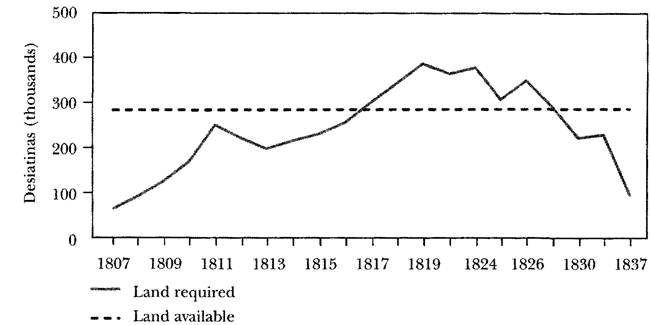
total livestock numbers peaked, Nogai were grazing 221,284 cattle and horses and 132,392 sheep. This is an enormous number of livestock for such arid land. Based on carrying capacity estimates, in 1819 Nogai herds would have needed some 387,000 desiatinas of grazing land - more than the total Nogai land allotment. Because Nogai pastures were strained to their limits, it is little wonder that the harsh winter of 1825 saw over 45,000 Nogai cattle and horses die and (expressed in AUs) an overall loss of more than 20 per cent of Nogai livestock. Figure 3.2 shows the total land requirements of Nogai livestock from 1807 to 1837. The pattern of expansion and contraction is highly characteristic of an ungulate irruption. By implication, the growth of Nogai herds had reached its upper limit by 1819, and probably by the mid-1820s overstocking was leading to land degradation.
A critical element of the land problem facing Nogai by 1819 was the shrinking size of range lands available to them outside of their allotment. As noted in Chapter 2, by 1810, per capita Nogai landholdings were already too low to support a traditional pastoral economy, so the Nogai were dependent on grazing livestock on unoccupied range lands north of the Iushanlee River. Between 1819 and 1824 Mennonites established eighteen new villages on the upper reaches of the Iushanlee and Kurushan rivers, sharply reducing Nogai access to range land even as Nogai herds were expanding.39 The consequences of this for Nogai society will be discussed below.
Although Demaison was not successful in transforming Nogai from pastoralists into agriculturists, the remarkable growth of their herds suggests that Nogai were undergoing a dramatic transformation all the
Figure 3.2 Nogai grazing land required and available, 1807-1837
Sources:,Otchetov Tavricheskikh Gubernatorov,’ RGlA, f.
1281, op. 11: d. 131 (1808-10); d. 132 (1811-15), d. 133 part 1 (1816, 1822), d. 133 part 2 (182327); Annual reports OfDemaison to the governor of Tavria: GAKO, / 26, op. 1: d. 994 (1814), d. 2503 (1817), d. 3308 (1818), d. 4137 (1819), d. 5017 (1820), d. 5394 (1821); Sergeev, 'Nogaitsy na Molochnykh vodakh,’ 61 (1828-31); Cornies, 1Landwirthschaftliche Notizen, ’ 1837, PJBRMA, file 992.same. This transformation requires explanation. Livestock were the most important symbol of wealth and social status for Nogai. Schlatter reported that wealthy Nogai men could not be distinguished by the clothes they wore or the houses they lived in; the only true index of their wealth was the size of their herds of cattle and horses.34 The rapid growth of herds was evidence of an enormous growth in wealth, but to what can this be attributed? In large part, no doubt, to the proximity of a growing population of peasant agriculturists. These agriculturists provided wages to Nogai, particularly during peak agricultural seasons.35 They also provided a market for horses and catde, tallow, hides, and meat. Nogai were converting their income from these sources into livestock.
Economic differentiation went hand in hand with the growth in Nogai herds. In the 1820s Schlatter saw poor Nogai begging for grain, and he frequendy mentioned distinctions between poor and rich, although he was impressed by the equal access to land enjoyed by all Nogai and thought that all but the poorest had adequate incomes.36 Living in a Nogai household, Schlatter said his host Ali was ‘not rich, but all the same had thirty head of cattle and five horses.’37 In 1824 the average Nogai household had nine horses, twenty-six head of cattle, and twenty- two sheep, so Ali was indeed poorer than the norm.38 Notably, Ali owned no sheep, for Nogai were traditionally cattle herders and the transition to sheep raising by a small minority of Nogai was a sign of economic assimilation, a subject examined more fully below.
Schlatter also described the local Nogai administrative system, which differed sharply from the traditional nomadic model detailed above. Schlatter found the Nogai divided into typical Russian peasant villages with ten-, fifty-, and hundred-men, village elders, obshchinas, and volosts, all under the direction of the state-appointed nachaΓnik?9 The extent to which this formal substitution of Russian for Nogai institutions was reflected in practical administrative practices is unclear. As an outsider, Demaison could not have exercised his authority on the basis of lineage, as was the custom with traditional Nogai leaders. When necessary, Demaison even employed Cossack troops to enforce his orders, as the 1820 salt scandal described in Chapter 2 shows.
The Nogai threat of exodus in 1815 suggests that in that year traditional leadership structures still existed and were capable of opposing the new official structures. However, the extreme growth of Nogai herds shows that important regulatory functions of traditional leaders were eroding. With migration no longer a way of life, decisions about pasture allocation could no longer be made in traditional ways. The traditional checks on herd growth were being eliminated and the balance that nomads must achieve with the productive potentials of their environment was being lost. Yet the failure of Demaison’s arrangement of grain for travel passes shows that the Russian system was not successfully replacing the failing traditional one. Instead, an administrative vacuum was developing.
Administration of the Nogai underwent an important change in 1825 WhenJohann Comies began to take an active role. His first Contactwith Nogai had come in his father’s home, where Johann Sr’s reputation as a healer brought a wide range of people, including Nogai, to his door.40 Perhaps motivated by this early contact, Cornies became a student of Nogai history and keen observer of contemporary Nogai life. In 1825 he first outlined his own program for their improvement: ‘Cannot at least the principal town of Nogaisk itself be improved and enlarged and provided with a high school? Cannot a model colony be established in the region, for poor but industrious and willing Nogai, which could serve as a model for other Nogai villages? Cannot a flock of improved sheep be bought through the community treasury, to be paid for from the profits of the improved wool in the future?’41 The Russian state never officially charged Comies with improving the condition of the Nogai. Nevertheless, programs that he began to implement in 1825 and continued to supervise until his death in 1848 gained the state’s full support.
Cornies’s first major initiative was a project to improve the quality of Nogai sheep. This project was a clear departure from the efforts of Demaison, for emphasis had shifted from arable to animal husbandry. For several years prior to 1825 Cornies had already been placing sheep in the hands of Nogai and to a lesser degree Doukhobors, Molokans, and German colonists. But his new program signalled an important change. Prior to 1825 Cornies had paid a fixed rate per year per head of livestock, but now he moved from a simple business transaction to a program explicitly directed at benefiting the Nogai.42 Conditions that Cornies incorporated into the project involved fundamental changes in the way Nogai supervised their herds. In effect, Cornies was trying to transform Nogai animal husbandry from pastoralist traditions with their emphasis on the cultural value of livestock to an organized, regulated, market-oriented system.
Starting in 1825 Cornies began lending merino sheep to Nogai, while encouraging Mennonites to follow suit.43 This seems at odds with his concern about overgrazing Nogai land. Yet if, as Cornies intended, Nogai reduced the size of their cattle herds and concentrated on raising smaller numbers of more valuable merinos, pressure on their grazing land would be reduced at the same time as the value of their livestock increased.
The terms of Cornies’s sheep loans were eventually formalized into a standardized contract. In the first extant example (from 1834), Cornies agreed to supply a Nogai named Kulman with forty-five ewes and five female lambs and pay half the cost of buying a ram for breeding.44 Kulman was to pay for the other half of the ram, as well as all other costs during the four-year contract. He was to provide fodder in winter, ensure that the sheep drank only well water, prevent them from mixing with the native Nogai breed of sheep known as kurdiuch sheep (which might infect them with diseases), and refrain from slaughtering healthy sheep under any circumstances. In a concession to Nogai religious customs, which regarded allowing animals to die of disease as sinful, Kulman was permitted to slaughter diseased sheep, but only in the presence of two Nogai elders who would attest that the slaughtered sheep were truly ill. Cornies and Kulman were to divide equally the annual wool production from the herd, and at the end of the four-year contract, after Kulman returned to Cornies forty-five ewes and five female lambs to match the original investment, the two would divide equally whatever offspring remained. However, if the size of the herd shrank during the four years, Kulman was to pay Cornies the full market value of lost sheep, except those for which he could produce a hide and prove the sheep had been diseased.
In essence this was a sharecropping - or more accurately share-pasturing - contract, albeit a very unusual one. In most sharecropping contracts a landlord provides capital in the form of land and seed, while the sharecropper provides only labour. But Cornies did not provide Kulman with land.45 Indeed, Kulman’s capital investment of land, in effect, made him a partner with Cornies. Sharecropping is usually described as exploitative, particularly by Marxian analysts for whom the concentration of the means of production in the hands of landowners is by definition exploitative.46 Regardless of whether the Marxian definition is accepted, there are few historical examples of sharecropping that have not been bad deals for the sharecroppers.47 The contract between Cornies and Kulman clearly was not exploitative. The clause releasing Kulman from responsibility for sheep lost to disease protected him from the most serious risk, and the contract was plainly structured with the intention of leaving Kulman with his own flock of merino sheep at its conclusion. Such sheep were worth five times as much as the kurdiuch sheep kept by most Nogai.48 This arrangement contrasts sharply with the lot of most sharecroppers, who receive only the temporary use of land and never gain ownership of it.
Cornies’s sharecropping contracts were generous. However, unlike Demaison’s earlier efforts they focused on a small economic elite. Because Nogai sharecroppers normally took charge of the sheep in late October or November, at the end of the grazing season but well before spring shearing, they had to supply fodder throughout the winter before receiving any income from wool. That was an expense that poor Nogai could not meet. The requirement that sheep be watered only at wells was also significant. Merino sheep were ill-adapted to conditions in the Molochna region, and drinking the brackish local water was a threat to their health.49 However, groundwater was thirty to fifty-five metres down, which made well-digging an expensive endeavour requiring specialized equipment and knowledge.50 In 1840 the Ministry of State Domains estimated that digging wells on the high steppe cost between 200 and 400 silver rubles per well.51 Such wells also demanded constant maintenance. Thus, well-digging required an investment that would be fully repaid only over a period of several years. Again, poor Nogai could not afford wells. Consequendy, most Nogai rejected the transition from cattle to sheep rearing, and the administrative strictures that went with it, and continued to practise traditional forms of husbandry.
Sharecropping contracts had important implications for traditional Nogai practices of land tenure. Nogai land had always been held communally. The sharecropping contracts, however, required that merino sheep be held apart from other livestock on the Nogai commons, and such contracts were made with individuals and not with the horde as a whole through its beys and murzas. When the contracts were initiated following the harsh winter of 1825 Nogai livestock numbers were very small, and the claims of Nogai sharecroppers to communal land did not conflict with the customary claims of other Nogai. As will be shown in Chapter 5, in the future, when demands on land changed, the sharecropping contracts would lead to conflict.
The contracts bypassed the role of the Nogai aristocracy in administering the allocation of pasture lands. Traditional administration of the pasture lands had its functional roots in a nomadic economy. However, the overgrazing of Nogai pasture lands in Molochna and the subsequent decimation of herds had already shown by 1825 that the traditional system was no longer effective under the new, sedentary conditions. Sharecropping, while contributing to undermining the old system, offered no replacement for that system because it benefited only a few individuals. Moreover, it placed the reins of administrative control in the hands of Cornies and other outsiders and not the Nogai. Sharecropping, with its lack of provisions for the poor, could not provide a basis for legitimizing wealth. The lack of cultural sanctions for economic differentiation did not bode well for Nogai development.
Between 1808 and 1833 the Russian state invested much well-intentioned effort into ‘civilizing’ the Nogai, but in the end there was little to show for it. The state’s policies were based on a limited understanding of the horde as uncivilized nomads and an equally limited belief that if the outward manifestations of civilization - nuclear villages and commercial husbandry - could be imposed, civility would be achieved. The benefits of such civility were never explicitly spelled out. It was assumed that sedentarism and peasanthood were intrinsically superior to nomadism and pastoralism. To be sure, Cornies had an economic rationale for his sheep program - merinos were more valuable than traditional Nogai livestock - but Comies linked economic prosperity to moral improvement, and morality was defined by orderly Mennonite practices.
The state’s efforts to inculcate practices of arable husbandry among Nogai met with Iitde success beyond the temporary increase in grain production during Demaison’s grain-for-passes program. The majority of Nogai also ignored the transition from cattle rearing to sheep rearing that economic rationality demanded. Most Nogai continued to cling to their traditional pastoralist customs. Yet with the end of the economic viability of nomadism in the Molochna River Basin, the functional role of traditional Nogai administrative structures also ended. While failing to impose new economic and administrative Stmctures, the state had successfully undermined the old, leaving only a vacuum.
Orthodox State Peasant Adaptation
In contrast to Nogai, Orthodox state peasants who came to the Molochna region were from land-poor regions of Russia where livestock holdings were extremely limited and arable agriculture dominated. Their understanding of the requirements of a viable agricultural village were clearly expressed by the advanced parties that came to New Russia to survey proposed village sites: they wanted good wells, hay meadows, forests, and fields for planting grain. As the peasants from Chernigov (quoted in Chapter 2), made clear in 1822, where the necessary environmental factors were not present they assumed that it would be impossible to establish successful villages.
The Chemigov peasants had a tradition of communal administration of land, and the advanced party represented the wishes of the community as a whole. It is impossible to know whether they had previously practised communal land repartition, but they were obviously familiar with the practice. Orthodox state peasant land in Molochna was officially allocated collectively to peasant obshchinas and not to individuals, but in practice obshchinas allotted arable and garden land to families in permanent hereditary tenure. This meant that after the initial allocation the Obshchina retained no communal control. As for the commons, these were held communally, but the obshchinas placed no conditions on their use. Given the abundance of land in the Molochna region during the early years of settlement this arrangement is not surprising, but it is notable that it resulted in the Orthodox state peasants being the only group in Molochna without any collective administrative control over land allocation.
With the obshchina having so little influence over the most important element in the economy, there could be little attraction or benefit to participating in obshchina administration. This helps account for the failure of Orthodox peasants to follow the path of sectarians and foreign colonists and develop a strong sense of corporate identity in the Molochna region. After the advanced parties approved the land grants, the obshchina as a representative of peasant interests disappeared almost completely from official records until the 1830s. It should also be noted that, given the obshchina’s role as the first instance of state control over peasants, its lack of status in Molochna was potentially a problem for the state too.
Despite Orthodox peasants’ preconceptions about what constituted a viable environment for settlement, they showed a remarkable ability to adapt to a region where there was little good water, no forests, and no market for the products of arable husbandry. They almost immediately converted to animal husbandry as their primary agricultural activity. One of the most distinctive features of Orthodox settlement in Molochna was the disregard that settlers showed for crop production. Travellers to the region were inevitably dismayed by the poor condition of the Orthodox group’s fields. Manuring was almost unheard of. Instead, manure was being dried and burned as fuel. An anonymous observer wrote that many peasants did not even bother to replough their spring fields before sowing them with winter crops: ‘Some find it sufficient to throw the seed on the unploughed field and drive over it with oxen or a plough, and that concludes the working of the winter fields.’52 As late as 1842 Baron von Haxthausen observed that some peasants did not even return to tend their fields between sowing and harvest.53
Land allotments to the Orthodox state peasants were not atomized into the small interstripped holdings that were typical of state peasant villages in central guberniias. In 1834 Witte observed that field rotations were ‘very distinctive’ because they were ‘not subject to common regulation, but absolutely [depended] on the arbitrary decision of each householder.’54 It would have been impossible to maintain such an unregulated system where interstripping prevailed. The peasants employed a long fallow system, sowing one area of the arable land for several consecutive years, then allowing it to lie fallow for several more. Based on zemstvo data collected in the 1880s, V.E. Postnikov described peasants using fields for six to nine years, then leaving them fallow for two to three.55 However, according to A. Shmidt, in the early years of settlement in Kherson guberniia, west of Molochna, peasants sowed
TABLE 3.2
Net grain harvests per Orthodox male soul, 1808-1833
| Year | Chetverts per soul | Year | Chetverts per soul |
| 1808 | 4.35 | 1821 | 0.65 |
| 1809 | 3.66 | 1822 | 3.59 |
| 1810 | 2.04 | 1823 | 0.30 |
| 1811 | 4.89 | 1824 | 0.54 |
| 1812 | 1.77 | 1825 | 2.13 |
| 1813 | 0.19 | 1826 | 3.13 |
| 1814 | 2.03 | 1827 | 2.68 |
| 1815 | 1.30 | 1828 | — |
| 1816 | 3.74 | 1829 | 4.72 |
| 1817 | 3.39 | 1830 | 1.45 |
| 1818 | 4.42 | 1831 | 3.84 |
| 1819 | 3.44 | 1832 | — |
| 1833 | 0.00 | ||
| Average | 2.43 |
Sources: RGIA, f. 1281, op. 11, d. 131-3; GAKO, f. 26, op. 1, d. 994, 2503, 3308, 4137, 501, 5394; GAOO, f. 1, op. 190, d. 12, 29, 62; 1Svedenie..., 1833, PJBRMA, file 610, 19.
their fields for four or five years, then left them fallow for ten. This pattern also can be inferred from Witte’s description of the Molochna region in the 1830s.56 The shorter cropping period and longer fallow was possible because of the abundance of land in the early period.
As explained in Chapter 2, the state regarded two chetverts of grain per male soul per year to be a subsistence minimum. As Table 3.2 shows, on average Orthodox peasants in Molochna produced very little more.57 Annual per capita grain production averaged about 1.2 chetverts (roughly 140 kilograms), enough to meet about two-thirds of the minimum subsistence needs of an average person.58 Peasants typically consume all food production up to 350 kilograms in grain equivalents per capita, while it is only when production exceeds 500 kilograms per capita per year that the use of draft animals in agriculture becomes worthwhile.59 The Molochna average was far below this, and in poor years it could not have left anything at all for the market. This low level of production was obviously intentional. Whenever net harvests exceeded four chetverts per male soul - about 232 kilograms per capita - Orthodox peasants reacted by planting less grain in the following year, giving
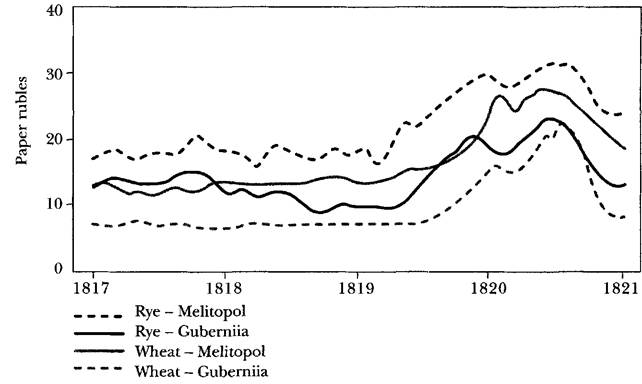
Figure 3.3 Rye and wheat prices (per chetvert) in Melitopol uezd and Tavria guberniia, 1817-1821
Sources: GAKO, f ЧП, op. 1, d. 1675-82, 1769-79, 1837-47, 1989-99, 2127-38, 2266-76, n.p.
a distinct indication that they saw little purpose in producing grain surpluses. On average between 1808 and 1833 Orthodox state peasants planted just 1.05 chetverts of grain per male soul per year, an amount that would have required just 1.05 desiatinas of land following existing sowing conventions in the region.60
This disregard for arable husbandry was not solely a reaction to the lack of markets in the region. Figure 3.3 shows the relationship between prices for wheat and rye in Melitopol compared with the rest of the guberniia. Prices were markedly lower in Melitopol uezd, reflecting isolation and the cost of transporting grain to major markets. Nevertheless, the figures imply a linkage between prices in the uezd and the guberniia. To be sure, given shared climatic conditions some similarity in price fluctuations must be expected regardless of whether there were shared markets. However, Table 3.3 demonstrates that the similarity had to do with more than the weather. It shows the results of a regression analysis of fluctuations in the price of rye and wheat, with the price in the guberniia as independent variable and the price in Melitopol uezd as dependent variable. The result for rye prices (τ2 = 0.37) indi-
TABLE 3.3
Regression analysis of monthly changes in the price of rye flour and wheat meal in Tavria guberniia (independent variable) and Melitopol uezd, 1817-1822
| Rye | Wheat | |
| Constant | 6.35 | -3.98 |
| SE Y Est | 2.93 | 1.95 |
| R2 | 0.32 | 0.87 |
| Observations (n) | 72.00 | 72.00 |
| DOF | 70.00 | 70.00 |
| X Coefficient(S) | 0.29 | 0.95 |
| SE of Coef. | 0.05 | 0.04 |
Sources: GAKO, f. 27, op. 1, d. 1675-82, 1769-99, 1837-47, 1989-99, 2127-38, 2266-76.
cates that there was no significant correlation between changes in rye prices in Melitopol uezd and the rest of Tavria guberniia. Thus, the similarities reflected in Figure 3.3 may well be nothing more than a reflection of common climatic conditions. However, the relationship between wheat price fluctuations in the guberniia and the uezd (r = 0.87) is strong evidence that changes in wheat prices in Melitopol were closely linked to price changes in the rest of the guberniia. This would indicate that there was a larger regional market that wheat producers in Melitopol were reacting to. The result for wheat is all the more convincing in light of the result for rye, and the difference between the two belies a simple climatic explanation, which would have affected rye and wheat identically.
Wheat surpluses were probably viewed as a windfall in the Molochna River Basin. Peasants planted enough to meet their subsistence needs, and in good years they sold their surplus. Good years could be very good indeed, for their land was on the fertile Azov Uplands. This accounts for the region’s interaction with the larger guberniia market. Bad years, however, could be disastrous, and settlers necessarily had to concern themselves with worst-case scenarios. The worst case came in various forms in 1812, 1815, 1821, 1825, and 1833, when drought, cold, locusts, or hail obliterated grain crops and reduced harvests to dangerously low levels.
Peasants in Melitopol uezd could anticipate at least a partial crop failure one out of about every five years. This could halt the transportation of grain altogether because the oxen that pulled carts across the steppe consumed grass and water, two things in desperately short supply during a drought.61 As a result peasants could not base agricultural strategies on potential profits from exporting wheat, for they knew that in the years when crops failed they would be left without food from their own fields, and at the same time it would be impossible for the state to import food to where they lived. Without a local port to permit the import of grain in years of harvest failure, the peasants’ first priority had to be self-sufficiency.
Gardening was the second major element of Orthodox state peasant arable husbandry in the Molochna region, which is the clearest evidence of this subsistence priority. These peasants devoted relatively little, ill-tended land to growing grain. However, they devoted extraordinarily large areas of prime river flood plain to gardens. No detailed records survive from the pre-1833 period, but figures for 1848 from Orekhov volost, the northern-most volost of Melitopol uezd, offer an indication of how much land was involved. The villages in Orekhov devoted on average a full desiatina per household to gardens.62 Garden sizes may have been shrinking by 1848, as total land holdings per capita shrank, but the amount of garden per male soul was still impressive. If Orthodox peasants worked their arable land poorly, they gardened well. In 1847 the civil governor of Tavria even described state peasants in the villages OfBolshaia and Malaia Znamenka in Dneprovsk uezd as ‘exceptional gardeners,’ and in good years, as the governor reported in 1837, state peasants living near towns or colonist villages throughout the guberniia sold ‘significant quantities’ of their produce.63
The contribution of the gardens to village food production is impossible to define. In the late nineteenth and early twentieth centuries Russian peasants obtained about 12 per cent of their consumption needs from gardens. However, this has little application to the first half of the nineteenth century before the tax demands of the growing state and pressures exerted by the international grain market shrank the amount of land peasants could afford to reserve for their own use.64 Indications are clear that gardens in the Molochna region played an essential role in the early years of setdement. The most explicit appear in reports from the nachal’niks of Melitopol and Dneprovsk uezds. When torrential rains and locusts combined in 1821 to destroy crops and lead to near-famine conditions, the state scrambled to find grain to feed peasants in the Crimea.65 However, Melitopol and Dneprovsk peasants, who experienced an equally poor harvest, did not receive grain from the state because, as the Melitopol nachal’nik reported, they would ‘be able to fare for themselves adequately from their household plots... and from their own livestock.’66 Gardening was labour intensive and would have detracted from time in the fields, but unlike grain fields, gardens, as long as they were located close to rivers, could be watered and would yield up their crops even in years of drought.
Turning to animal husbandry, as appendix Table A.2 shows, between 1808 and 1827 (the period for which records exist) Orthodox peasant livestock holdings grew rapidly. By 1827 the average Orthodox family had six cows and thirteen sheep; there were two horses for every three families. Herds were slowly filling available pasture lands, but by 1827 they had not yet overflowed them. In that year pasture land requirements were about eight desiatinas per male soul, or just over half of the allotment norm. With both livestock and human populations continuing to grow the potential for future problems was looming, but the lack of post-1827 livestock figures makes it impossible to say exactly when the critical point was reached.
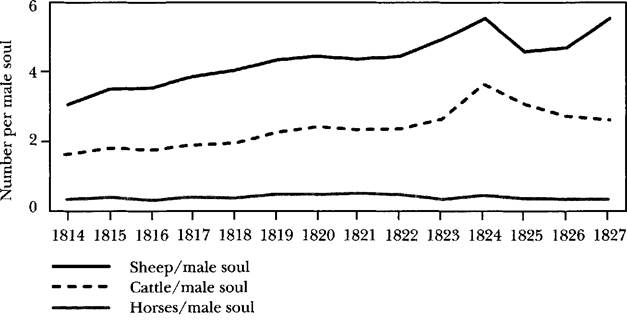
Although holdings of all types of livestock grew between 1814 and 1827, sheep holdings grew at a faster rate. Following the harsh winter of 1825 horse and cattle holdings declined, while sheep holdings continued to grow (see Figure 3.4). By implication, Orthodox state peasants, unlike Nogai, were interested in the commercial potential of sheep relative to other livestock.
There is no indication that Orthodox state peasants shifted from raising kurdiuch sheep to the more-valuable merinos. The Nogai transition to merinos came during the decimation of their herds that had begun in 1825 and continued into the 1830s, when Nogai herds had already exceeded the carrying capacity of their land grant. Merinos gave more value per unit of land, but required more labour. This represented a substitution of more labour-intensive, higher-yielding husbandry for an existing system - under which, however, income per land unit had already been maximized. The Orthodox settlers had not yet reached this point in 1827, and as long as they experienced economic growth under the existing system there was little motivation to take on the increased labour and capital costs of the transition to merinos. This was particularly true considering that the Orthodox group was not offered the same generous sharecropping contracts that Nogai received from Cornies to subsidize such a transition. A second, equally important consideration was the relative durability of kurdiuch sheep. They were hardy and well adapted to the steppe, requiring little care and less water than merinos. Kurdiuch sheep were also less susceptible to dis-
Figure 3.4 Livestock holdings, 1814-1827
Sources: ‘Otchety Tavricheskikh Gubernatorov,’ 1808-16, 1822-7, RGIA, f. 1281, op. 11.
ease and bred more rapidly.67 Isolated from export and import markets, the first priority of Molochna peasants was the food, tallow, clothing, shoes, and manure they could obtain from the sheep for their own uses. The market value of wool came a distant second. Thus from a subsistence perspective kurdiuch sheep made more sense than merinos.
The agricultural adaptations described so far are graphically summarized on Map 4. Based on an 1848 map, Map 4 retains the characteristic features of Orthodox villages in the early years of settlement in the Molochna River Basin. The village proper (as opposed to the commons and arable land) was extraordinarily long and narrow, stretching along the banks of the river and up the two creeks that fed it to ensure that each household had its piece of the invaluable flood plain. One Molochna village, Bolshoi Tokmak, stretched along more than six kilometres by the mid-1840s, demonstrating just how elongated such villages could become.68
The most unusual characteristic of Orthodox villages was the arrangement of the commons and arable land, which reversed the typical land allocation pattern in most of Russia and Western Europe.69 As LU. Witte described it in 1834, ‘The fields lie far from the villages, and sometimes several dozen versts. Immediately beside the villages, where in other countries the very best, or, so-to-say, primary fields... are located, the pasture is located in [New Russia].’70 The standard practice of placing arable land close to the village and pasture further away derives from the fact that cattle and sheep can be tended by relatively few people and can quickly transport themselves to and from distant pastures, while agricultural implements and crops are heavy and cumbersome and large numbers of people travel to and from grain fields during the peak work seasons. The reversal of the normal arrangement in Molochna vividly illustrates the low priority given to grain production by Orthodox peasants.
The arrangement also emphasizes how, in the Molochna region, grain competed unsuccessfully with livestock and kitchen gardens for water. Grain fields were relegated to the high steppe where groundwater lay at unreachable depths of thirty or more metres, whereas the rich flood plains were reserved for gardens. Grain production from such fields was utterly dependent on Molochna’s unreliable precipitation. In this light it may be useful to reconceptualize state peasant ‘kitchen gardens’ as infields in an infield-outfield agricultural system, making the point that state peasants in Molochna were really not living far from their land allotments at all.71 Indeed, the most valuable part of their land was right at their doorsteps.
Yet the state assessed the self-sufficiency of its peasants in terms of grain production, and by this standard Orthodox settlers in Molochna were notable failures. In 1837, when Koppen surveyed the Molochna region, he expressed the state’s frustration with its intractable wards: ‘What has been done in the colonies can be done by the state peasants also. It is well known in what comfort, and even prosperity, the colonists live, but their Russian and Little Russian neighbours adopt nothing from them. [The Orthodox state peasants] know very well and recount at great length how the Germans conduct their farming, but to the question, why do they themselves not imitate these practices, each and every one gives the same reply: “Our fathers didn’t do it like that.’”72
Surely the most important lesson to be learned from studying the Orthodox state peasants in Molochna is that Koppen’s assessment was not true. These peasants, who had come from land-poor guberniias, arrived on the virtually unpopulated steppe and immediately and successfully adapted to their new conditions. They settled into a way of life diametrically opposed to that of their fathers. Within just a few short years they abandoned the intensive three-field agriculture they had known in Russia’s interior guberniias and turned instead primarily to pastoralism, then gardening, and finally long-fallow agriculture. What defined Orthodox peasants in Molochna was not their inability to adapt, but their stubborn insistence on a subsistence adaptation.
In a sense this was all the state really expected of them. After all the state structured its administration of the Orthodox state peasants around a policy of ensuring them a subsistence food ration. The state’s exasperation with Melitopol peasants was the result of policies based on peasant agricultural practices and subsistence requirements in interior guberniias. Land survey departments conducted thousands of surveys and drew thousands of maps of New Russia, but the state never learned - at least not before 1833 - that all land is not equal. It never addressed access to water or access to markets, and it assessed peasant conditions using grain harvest figures that were based on the food consumption patterns of peasants from interior guberniias. These had no relation whatsoever to consumption patterns on the steppe, where peasants had large livestock holdings and, in the Molochna region at least, bountiful gardens.
Underpinning the state’s frustration with Orthodox peasants was the implicit acknowledgment that it had little control over their actions. The Orthodox community held their land in permanent hereditary tenure, and the state had no effective administrative organs at local levels to force them to accept central guidance. Indeed, it seems evident that there were not even local self-administrative organs guiding peasant agricultural activities.
Probably the peasants understood that the state could not be relied on to treat them as anything other than an undifferentiated part of the state peasant whole. Peasants knew better than to abandon agricultural practices that left their chances of survival in their own hands instead of in the hands of a state that plainly did not understand how or where they lived. It must also be remembered that the peasants were, in their own fashion, doing well enough - the growing size of their herds attests to this. By 1827 there was no sign in Orthodox society of the problems of poverty and economic differentiation that were already apparent in Nogai society. To be sure, the situation that had created problems for Nogai was looming for Orthodox peasants, as well. Their extensive land allocation practices were based on the assumption that there were no limits on the availability of land and that, as their population grew, the state would just grant them more land.78 As long as land remained available, the Orthodox community did not have to face the problem of how to deal with the poor; consequendy, there was also no need to justify the wealth that some peasants were accumulating. The state’s failure to understand the unique conditions presented by the steppe could also work to the peasants’ benefit. The peasants must have known that the state assessed their condition by the size of their grain harvests and not by the livestock in their fields and the vegetables in their gardens. It is altogether possible that, while Nikolai Gogol’s Akaky Akakieviches of St Petersburg shuffled hungrily home to their wretched rooms, the peasants in Molochna were smugly slurping their cabbage soup - and most assuredly with meat!