Changing the Land: Sectarians and Foreign Colonists
For Nogai and Orthodox societies, immigration to the Molochna region undermined traditional corporate structures. For Mennonites and Doukhobors, it permitted a flourishing of traditional corporate identities that were rooted in religious belief and practice.
The evidence is too scarce to permit a close reading of developments among other German colonists and the Molokan sectarians, but it is fair to conjecture that the processes were similar. The ethnoreligious minorities, faced with the alien physical and ethnocultural landscape of Molochna, turned inward to their fellow believers and developed strongly united communities able to adjust to markets and bend the environment to their needs.Like Orthodox state peasants, sectarians received little input from the state regarding agricultural practices. Unlike Orthodox peasants, the sectarians proved to be highly conscious of market demands. Indeed, observers singled out sectarians along with foreign colonists as extraordinarily prosperous settlers. The Molokan case is particularly interesting because, while Doukhobors and foreign colonists had particularly generous land allotments, Molokans prospered on the poorest land grant in the region. Arguably, then, the success of all three groups had less to do with generous land grants than it did with social organization and particularly with the maintenance of a degree of public control over land. The ability to meet the challenges of the frontier as large cohesive groups rather than as discrete individuals gave colonists, Doukhobors, and Molokans significant advantages over their Orthodox and Nogai neighbours.
Sectarians
When Savelii Kapustin, leader of the Doukhobors from 1790 to 1820, arrived in the Molochna region in 1805, he established a system of communal tenure.74 However, Englishman Robert Pinkerton, who visited the Doukhobors in 1816, reported that ‘every family has its own private property, catde, fields, etc.’ Pinkerton also noted that Doukhobors had ‘fields of corn, gardens and flocks which belong to the whole community, and the revenues of which are applied for the common benefit of the society.’75 Some element of Communalism survived to 1837, when Melitopol District Administrator (zemskii ispravnik) Kolosov described how ‘Kapustin, seeing the inconvenience of the communal system that was already provoking grumbling, ordered the division of everything that had been held collectively into two parts, half of which was divided up equally among the villagers, and half of which remained in common and was administered under Kapustin’s authority by his adherents, the so-called Apostles, as well as other privileged persons.’76
The Doukhobors were officially state peasants, and the state kept no economic records of them separate from their Orthodox neighbours.
This makes knowledge of their agricultural practices as distinct from other peasants difficult to obtain. Anecdotal evidence suggests that they were superior farmers, sober (in both a literal and figurative sense), and industrious. In 1832 a report by M.S. Vorontsov, governor general of New Russia, described them as ‘among the best of the Government’s colonies,’77 and in 1838, as consensus was building to exile them, Russian regional historian A.A. SkaΓkovskii described them as ‘a rather useful people who have established many orderly villages.’78Like everyone else in the region, the Doukhobors concentrated their agricultural efforts on animal husbandry.79 Vorontsov wrote in 1832 that the Doukhobors were involved in an ‘enormous cattle-raising enterprise and improved sheep breeding,’ and other eyewitnesses also mention the impressively large Doukhobor herds. Some Doukhobors even followed the Mennonite lead and leased merino sheep to neighbouring Nogai for a half-share of the resulting wool and lambs.80 In 1840 a Doukhobor named Lukian Verigan was owner of one of the largest herds of merino sheep in Molochna with 1,500 head, while after their exile to the Caucasus in the 1840s the sectarians enjoyed enormous economic success based on the merino sheep-raising practices that they had perfected in Molochna.81 The Doukhobors, like the Nogai, at first concentrated on raising cattle, but by the 1820s they increasingly turned to raising the commercially lucrative merino sheep.
Disputes in the Canadian Doukhobor community in the twentieth century often centred around the issue of communalism, so Kolosov’s description of Doukhobor ‘grumbling’ over the same issue in the early nineteenth century is not surprising.82 Reports of serious disputes in the Doukhobor community in the 1830s are usually ascribed to the unfair privileges Kapustin granted to his Apostles.83 These disputes will be considered in detail in Chapter 4, but for the moment their economic significance must be noted.
One of the curiosities of the Doukhobor faith is that in spite of their implicitly egalitarian belief in the in-dwelling spirit of God in every person, the Doukhobors credited their leaders with a larger than normal share of God’s spirit, entitling them to lead by divine right.84 Savelii Kapustin and his heirs ruled all aspects of Doukhobor society, issuing orders and resolving disputes from a building known as the Orphans’ Home in the village of Terpenie. They exercised their authority with the help of the Apostles, who in 1816 numbered twenty-five.85 The Apostles, in turn, benefited from their positions by receiving particularly large land allotments, which permitted some of them to own as many as 1,000 head Oflivestock.86If this arrangement provoked ‘grumbling,’ it was not apparent before 1830. Indeed, the unity expressed by the Doukhobors in 1824 during their land dispute with the state (see Chapter 2) suggests that they were a strongly united community. Arguably, the existence of an internal unofficial administrative system based on religious principles played an important role in the economic prosperity of that united community. The expense of the transition to raising merino sheep has already been discussed in reference to Orthodox peasants and Nogai. Orthodox peasants faced the larger world as individuals, or at best as members of village obshchinas that possessed little independent authority, and so they were unlikely to have sufficient personal wealth to invest in the transition to merino sheep. Some wealthy Nogai made this transition, but they accomplished it only through subsidies from Cornies and other Mennonites. The majority of Nogai were left out of this process. Doukhobors, with a system that provided for community-wide economic cooperation and investment, managed the transition on their own.
The Apostles represented a community-sanctioned form of economic differentiation that provided an engine to drive Doukhobor economic progress within a system that also protected the welfare of the broader community through communally held and distributed property.
The legitimacy of the Doukhobor leader and his appointed Apostles was formally based on religious doctrine, and the ability of the system to achieve economic success must be considered an important element in its strength. In the administrative vacuum of the Molochna region, the Doukhobors were building for themselves a commonwealth based on economic success, as well as faith.Unfortunately, there is no record of how Molokans administered their land and little record of their agricultural practices. However, their status as latecomers to Molochna, and their resultant lack of good land, set them sharply apart from other groups of settlers. Two isolated accounts from 1847 suggest that Molokans found distinctive solutions to the problems this created for them. The first comes from the civil governor of Tavria, who noted that Molokans were the best gardeners in the region and grew so much produce that they sold the excess in neighbouring communities.87 Gardening as intensive agriculture has already been discussed. For Molokans, with their small, poor land holdings, gardening was a way of getting the most from what little good land they had. The second account comes from the agronomist Wilhelm Bauman, who wrote that Molokans bred the best horses in the Molochna region and that colonists had an expressed preference for such horses, paying as much as 300 rubles per head.88 Apparendy Molokans, who had insufficient land to raise large numbers of livestock, had elected to concentrate, instead, on raising smaller numbers of high-quality livestock, serving a niche market in Molochna.
The success of both Doukhobors and Molokans in adapting to conditions in Molochna deserves attention. Doukhobors were unusually well endowed with land, and this gave them an advantage over Orthodox state peasants. Nogai, too, had a large land grant; however, they did not enjoy comparable success. Arguably, the internal administrative arrangements in the Doukhobor community, based on their religious organization, made it possible for Doukhobors to react as a community to the challenges posed by the frontier.
The success of Molokans is particularly interesting in this light, because they received the poorest land allotment of all settler groups in the region and could not base their success on sheep breeding, as could most others. There is little evidence about the internal organization in Molokan villages, but if they shared the well-developed internal religious administrative structures of the Doukhobors, this may go far to explaining their successful, unique adaptation based on market gardening and horse breeding.Foreign, Colonists
The success that foreign colonists enjoyed in New Russia is commonly attributed to the large size of their land allotments and to land tenure regulations that prevented subdivision of allotments and ensured that they remained of economically viable size.89 The benefit of these provisions to colonists is undeniable, but the provisions also had the potential to be divisive, as developments in Mennonite society would show.
In 1806 Governor General Richelieu said, ‘The Mennonites are astonishing, the Bulgarians incomparable, and the Germans intolerable.’ This statement is often repeated as a general indictment of German colonists. However, if the 1813 account of Inspector of Colonies Zieber is accepted, German colonists in Molochna were far from ‘intolerable.’90 Zieber found that 315 of 417 German colonist families ran excellent farms, seventy-four had problems because of deaths or illnesses, and just twenty-four were failing because of ‘insufficient love of work.’91 There is much less data on German colonists than Mennonites, but there are no obvious reasons for treating the economic development of the two groups in the Molochna region separately.
Data on foreign colonist agricultural production show that, on average, Mennonites were the most prosperous colonists, but German colonists followed a similar pattern of development and were prosperous in their own right. The first generation of colonists produced grain.
Quantities were small and were probably only intended to satisfy consumption needs (see Table 3.4). As with Orthodox state peasants, commercial grain production in the colonies was likely an incidental result of years with particularly good weather conditions. For colonists, as for other Molochna settlers, the most important innovation in the first years of settlement was the transition to sheep breeding. As appendix Table A.2 shows, the number of sheep in the colonies rose dramatically beginning in the 1820s.This transition was initiated and supported by the state. Samuel Contenius, head of the Guardianship Committee, began distributing fine-woolled merino sheep to Mennonites in the Khortitsa settlement in 1803. Governor General Richelieu extended this practice to Molochna in 1808.92 The focus of Contenius’s effort was interbreeding merino sheep with the local kurdiuch breed to engender the hardiness of the native sheep and the fine wool of the imports. In 1828 wool from the resultant mixed breeds sold for twenty-seven rubles per pud, about 80 per cent of the value of pure-bred merino wool and seven times the
TABLE 3.4
Net grain harvests (in chetverts) per capita in colonist villages, 1805-1832
| Mennonites | German colonists | |
| 1805 | 0.73 | 0.58 |
| 1817 | 2.78 | |
| 1818 | 1.57 | |
| 1819 | 0.99 | |
| 1820 | 1.02 | |
| 1821 | 0.62 | |
| 1825 | 2.15 | |
| 1826 | 3.54 | |
| 1828 | 2.55 | 1.45 |
| 1829 | 6.37 | 5.55 |
| 1830 | 2.32 | 2.27 |
| 1831 | 7.55 | 7.91 |
| 1832 | 3.33 | 3.07 |
Sources: GADO, f. 134, op. 1, d. 246, 310, 786; GAKO, f. 26, op. 1, d. 2503, 3308, 4137, 5017, 5394, 2503; GAOO, f. 6, op. 1, d. 1236; Tabellen: Ober den Zustand der Molotschner Kolonisten,' 1848, PJBRMA, file 1138, 1ob-37ob; ‘S Otchetami mestnykh kolonistskim nachal’stvo so Sostoianii kolonii za 1828,’ RGIA f. 383, op. 29, d. 627-31.
value of coarse kurdiuch wool." Contenius had his inspectors keep close track of sheep breeding in the colonies and compile detailed monthly reports. In 1824 General LN. Inzov, who in 1818 had succeeded Contenius as head of the Guardianship Committee, created the ‘Organization for the Improvement of Sheep Breeding’ headed by Cornies.94 Although the organization had no authority to dictate sheepbreeding practices, its correspondence implied that it expected cooperation from colonists, and the rapid growth of merino flocks implies that it received it."
Besides sheep breeding the state placed heavy emphasis on growing trees. Managed forestry was an increasing concern throughout Europe in the first half of the nineteenth century and, inspired by the German development of ‘forest mathematics,’ Alexander I appointed a Forstmeister in every Russian guberniia.96 The basic assumption of forestry policies was that where the environment did not conform to human needs it could be transformed. This was an assumption the colonists shared. Mennonites, in particular, were familiar with western forestry practices, being renowned for their use of trees to stabilize the banks of rivers in swampy regions of the Vistula-Nogat Delta. Encouraged by the state Mennonites quickly established tree plantations in Molochna. In 1815 there were 9,400 mature mulberry trees (grown for an ill-fated attempt to establish a silk industry), 2,268 mature fruit trees, 608 mature forest trees, and 71,235 saplings in the colonies.97 In 1825 there were over 233,000 mature trees, and by 1834 Mennonites alone had 254,058 trees, and the German colonists had 121,021.98
Following the pattern established with sheep, in 1830, on Contenius’s advice, the Guardianship Committee created a ‘Society for the effective propagation of afforestation, horticulture, sericulture, and viticulture’ (hereafter the Forestry Society), with Cornies as its chairman-for-life." This was the forerunner of the controversial ‘Society for the improvement of agriculture and trade’ (hereafter the Agricultural Society), established in 1836. It is vital to emphasize that the Forestry Society did not have the broad authority and jurisdiction of the Agricultural Society, concerning itself almost exclusively with planting and care for trees.100 Like the ‘Organization for the Improvement of Sheep Breeding,’ the function of the Forestry Society was intended to be advisory rather than regulatory.
Historians traditionally have divided controversies in the Molochna Mennonite settlement into religious disputes born of conflicts between religious and civil authorities in the 1830s and 1840s, and economic disputes born Oflandlessness in the 1850s and 1860s. Arguably, the two shared a common origin in land allocation practices established at the foundation of the settlement. Turmoil in the 1840s centred on secular infringements on the traditional jurisdiction of Mennonite religious institutions; this is described in Chapter 5. The relationship between secular and religious authority in earlier decades demands close attention, for many future disputes grew out of land allocation practices established in the first years of settlement.
As described in Chapter 2, the Russian state established a secular administrative system to parallel the traditional congregational one in Mennonite communities.101 It was only when secular Mennonite institutions gained the authority to overturn the decisions of congregational institutions in the 1840s that significant conflicts arose between the two systems. Cornies, by the 1840s the foremost representative of secular authority in the Mennonite settlement, was the focal point of unrest (see Chapter 5). To a significant degree, however, the problems of the 1840s were a natural consequence of geographic isolation and an administrative system that put Mennonites in control of their community land.
The Russian state encouraged foreigners to immigrate because it expected them to positively influence agriculture in New Russia, and it provided plenty of land to ensure that every colonist that wished to could farm. Yet, surprisingly, in Mennonite villages, where an egalitarian ethic of mutual support might have been expected to prevail, economic differentiation arose at an early date. Mennonites were not an economically homogeneous group when they arrived in the Molochna region. Of the first 293 immigrant families, 178 had combined assets of 269,923 rubles when they entered Russia; the remaining 115 families had assets of just 35,253 rubles.102 As Figure 3.5 shows, by 1808 the livestock holdings of the wealthiest fifth of the Mennonite population were three times greater than those of the poorest fifth.103 In itself this is not surprising, for it was not wealth but poverty that Mennonites opposed. As long as an individual was prepared to employ his wealth to allay the poverty of other members of his congregation when necessary, wealth in itself was not discouraged.104 What Mennonites did oppose was social differentiation. It was to prevent the social manifestation of economic differentiation - the sin of pride - that Mennonite congregations imposed on their members conformity in dwellings, clothing, and other areas that carried the potential for the outward expression of wealth.
Extant records of landlessness in Mennonite villages are summarized in Table 3.5. The earliest record is from 1813 when, just a decade after the establishment of the settlement, 12 per cent of the Mennonite population was landless.105 By 1839 this figure had climbed to 47 per cent.106 In theory surplus land should have forestalled such landlessness, but in practice it did not.107 The problem was that although the surplus land was supposed to constitute one-sixth of all types of land including pasture, arable land, meadows, and waste, the original settlers could ill-afford to leave any part of their village’s best land - the river flood plain - unused in the first years of settlement.
In those early years Molochna was far from the ‘oasis’ that later observers would see. The treeless, arid steppe was unlike the land of the Vistula-Nogat Delta that the Mennonite settlers had left behind, and the virgin steppe with its thickly matted sod was enormously difficult to plough. As late as 1813 the Inspector of Colonies reported that many settlers had still not ploughed any land on the high steppe, concentrating instead on planting the flood plain.108 Unlike Orthodox peasants, Mennonite colonists did not focus all their attention on animal hus-
Figure 3.5 Differentiation in Mennonite villages (from poorest quintile to richest), 1808
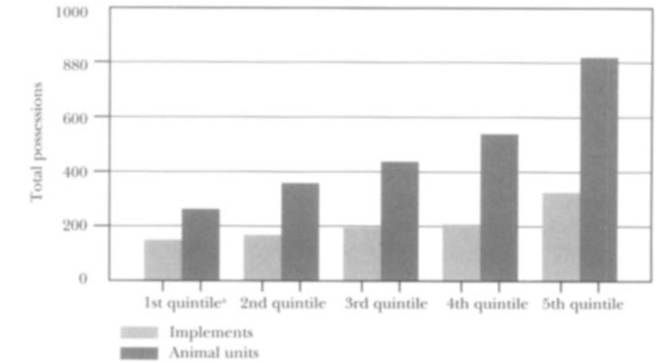
aThe first quintile comprises 71 families; the other four each have 70 families. Source: Unruh, Die niederlandisch-niederdeutschen Hintergriinde der Wiennonitischen Ostwanderungen im 16., 19. und 18 Jahrhundert, 304-29.
bandry in the first years of settlement. Instead, they devoted extensive amounts of labour and resources to arable husbandry and tree planting. These efforts to change the environment to more closely resemble the one that they had left behind were quite different from the Orthodox state peasant and Nogai example of adapting their practices to the new environment. Although this would benefit the colonists in the future, in the short term it meant that they frequently faced shortages and had to turn to the state for subsidies.109 Under such circumstances the first colonists naturally allotted to themselves all of the best land. This helped them to survive those first hard years, but left them with little good land for future generations. All that remained of the surplus was the high steppe, suitable only as pasture land.110 Unlike Orthodox peasants, who received new land after each census, Mennonite colonists could not turn to the state for new land as their population grew. From the state’s point of view the surplus land already provided Mennonites with more than enough.
Despite the increase in families in the Mennonite settlement from 351 in 1808 to 569 in 1818, just thirty-one new land allotments were
TABLE 3.5
Landlessness among foreign colonists in Molochna, 1813-1839
| Mennonites | Other colonists | |||
| Landless families as % of all families | Landless population as % of all population | Landless families as % of all families | Landless population as % of all population | |
| 1813 | 17.16 | 11.89 | 8.89 | 8.26 |
| 1815 | 19.74 | 14.84 | 15.43 | 13.83 |
| 1816 | 22.57 | 16.31 | 19.60 | 16.23 |
| 1817 | 24.70 | 19.39 | 19.72 | 17.43 |
| 1818 | 32.86 | 29.20 | 20.88 | 17.34 |
| 1820 | 44.19 | — | — | — |
| 1826 | 32.92 | 25.37 | — | — |
| 1830 | 41.14 | 32.25 | — | — |
| 1834 | 47.27 | 36.42 | 18.69 | 13.37 |
| 1839 | 56.99 | 46.83 | 21.02 | 15.97 |
Sources: GAOO, f. 6, op. 1, d. 773, 973, 1024, 1236; 'Verzeichnis: der Mennonisten Kolonien an der Molotschna, uber die Familien und Seelenzahl in derselben Vieh Bestand und Acker Gerate,1 1818, PJBRMA, file 17, 6-19; ‘Haupt Listen: der Molotschner Mennonisten Collonie [sic], wie gross in derselben die Seelenzahl, Viehe Gestand, Acker und handwerke Gerate,' 1818, PJBRMA, file 19, 33ob-35; GADO, f. 134, op. 1. d. 786, 893, 981.
awarded, including sixteen to newly arrived colonists who founded the village OfRueckenau in 1811. In the early 1820s landlessness momentarily declined as the Mennonite settlement used reserve land to found new villages for new immigrants, but the trend reversed and landlessness again grew sharply in the 1830s. Although a degree Oflandlessness was anticipated at the settlement’s foundation - some people were expected to prefer employment in crafts or commerce - the failure of so many families to acquire allotments obviously reflects the growth of a poor segment in Mennonite society.
An important factor mitigating the impoverishment of the landless was the Mennonite inheritance system. On the death of a landowner all of his or her property was liquidated, and the proceeds were distributed equally among the surviving sons and daughters. This system provided for redistribution of wealth to landless families, promoting capital investment by the landless and contributing to the economic growth and diversification of the Mennonite community.111 Yet land was the key source of wealth in predominantly agricultural Molochna, and the best that most of the landless could hope for was to lease land from the crown or from neighbouring estates. This practice was widespread. However, because leased land was more expensive than village allotment land, and because it was often of lower quality, differentiation still grew.
In Prussia congregations had governed public life, but Mennonites there did not hold property communally; the acquisition and use of land lay outside of the authority of the congregation. Allotment holders in Molochna controlled their own land. However, they also controlled their village’s surplus land, and this gave them influence over the economic opportunities of their fellow Mennonites quite unlike anything they had known in Prussia. Allotment holders used their authority to impose strict limitations on access to land and insisted that recipients of the few available new allotments have sufficient capital to purchase implements and livestock. This effectively excluded the poor from owning land.112
Such official sanctioning of economic differentiation was rooted in the need to protect the welfare of the whole community by ensuring that all viable land was farmed efficiently. Still, community authority over land allocation was a distinct departure from the traditional jurisdiction of the Mennonite congregation.
Owning land had always been an essential attribute for full membership in Mennonite society. Consequently, Mennonites had no traditional social sanction for economic differentiation. By 1833 it had become clear that not everyone in Molochna would be able to own land. The challenge facing the Mennonite community was to find a way to provide for its poor, while legitimizing the rich. In the long run this problem would pose fundamental challenges to congregational unity. It also had positive implications: the self-administration of land in the Mennonite settlement, as in the Doukhobor community, gave self-administrative structures an important functional role that was not present in Orthodox communities. The landed had a vested interest in resolving the problem and, as with the Doukhobors, this stimulus to active involvement in public life encouraged the development of a Mennonite commonwealth. This subject is taken up more fully in Chapter 5.
The growth of landlessness was paralleled by the closely related phenomenon of rapid growth of livestock populations in the Mennonite settlement. As Table 3.6 shows, by 1830 Mennonites no longer had enough allotment land to feed their livestock, making it necessary for them to lease land. A significant source of leased land was their own
TABLE 3.6
Pasture requirements (in desiatinas) of the Molochna Mennonite settlement, 1825-1835
| 1825 | 1830 | 1835 | |
| Total allotted land | 53,840 | 58,851 | 64,833 |
| Household plots | 1,833 | 2,366 | 2,984 |
| Arable (estimated)8 | 6,582 | 14,483 | 19,913 |
| Allotted land available as pasture | 43,592 | 39,696 | 38,952 |
| Surplus land (estimated)11 | 8,873 | 9,642 | 10,552 |
| Mennonite-Controlled pasture | 52,465 | 49,338 | 49,504 |
| Pasture required | 37,139 | 62,339 | 120,773 |
| Pasture surplus or deficit | 15,326 | (13,001) | (71,209) |
| Reserve land | 60,527 | 57,855 | 54,747 |
| Pasture surplus or deficit including reserve | 75,853 | 41,746 | (13,414) |
a Based on data from 1824, 1827, and 1834, showing that Mennonites planted approximately 0.60 chetverts per desiatina (see GADO, f. 134, op. 1, d. 786, 837, 981).
b One-sixth of total land allotted to landed families.
Sources: GADO, f. 134, op. 1, d. 786, 893, n.p.; 'Historische Ubersicht der am rechten Ufer des Molotschna Flusses angesiedelten deutschen Kolonisten und dessen Zustand,' 1836, PJBRMA, file 375, 1-14.
reserve lands which were administered by the Guardianship Committee and leased to Mennonites on the same basis as other unsettled crown land.113 As Cornies noted in 1831, such leased land had ‘the disagreeable aspect that it involves the fulfilment of conditions difficult for the poor, [although] for the rich and the moderately [prosperous], who possess the means to fulfil [the conditions], they are not so difficult.’114 Even including this reserve land, by 1835 Mennonites in the Molochna River Basin did not have enough pasture land for their livestock.
Mennonites had several options to fill the gap between the forage their land provided and the food their livestock required. They could improve the quality of grazing land through irrigation, plant high-yield pasture grasses, or grow fodder crops; they could harvest hay on the high steppe; or they could lease land to expand their grazing area. The cost of irrigation or of introducing non-native grasses was prohibitively high, and the first such experiments were only begun in the late 1830s.lιs Mennonites grew significant quantities of oats (about one chetvert for every horse in the colony in the 1830s) primarily as a fodder crop, and haying on the high steppe, although labour-intensive, began as early as the mid-1820s. However, shortages of labour meant that during haying season workers could demand high wages.116
Hay and oats reduced the gap between land and livestock, but did not close it altogether, making land leasing necessary. This had its price, but here at least landowners could control some of their costs. By 1834 Mennonites were leasing 10,637 desiatinas of surplus land from their villages along with unknown amounts from the state and neighbouring settlers.117 Because landowners controlled the disposition of the surplus land, they could and did grant themselves very cheap leases. The state granted them cheap leases on reserve land, as well, to encourage sheep breeding.118
Cornies and other leaders in the transition to sheep breeding acquired large areas of cheap leased land in the 1820s, when it was still plentiful and rented for as little as a kopeck per desiatina per year. By the early 1830s, however, when Iatecomersjoined the sheep bonanza, leased land had become expensive.119 Land requests of Molokans and Orthodox state peasants (detailed in Chapter 4) show that non-Menno- nite sources of rental land were drying up, while isolated data from Cornies' estates at Iushanlee and Tashchenak document the rapid increase in rental costs, although their interpretation raises difficulties.
Instead of renting land, Cornies paid neighbouring Nogai and, to a lesser degree, Orthodox state peasants, Doukhobors, Molokans, and even German colonists to pasture and care for sheep for fixed periods. The amount Cornies paid to different contractors varied by as much as IOO per cent in any given year, and the rate for sheep was anywhere from one-seventh to one-fifteenth the rate for cattle and horses, a reflection of the higher land requirements and supervisory costs of the latter. Because Cornies was paying for labour as well as land these data cannot be compared directly with land rental rates from other sources, but the rate ofincrease is illuminating. Between 1824 and 1834 Cornies’s land and herding costs rose by 250 per cent for cows and horses and by 286 per cent for sheep.120 The same sources show that Cornies paid the Mennonite Gebietsamt 623 rubles to lease surplus land in 1829 and 1,221 rubles in 1833. The amount of land Cornies leased is not recorded, but the rate could have been no more than the open-market price of sixty kopecks per desiatina in 1837, and it was almost certainly much less. In other words, Cornies alone was leasing no less than 2,035 desiatinas of the Mennonite settlement’s 10,637 desiatinas of surplus land in 1833, or 20 per cent of the settlement’s entire supply of surplus land.
Although the surplus land was range land and could not have been used to provide allotments to the landless, the fact that it went to a handful of rich landowners at artificially low rates must have seemed unjust to the landless. In effect, by 1830 the landless found themselves competing for land with the sheep of the landed. They did not compete as equals. The situation precisely parallels that of the 1860s, when some few Mennonite landowners used their influence in village administrative organs to grant themselves inexpensive leases on surplus lands. The landless had no vote in the assemblies and could not defend their own interests.
There is no evidence of protest by the landless. This must be credited to the efforts of Mennonite leaders to find economic alternatives for them. These efforts are detailed in Chapter 5, so only the early development oflabour markets will be sketched here. The main options for the landless were to take up a craft or work as labourers. Mennonites in Prussia had been extensively involved in trade and handicrafts, and some 38 per cent were trained in a craft when they arrived in the Molochna.121 However, Prussia was different from Molochna. Danzig and Elbing were important port cities, while the surrounding regions were heavily populated, providing a ready market for Mennonite craft production.122 In the Molochna region there was no nearby port, and neighbouring settlers produced most of their own requirements. In 1808 craftsmen were among the wealthiest Mennonites in Molochna, but demand for their products was limited, and by the 1830s few could boast a large enough trade to keep a permanent stock or own wagons and horses to deliver their goods.123 By 1834 ‘poor but industrious’ landless Molochna Mennonite families were a noticeable feature to travellers,124 and Mennonite memoirists recall such families working long, gruelling days producing handicrafts.125
By the 1840s landowners would have twice the income of craftsmen and as much as ten times the income of labourers.126 This enormous gap between incomes suggests an oversupply of labourers, raising questions about the natural labour absorption rate in Molochna. One way to estimate this rate is to look at German colonists, who had similar Western European backgrounds, similar land tenure arrangements, but far less landlessness. Table 3.7 shows the growth of landlessness in both groups. It does not tell the whole story, however, for about a third of the German landless lived in one village, Molotschna (later renamed Prishib), which was apparently designated as a market town from the time of its establishment.127
TABLE 3.7
Occupation of Mennonite landless population, 1826-1834
| Total landless population (ri) | Working-age (n) | Craftsmen (n) | Labourers (n) | |
| 1826 | 1,631 | 916 | 402 | 514 |
| 1830 | 2,505 | 1,426 | 440 | 986 |
| 1834 | 3,202 | 1,828 | 485 | 1,343 |
Sources: GADO, f. 134, op. 1, d. 786, 893, 981, n.p.
Other German villages had an average of just six landless families each in 1839, a sharp difference from Mennonite villages where over half the families (but 47 per cent of the population) were landless. The German colonists kept landlessness low partly by distributing their surplus land, rather than leasing it out. They also avoided the problem by maintaining large, multigenerational households, a practice that hid underemployment in the German villages.128 Still, with fewer restrictions on landowning, a greater proportion of Germans could farm, so arguably the rate of landlessness more closely approximated the natural rate of labour absorption. In 1839 only 16 per cent of German colonists were landless compared with 47 per cent of Mennonites. If the German level was natural, by implication forty-seven landless persons competed for every Sixteenjobs in the Mennonite settlement. Some landless householders from both groups leased land, so this overstates the extent of competition for labour. Nevertheless, the difference between the two groups still implies a significant level of underemployment in the Men- nonite settlement. Little wonder that wages were low.
Some types of craft work could be lucrative, and some landless Men- nonites chose it in preference to farming. As Table 3.7 shows, however, between 1826 and 1834 the number of craftsmen in the settlement grew very slowly, by just 2.4 per cent per annum, whereas the number oflabourers grew by 12.75 per cent per annum, far outstripping the 4 per cent per annum growth rate of the Mennonite settlement as a whole.
In Prussia landless Mennonites competed for jobs in a proto-industri- alized region where their industriousness and skill made them valuable employees. The surrounding non-Mennonite economy provided landless Mennonites with employment and a market for the products of cottage industry. In Russia Mennonites were virtually the only significant employers, owning the few agricultural estates, mills, textile manufactures, and brick works that offered the landless jobs. Demand for manufactured goods was minimal, for the Molochna region was isolated from export markets, and neighbouring villagers had a largely self-sufficient subsistence economy. The result, of necessity, was the creation of an employer-employee relationship that parallelled the landed- landless relationship. The isolation imposed by the move to Molochna had taken away the economic options available to landless Mennonites in Prussia and created distinct new divisions in Mennonite society.
The connection between this economic differentiation and the religious disputes that dogged Molochna Mennonites can only be inferred. Mennonites traditionally styled themselves the ‘quiet in the land,’ alluding to their religious ideal of withdrawal from secular entanglements. They possessed a foundation myth of agricultural life as the ideal expression of their withdrawal from ‘the world.’129 In Prussia, Holland, the United States, and elsewhere, Mennonite communities experienced a constant erosion as ambitious entrepreneurial Mennonites moved to town to pursue their fortunes in the world, while poor landless Menno- nites moved to town to find work to survive. It is worth noting that this process closely parallels the way that rich and poor elements in nomadic societies drift away to sedentary communities. With Mennonites, as with nomads, the process made a necessary contribution to the survival of traditional, landed Mennonite society by removing potentially disquieting elements - the entrepreneurial and the poor - from Men- nonite communities. Not coincidentally, many eighteenth-century Prussian Mennonite religious conflicts manifested themselves as disputes between conservative rural and progressive urban congregations.130
Immigration to the Molochna region brought a physical withdrawal from the world to match the Mennonite ideal of spiritual withdrawal. However, it was also a withdrawal from the economic safety valves of the industrializing West. Ambitious entrepreneurial Mennonites remained in the setdement, for the land they were allotted or that they leased cheaply provided their only avenue to wealth. Poor Mennonites, lacking access to towns and markets and not even speaking the same language as the surrounding population that formed the bulk of any incipient regional market, were also forced to remain in the settlement and work for wealthy Mennonites.
In this pressurized situation two significant conservative congregations sprang up: the Kleine Gemeinde (in 1812) and the Large Flemish Congregation (in 1824).131 Historian Delbert Plett speculates about the socioeconomic make-up of the Kleine Gemeinde, based on an 1808 census, concluding that members ‘were of no particular socio-economic status’; however, the list of Kleine Gemeinde families that Plett provides is, by his own admission, fragmentary, while the census data on which his calculations rest was compiled four years prior to the formation of the congregation.132 Without more complete information, no useful socioeconomic portrait can be attempted. As for the Large Flemish Congregation, there is neither a comprehensive list of its members nor a census from which to evaluate their socioeconomic condition, so here again, no quantitative analysis is possible.
All the same, there is much in the recorded religious beliefs of both conservative congregations to support the contention that these beliefs reflected fundamental economic divisions. In 1833 Heinrich Balzer, the most erudite member of the Kleine Gemeinde, launched a passionate attack on the growing extravagance of the wealthy in Molochna Menno- nite society. Denouncing ‘pride, ostentation, vanity, greed for money and lust for wealth, avarice, drunkenness, luxury, vicious life, masquerades, obscene songs, gambling, and above all the miserable smoking of tobacco,’ Balzer called on Mennonites to strive only for ‘the lowest state, that of husbandman’ as that ‘most conducive... for the preservation of genuine simplicity in God.’133 This contrast between wealthy worldliness and simple husbandry is a clear indictment of rising economic differentiation, although the equation of rectitude with husbandry must have been cold comfort to the landless poor. The date of Balzer’s sermon must be stressed. By 1833 pastures were overcrowded and landlessness was rising rapidly. This was also the middle of the Great Drought (see Chapter 4), when some accounts claim no rain fell for twenty consecutive months and the Molochna Estuary itself dried up.134 That winter families used thatch from their roofs to feed their livestock.135 Drought, overcrowding, landlessness, and religious discord - the connections seem compelling.
More on the topic Changing the Land: Sectarians and Foreign Colonists:
- Changing the Land: Sectarians and Foreign Colonists
- Antony Robert, Carroll Stuart, Pennock Caroline D. (eds.). The Cambridge World History of Violence. Volume 3: AD 1500-AD 1800. Cambridge University Press,2020. — 710 p., 2020