Species distribution models can be used to predict a species' geographic range
As we have seen, to determine the geographic distribution of a species, scientists record all locations where the species is found. Most of our examples thus far in this chapter have involved species whose distributions are well understood.
However, there are many species whose geographic ranges are not yet known. When such species are rare or in need of protection, it can be difficult to plan how best to protect them. Furthermore, ecologists often want to predict future distributions of species—for example, whether and how a pest species will spread after it has been introduced to a new geographic region. Scientists and policymakers face similar challenges when they seek to predict how distributions of species will shift in response to global climate change.One way to predict the current or future distribution of a species is to characterize how both abiotic and biotic conditions influence their occurrence or abundance. Such information can be used to construct a species distribution model, a tool that predicts the geographic distribution of a species based on the environmental conditions at locations the species is known to occupy.
Investigators from the United States and Mexico used such an approach to predict the distributions of chameleons in Madagascar (Raxworthy et al. 2003). The researchers obtained information about vegetation cover (from satellite images), temperature, precipitation, topography (elevation, slope, aspect), and hydrology (water flow, tendency to pool) from government and commercial sources. Values for these environmental variables were recorded for each of a series of 1 ? 1-km2 areas (referred to as grid cells) that covered all of Madagascar. Next, for 11 chameleon species, rules were developed that described the environmental conditions in which each of the species was most likely to be found; we'll refer to these rules as habitat rules.
There are many different ways to develop such habitat rules. The chameleon study used a computer program that compared the environmental conditions of grid cells selected at random from a map of Madagascar with the environmental conditions of grid cells where a chameleon species was known to occur. For example, initially a habitat rule might state that a species should be found in locations where the temperature ranges from 15°C to 25°C and the elevation ranges from 300 to 550 m. This rule might change at random to a temperature range of 15°C to 30°C and an elevation range of 300 to 500 m. If the new rule improves the ability of the program to predict where the species is actually found, it is retained, and other, less successful rules are discarded.
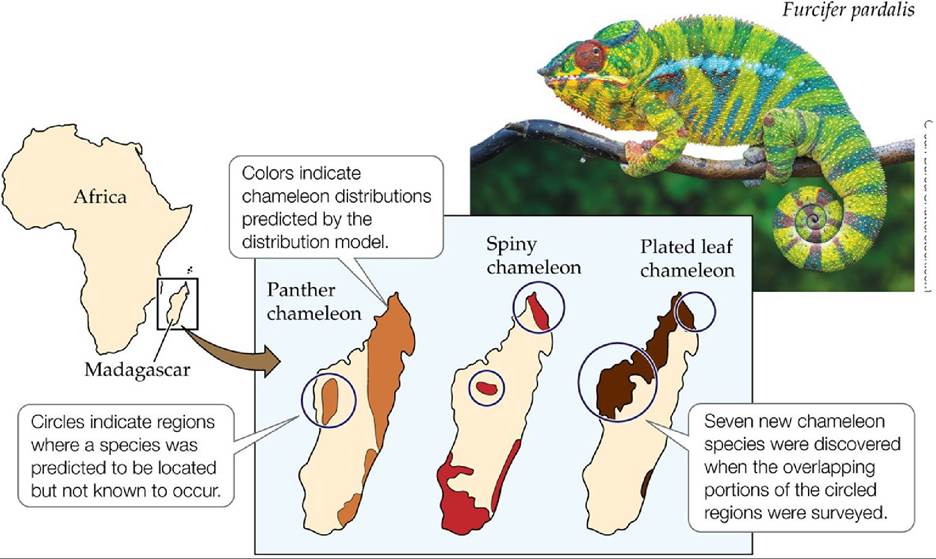
For the Madagascar chameleons, the accuracy of the distribution model developed was tested with chameleon location data that had not been entered into the program. The model performed well, correctly predicting where these chameleons lived 75% to 85% of the time. Next, the model was used to predict the geographic ranges of each of the 11 chameleon species—information that will be useful in efforts to protect chameleon habitat. Finally, the researchers investigated an interesting “error” in the model: there were several overlapping areas in which the model predicted that 2 or more of the 11 species would be found but in which no chameleons were known to occur (FIGURE 9.8). When two of these overlapping areas were surveyed, 7 previously unknown chameleon species were discovered. More intensive surveys conducted at the same time, but at sites outside these overlapping areas, found only 2 new species. Thus, the scientists were able to predict both the distributions of known chameleon species and the locations of habitats suitable for other chameleons, and the latter prediction led to the discovery of 7 new chameleon species.
© Jan BuresZShUtterstock.com
FIGURE 9.8 Predicted Distributions of Madagascar Chameleons The predicted distributions of 3 of 11 species of chameleons are shown for the panther chameleon (Furcifer pardalis), the spiny chameleon (F verrucosus), and the plated leaf chameleon (Brookesia stumpffi).
All 11 of the predicted distributions proved accurate. (After C. J. Raxworthy et al. 2003. Nature 426: 837-841.) View larger imageClimate Change Connection
Effects of Climate Change on the Geographic Distributions of Species
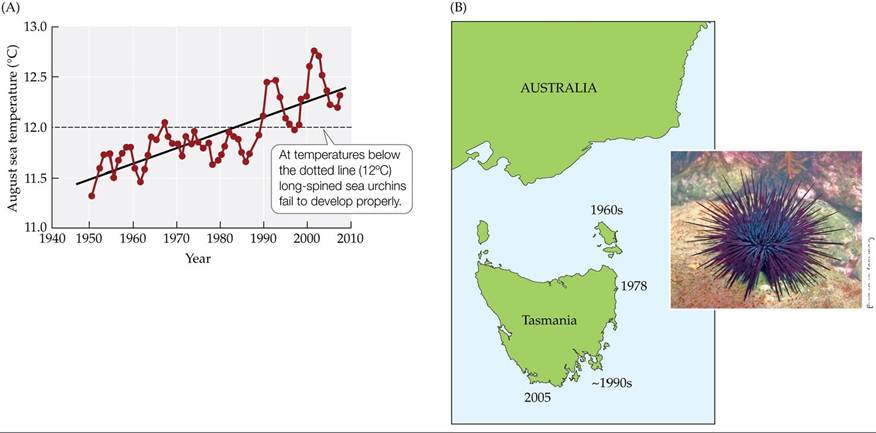
The waters along the east coast of Tasmania have warmed considerably since 1950 (FIGURE 9.9A). As this warming has occurred, the long-spined sea urchin (Centrostephanus rodgersii) has extended its range to the south (FIGURE 9.9B). The changes in the distribution of this urchin are consistent with the idea that climate change is the underlying cause: the larvae of C. rodgersii fail to develop properly in waters colder than 12°C, and the urchin has moved into new regions as waters in those locations have warmed to the point that they remain above that temperature. As C. rodgersii has expanded its range, it has established extensive urchin barrens in which all kelp have been removed by grazing (Ling 2008). Thus, through its effects on the geographic distribution of the long-spined sea urchin, ongoing climate change appears to be having a profound effect on kelp ecosystems along the Tasmanian coast. As observed for the long-spined sea urchin, shifts in the geographic distributions of hundreds of other species have been linked to climate change (Parmesan and Yohe 2003). In some marine communities, range shifts driven by climate change have contributed to the rapid replacement of temperate species with species from subtropical or tropical regions, leading to the formation of entirely new communities (Wernberg et al. 2016). On land, many species in the Northern Hemisphere have expanded the northern edges of their ranges toward the pole, while the southern edges of their ranges have maintained relatively stable positions (Sunday et al. 2012). But range shifts do not always occur in this way, nor do they necessarily keep pace with ongoing climate change.
Courtesy of S.
LingFIGURE 9.9 AClimate-DrivenRangeExtension Winterwatertemperaturesalong the east coast of Tasmania in August, the most important month for offspring production in long-spined sea urchins (A). The map in (B) shows the years in which long-spined sea urchins were first observed at points along the Tasmanian coast. (After S. Ling et al. 2009. Proc NatlAcad Sci USA 106: 22341-22345. © 2009 National Academy of Sciences, U.S.A.) View larger image
For example, Kerr et al. (2015) found that the geographic ranges of 67 species of bumblebees have shown rapid losses in the south and only a slow expansion in the north—as a result, their ranges are shrinking and the populations of some bumblebee species have declined as the climate has warmed. Moreover, even when the range expansion of one or more species keeps pace with climate change, such range shifts can have cascading and wide-ranging effects on other species (as illustrated by the decimation of kelp forests as the long-spined sea urchin expanded its range to the south). The exact nature of such cascading effects can be hard to predict, but it is clear that ongoing climate change will have major effects on ecosystems throughout the globe.
More on the topic Species distribution models can be used to predict a species' geographic range:
- CONCEPT 9.2 Species vary in their distribution and abundance across their geographic range.
- CONCEPT 4.1 Each species has a range of environmental tolerances that determines its potential geographic distribution.
- The geographic ranges of species vary in patchiness
- The geographic ranges of species vary in size
- CONCEPT 19.1 Species diversity differs among communities as a consequence of regional species pools, abiotic conditions, and species interactions.
- One of the most obvious ecological patterns on Earth is the variation in species composition and diversity among geographic locations.
- The physical environment can affect competition and ultimately the distribution of species
- CONCEPT 13.1 Parasites typically feed on only one or a few host species, but host species have multiple parasite species.
- Invasive species can displace native species and alter ecosystem properties
- Where should we put our focus in preventing species loss—on the species or the habitat?
- The distribution and abundance patterns of species and populations vary in their spatial extent across the landscape.
- The outcome of competition between species can be changed by a broad suite of factors, including features of the physical environment, disturbance, and interactions with other species.
- We have seen in previous chapters that disturbance, stress, and predation can modify species interactions and allow for species coexistence.