The outcome of competition between species can be changed by a broad suite of factors, including features of the physical environment, disturbance, and interactions with other species.
For example, a difference in abiotic conditions— as might occur from one place to another—can cause a competitive reversal, in which the species that was the inferior competitor in one habitat becomes the superior competitor in another.
Cases in which the outcome of competition may be modified under different abiotic conditions include Tansley's bedstraws, described in the Introduction, and the acorn barnacle in North America (see Figure 9.13).Interactions with other species can have similar effects on the outcome of competition between species. The presence of herbivores has been shown to reverse the outcome of competition between species of encrusting marine algae (Steneck et al. 1991) and between ragwort (Senecio jacobaea) and other plant species (FIGURE 14.15). Herbivores can have this effect if they prefer to feed on the superior competitor, thereby reducing the growth, reproduction, or survival of that species. What is true of herbivores is also true of predators, pathogens, and mutualists: an increase or decrease in the abundance of such species can change the outcome of competition among the species with which they interact.
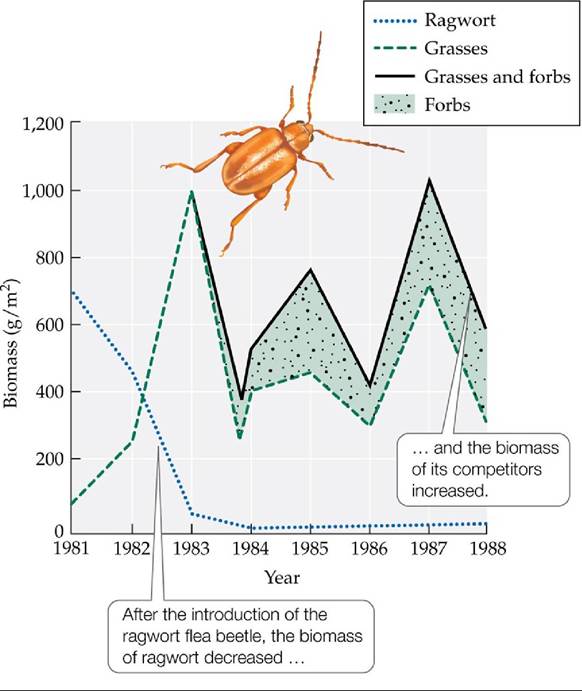
FIGURE 14.15 Herbivores Can Alter the Outcome of Competition Ragwortfleabeetles are herbivores that feed on ragwort (Senecio jacobaea), an invasive plant species. The graph tracks the biomasses of ragwort, grasses, and forbs (broad-leaved herbaceous plants) at a site in western Oregon after the flea beetle was introduced there in 1980. The results show that in the absence of the flea beetle, ragwort was a superior competitor, but it declined precipitously when the beetle was introduced. (After P. McEvoy et al. 1991. Ecol Appl 1: 430-432.) View larger image
In later chapters, we'll explore many examples in which species interactions alter competitive outcomes—sometimes preventing a superior competitor from driving other species to extinction. Here, we'll focus on the effects of the physical environment and disturbance.
More on the topic The outcome of competition between species can be changed by a broad suite of factors, including features of the physical environment, disturbance, and interactions with other species.:
- CONCEPT 14.4 The outcome of competition can be altered by predation, the physical environment, and disturbance.
- We have seen in previous chapters that disturbance, stress, and predation can modify species interactions and allow for species coexistence.
- The physical environment can affect competition and ultimately the distribution of species
- Environmental context can change the outcome of species interactions
- CONCEPT 19.1 Species diversity differs among communities as a consequence of regional species pools, abiotic conditions, and species interactions.
- CONCEPT 19.3 Processes such as disturbance, stress, predation, and positive interactions can mediate resource availability, thus promoting species diversity.
- CONCEPT 15.1 In positive interactions, no species is harmed, and the benefits are greater than the costs for at least one species.
- The intermediate disturbance hypothesis considers species diversity under variable conditions
- Changes in species interactions
- The way we think about species interactions changes dramatically when we consider that they are embedded in a community of multiple interactors.
- As indicated above, ecologists have long thought that competition between species was important in communities.
- Species interactions vary greatly in strength and direction
- Species interactions