The way we think about species interactions changes dramatically when we consider that they are embedded in a community of multiple interactors.
Instead of a particular species experiencing a single, direct interaction with another species, we are now dealing with multiple species interactions that generate a multitude of connections—some direct, but many indirect (FIGURE 16.11).
Direct interactions occur between two species and include trophic and non- trophic interactions—the interactions we explored in Unit 4. Indirect interactions occur when the relationship between two species is mediated by a third (or more) species. The simple addition of a third species to a two-species interaction creates many more effects, both direct and indirect, which have the potential to change the outcome of the original interaction dramatically.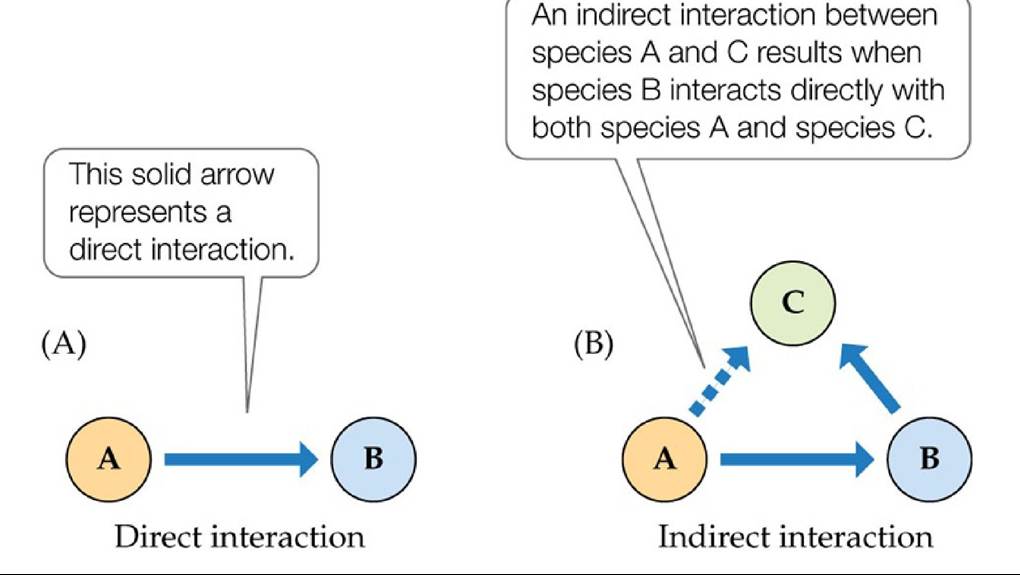
FIGURE 16.11 Directandlndirectspecieslnteractions (A)Adirectinteractionoccurs between two species. (B) An indirect interaction (dashed arrow) occurs when the direct interaction between two species is mediated by a third species. View larger image
A social interaction analogy fits well here. Consider Figure 16.11B. Let's say you are person A and you have a good friend (person B) with whom you interact well. Now, suppose this friend meets another person (person C) who dominates your friend's time. They go to dinner, the movies, and bowling—all things you and your friend enjoyed together—without you. At some point, this new friend might begin to interfere with your friendship, possibly compromising it to the point at which it becomes antagonistic. Sadly, the indirect effect of person C changes your friendship irreparably. You might say that “the friend of my friend is my enemy.” Likewise, one could imagine gaining a friend indirectly, if your foe had a foe (in this case, “the enemy of my enemy is my friend”). The point is that simply adding another person to the social circle can change the outcome of your relationship completely. The same is true of species interactions when we view them in the community context, rather than as isolated entities.
More on the topic The way we think about species interactions changes dramatically when we consider that they are embedded in a community of multiple interactors.:
- Interactions of Multiple Species
- CONCEPT 19.1 Species diversity differs among communities as a consequence of regional species pools, abiotic conditions, and species interactions.
- CONCEPT 13.1 Parasites typically feed on only one or a few host species, but host species have multiple parasite species.
- The outcome of competition between species can be changed by a broad suite of factors, including features of the physical environment, disturbance, and interactions with other species.
- We have seen in previous chapters that disturbance, stress, and predation can modify species interactions and allow for species coexistence.
- CONCEPT 16.2 Species diversity and species composition are important descriptors of community structure.
- CONCEPT 15.1 In positive interactions, no species is harmed, and the benefits are greater than the costs for at least one species.
- Environmental context can change the outcome of species interactions
- Species diversity is an important measure of community structure
- Species interactions vary greatly in strength and direction