We have seen in previous chapters that disturbance, stress, and predation can modify species interactions and allow for species coexistence.
We saw that when two species are competing with each other for the same resource, as in the case of the sea palms and mussels competing for space in the rocky intertidal zone
(see Concept 14.4), coexistence can be achieved if the population growth of the dominant species is disrupted.
In that example, mussels are the dominant competitors, and sea palms can coexist with them only where the mussels are disturbed frequently enough by wave action to allow the sea palms to acquire space. In this and many other examples in this book, as long as disturbance, stress, or predation keeps the dominant competitor from reaching its own carrying capacity, competitive exclusion cannot occur, and coexistence will be maintained (FIGURE 19.12).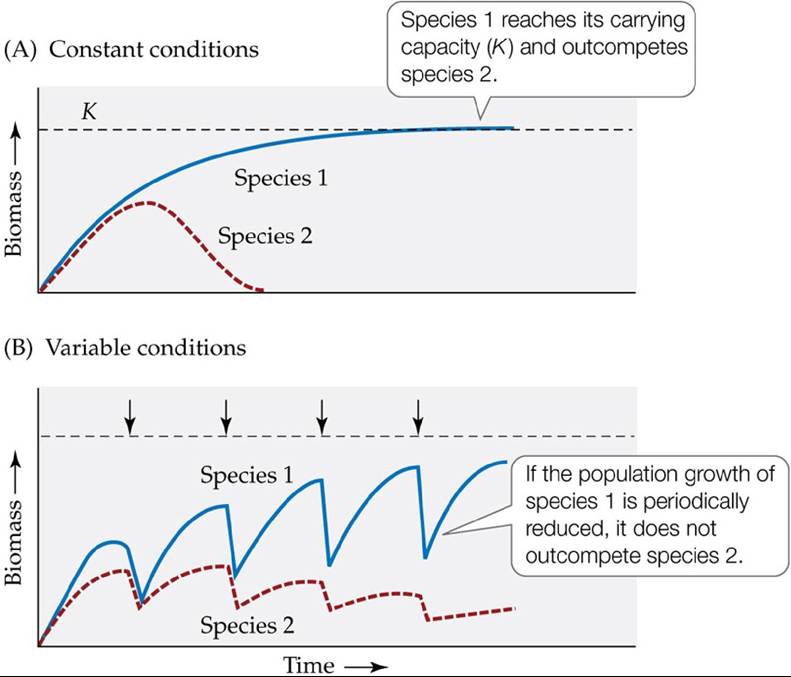
FIGURE 19.12 The Outcome of Competition under Constant and Variable Conditions (A) Under constant conditions, species 1 (the dominant competitor) outcompetes species 2 when it reaches its own carrying capacity (K). (B) If disruptive processes such as disturbance, stress, or predation (represented by the arrows) reduce the population growth of species 1, it will not reach its carrying capacity and will not outcompete species 2, thus allowing coexistence. (After M. Huston. 1979. Am Nat 113: 81-101.) View larger image
We have also explored the effect of positive interactions between species in ameliorating extreme conditions and allowing coexistence. For example, we saw in the cases of salt marsh plants (Figure 17.14) and plants at high elevations (Figure 15.9) that species that might normally be unable to tolerate stressful conditions can maintain viable populations under those conditions because of the facilitative effects of other species.
Let's expand these ideas about modification of species interactions to whole communities and ask how processes that mediate resources influence species diversity.
More on the topic We have seen in previous chapters that disturbance, stress, and predation can modify species interactions and allow for species coexistence.:
- CONCEPT 19.3 Processes such as disturbance, stress, predation, and positive interactions can mediate resource availability, thus promoting species diversity.
- The outcome of competition between species can be changed by a broad suite of factors, including features of the physical environment, disturbance, and interactions with other species.
- The Menge-Sutherland model separates the effects of predation from those of disturbance and stress
- CONCEPT 19.1 Species diversity differs among communities as a consequence of regional species pools, abiotic conditions, and species interactions.
- CONCEPT 15.1 In positive interactions, no species is harmed, and the benefits are greater than the costs for at least one species.
- The intermediate disturbance hypothesis considers species diversity under variable conditions
- Environmental context can change the outcome of species interactions
- Species interactions
- The way we think about species interactions changes dramatically when we consider that they are embedded in a community of multiple interactors.
- Changes in species interactions