Processes that mediate resources can allow species to coexist
There is an old adage among ecologists that goes something like this: “If you think it's a new idea, check Darwin. He probably proposed it first.” In fact, when it comes to theories that explain coexistence, Darwin was the first to formally recognize disturbance as a mechanism for the maintenance of species diversity.
In The Origin of Species (1859, p. 55), he noted the following results after an impromptu experiment in which he left a meadow on his property undisturbed by mowing: “Out of twenty species growing on a little plot of mown turf (three feet by four) nine species perished, from the other species being allowed to grow freely.” Without mowing, the dominant competitors in the meadow community competitively excluded weedy plants and cut species richness nearly in half. Darwin used this example, along with a multitude of others, to support the argument that nature applies limits to the tendency of species to increase in abundance and outcompete other species. His hypothesis was that species struggle for existence, a necessary first piece to his theory of natural selection.In 1961, G. E. Hutchinson revived this idea in a paper titled “The Paradox of the Plankton.” Hutchinson, an influential community ecologist from Yale University (and major professor to Robert MacArthur), provided one of the first mechanistic descriptions of how coexistence could be maintained under fluctuating environmental conditions. He focused on phytoplankton communities in temperate freshwater lakes (FIGURE 19.13). The simple idea behind Hutchinson's model was the seeming paradox of the presence of 30-40 species of phytoplankton given the relatively limited resources at their disposal. He reasoned that all of the phytoplankton compete for the same array of resources, including carbon dioxide, nitrogen, phosphorus, sulfur, and trace elements, which are likely to be evenly distributed in lakes.
How could so many species manage to coexist with so few resources and in such a structurally simple environment as a lake? Hutchinson hypothesized that the conditions in the lake changed seasonally and over longer periods and that those changes kept any one species from outcompeting the others. As long as conditions in the lake changed before the competitively superior species eliminated others, coexistence would be possible.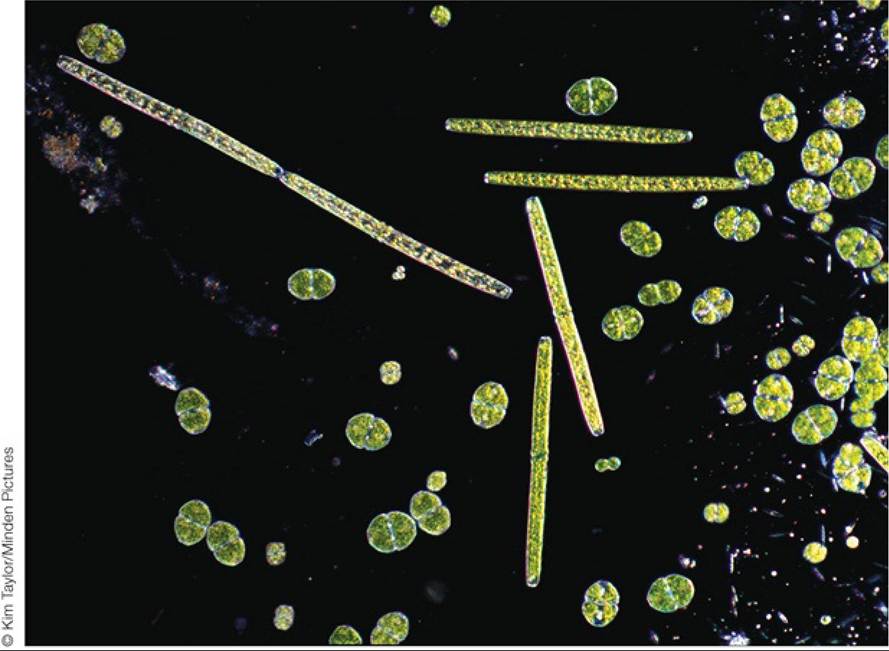
FIGURE 19.13 ParadoxofthePlankton Phytoplankton from a freshwater lake. How can so many species coexist using the same set of basic resources? G. E. Hutchinson suggested that the answer is the influence of environmental variation over time. View larger image
Hutchinson's model has two components that interact to control coexistence among species. One is the time required for one species to competitively exclude another species (tc), which depends on the population growth rates of the two competing species. The second is the time it takes for environmental variation to act on the population growth of the two competing species (te)∙ Hutchinson predicted that when competitive exclusion occurs more rapidly than environmental conditions can change (tc be achieved. One could imagine this occurring in communities where there is little environmental change or where the dominant competitor has very rapid growth rates. Conversely, in a fluctuating environment to which the competitors are adapted (where tc >> te), environmental variation does not affect the competitive interactions, and competitive exclusion occurs. One could imagine this pattern in environments with frequent, low-intensity environmental fluctuations and long- lived species. Hutchinson argued that it is only when the time it takes for competitive exclusion to occur is roughly equal to the time it takes for environmental variation to interrupt the competitive interaction (when tc = te) that competitive exclusion is thwarted and coexistence occurs.
Hutchinson argued that this condition is likely to be met often in lake phytoplankton communities; otherwise, very few species, rather than tens of species, would coexist.Hutchinson proposed the idea that competitive exclusion is rare in nature, but he did not test it. It was Robert Paine's work in the rocky intertidal zone of the west coast of North America in the late 1960s that provided some of the most rigorous and convincing evidence that coexistence could be maintained by disruptive processes such as predation or disturbance. Paine (1966) manipulated population densities of Pisaster, a predatory sea star that feeds preferentially on the mussel Mytilus californianus. In plots from which Pisaster was removed, species richness decreased as mussels outcompeted barnacles and other competitively inferior species. In plots where Pisaster was present, species richness was enhanced. There are several important aspects to Paine's work, including the keystone species concept and the effects of indirect interactions, but we will consider those aspects in more detail in Concept 21.4 when we discuss food webs. For now, let's concentrate on an idea that arose from the work of Darwin, Hutchinson, and Paine: the intermediate disturbance hypothesis.