The intermediate disturbance hypothesis considers species diversity under variable conditions
The intermediate disturbance hypothesis was proposed to explain how gradients in disturbance (although we can easily include stress and predation in this model) affect species diversity in communities (FIGURE 19.14).
This hypothesis was first formally proposed by Joseph Connell, Paine's contemporary and an author of the classic work on barnacle competition (see Figure 14.16). Connell (1978) recognized that the level of disturbance (its frequency and intensity; see Figure 17.4) experienced by a particular community could have dramatic effects on its species diversity. He hypothesized that species diversity would be greatest at intermediate levels of disturbance and lowest at high and low levels of disturbance. Why would this be the case? At low levels of disturbance, competition would regulate species diversity because dominant species would be free to exclude competitively inferior species. At high levels of disturbance, on the other hand, species diversity would decline because many individuals would die and some species would become locally extinct as a result. At intermediate levels of disturbance, species diversity would be maximized simply by the balance between disruption of competition and mortality due to disturbance.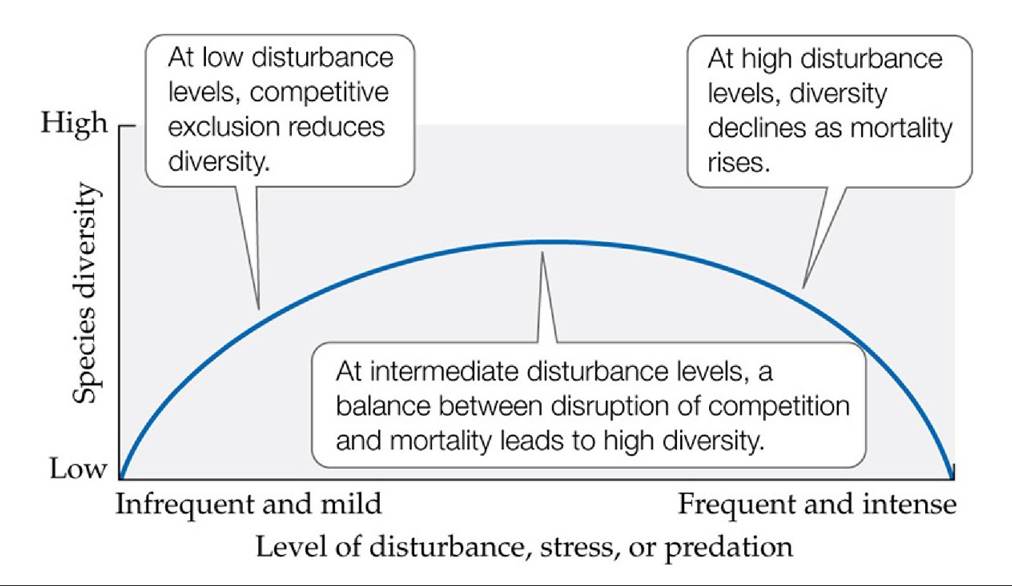
FIGURE 19.14 ThelntermediateDisturbanceHypothesis Speciesdiversityisexpected to be greatest at intermediate levels of disturbance, stress, or predation. (After J. H. Connell. 1978. Science 199: 1302-1310.) View larger image
The intermediate disturbance hypothesis is highly amenable to testing. One such test was carried out by Wayne Sousa (1979a), who studied succession in intertidal boulder fields in Southern California (see Figure 17.15). In a different but related study, Sousa measured the rate of disturbance of communities living on the boulders and documented their species richness (FIGURE 19.15).
Small boulders were rolled over frequently by waves and thus constituted highly disturbed environments for the marine algae and invertebrate species that lived on them. The opposite was true for large boulders, which rarely experienced wave forces large enough to dislodge them. Intermediate-sized boulders, of course, were rolled over at intermediate frequencies. After 2 years, Sousa found that most of the small boulders had only one species (early successional species: the macroalga Ulva or the barnacle Chthamalus), while the greatest percentage of the large boulders had two species (late successional species: the macroalgaGigartina canaliculata and others). The greatest percentage of the intermediatesized boulders had four species, but some had up to seven species (a mixture of early, mid, and late successional species). Sousa’s study is just one of many that have demonstrated the highest diversity at intermediate disturbance levels.
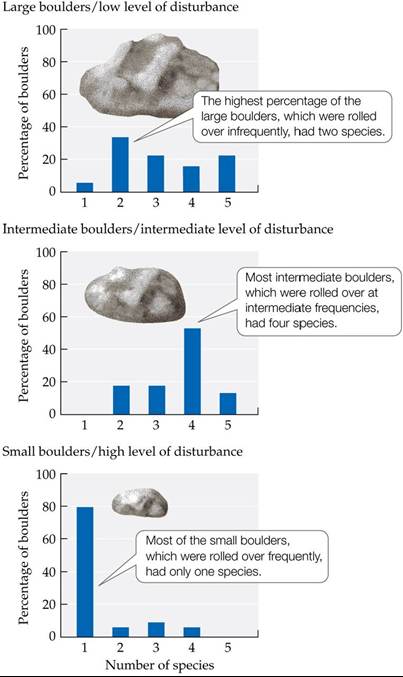
FIGURE 19.15 A Test of the Intermediate Disturbance Hypothesis Marine intertidal communities were surveyed on boulders that differed in the level of disturbance they experienced from being rolled over by wave action.
Which size boulder had the lowest species richness, and why?
(After W. P. Sousa. 1979a. Ecology 60: 1225-1239.) View larger image