There have been several elaborations on the intermediate disturbance hypothesis
The intermediate disturbance hypothesis is a simple model that relies on variation in disturbance levels to explain species diversity in communities. A handful of ecologists have used it as a foundation for adding more complexity and realism to their theories.
One of the first to elaborate on the model was Michael Huston (1979), who acknowledged the effect of disturbance on competition but reasoned that a second process, competitive displacement, could be an important mediating factor. Competitive displacement occurs when the best competitor uses limiting resources that the weaker competitor requires, ultimately causing a decline in the weaker competitor's population growth to the point of extinction. Huston's dynamic equilibrium model considers how the frequency or intensity of disturbance and the rate of competitive displacement combine to determine species diversity (FIGURE 19.16). Like Hutchinson's model, Huston's model predicts maximum species diversity when the level of disturbance and the rate of competitive displacement are roughly equivalent (hence the term equilibrium in the model name). Species diversity will be highest when the frequency or intensity of disturbance and the rate of competitive displacement are both at low to intermediate levels (see Figure 19.16, point LL). Moreover, species diversity will be lowest either when disturbance is high and competitive displacement is low (point HL) or when competitive displacement is high and disturbance is low (point LH). When both processes are high and roughly similar (point HH), we expect species diversity to be relatively low because both high mortality and competitive displacement will be acting to reduce species diversity. Perhaps because of its added complexity, there have been few observational or experimental studies of the dynamic equilibrium model. One example comes from an observational study of riparian wetlands in Alaska by Pollock et al. (1998).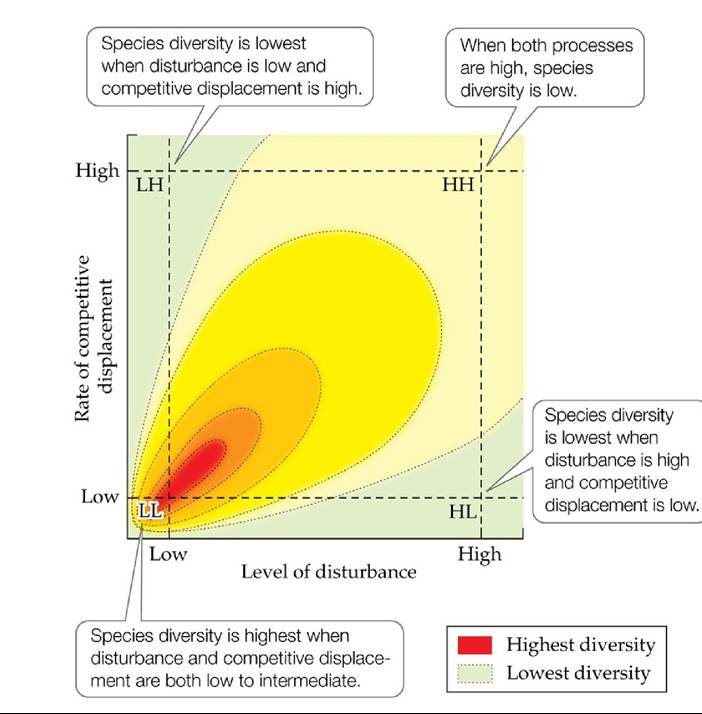
FIGURE 19.16 TheDynamicEquilibriumModel Thedynamicequilibriummodelpredicts that species diversity will be highest when the frequency and intensity of disturbance and the rate of competitive displacement are both low to intermediate. (After M. Huston. 1979. Am Nat 113: 81- ιoι.) View larger image
Another elaboration of the intermediate disturbance hypothesis comes from Hacker and Gaines (1997), who incorporated positive interactions into their model. If we think back to the previous chapters in this unit, we learned that species interactions are highly context dependent, varying in direction and strength depending on certain physical and biological factors. Theory and experiments both suggest that positive interactions should be more common under relatively high levels of disturbance, stress, or predation—all circumstances in which associations among species could increase their growth and survival. Hacker and Gaines reasoned that positive interactions might be particularly important in promoting species diversity at intermediate to high levels of disturbance (or stress or predation) for two reasons (FIGURE 19.17). First, at high levels of disturbance, positive interactions should increase the survival of individuals of the interacting species through both the amelioration of harsh conditions and associational defenses. Second, at intermediate levels of disturbance, species will be released from competition and thus are more likely to engage in positive interactions, an effect that should further increase species diversity.
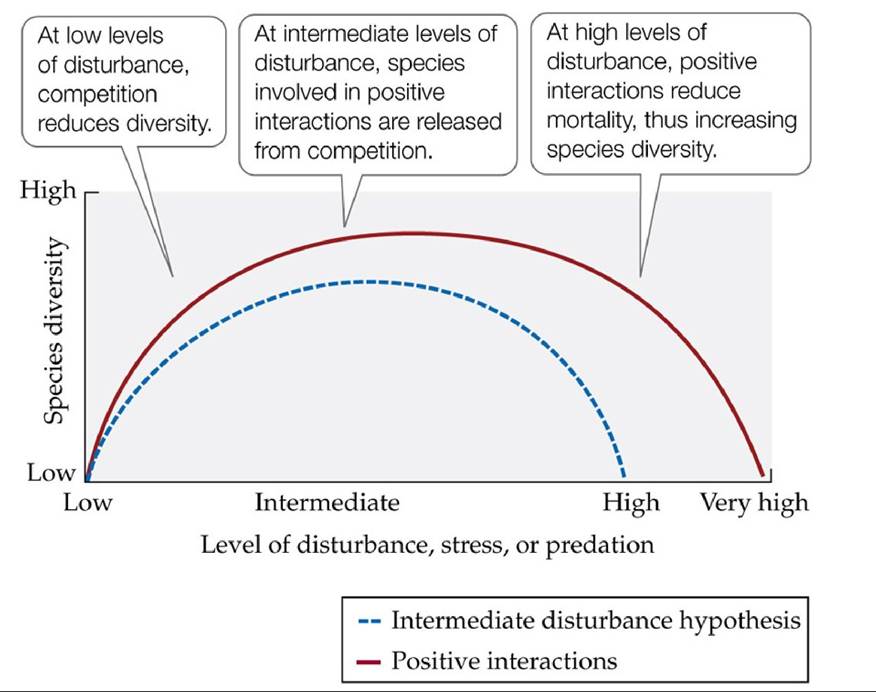
FIGURE 19.17 Positive Interactions and Species Diversity The intermediate disturbance hypothesis has been elaborated to include positive interactions. (After S. D. Hacker and S. D.
Gaines. 1997. Ecology 78: 1990-2003.) View larger image
Hacker and Gaines used studies of a New England salt marsh to support their theory.
In this community, there is a strong gradient of physical stress due to saltwater inundation. The highest stress occurs closest to the shoreline, where the tides inundate the plants most frequently. A survey of plants, insects, and spiders across the marsh revealed three distinct intertidal zones, each with a different species composition, and showed that the middle intertidal zone had a higher species richness than either the high or low intertidal zone (FIGURE 19.18A). The researchers then conducted transplant experiments in which all the plant species were moved to all three zones, with or without the most abundant plant of their own zone: the tall shrub Iva frutescens in the high intertidal zone, and the rush Juncus gerardii in the middle and low intertidal zones (Bertness and Hacker 1994; Hacker and Bertness 1999). The results revealed that competition with Iva in the high intertidal zone led to the competitive exclusion of most plant species transplanted there, whether or not Juncus was also present. In the low intertidal zone, physiological stress was the main factor in controlling population numbers, as many individuals died whether Juncus was present or absent. In the middle intertidal zone, however, Juncus facilitated other plant species. Without Juncus, mortality was 100% for most species by the end of the summer. The mechanism of facilitation, described in Concept 16.3, was amelioration of both hypoxia and salt stress by Juncus. Additionally, as we saw in that discussion, Juncus indirectly facilitates an aphid herbivore that depends on Iva for survival (see Figures 16.12 and 16.13). It turns out that such indirect interactions affect a number of insect herbivores that feed on a variety of other plants facilitated by Juncus in the marsh. Hacker and Gaines (1997) concluded, based on these studies, that positive interactions are critically important in maintaining species diversity, especially at intermediate levels of physical stress (FIGURE 19.18B). They recognized that physical stress in the middle intertidal zone of the New England salt marsh both decreased the competitive effect of Iva and increased the facilitative effect of Juncus (and its indirect effects on insects), thus providing ideal conditions for enhanced species coexistence and diversity.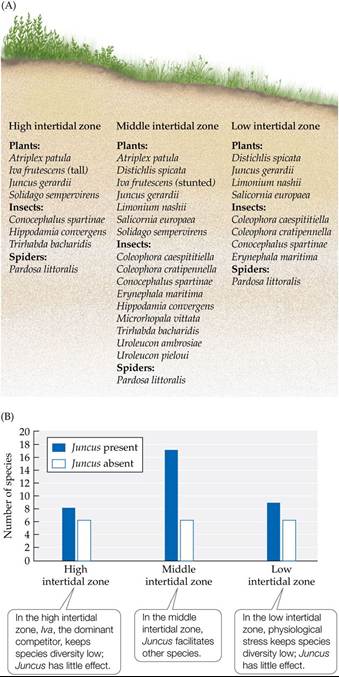
FIGURE 19.18 Positive Interactions: Key to Diversity in Salt Marsh Communities? (A)
Surveys of plant and arthropod species diversity in a New England salt marsh show diversity to be greatest in the middle intertidal zone. (B) Experiments suggest that the high diversity of plants and arthropods in this zone is controlled by the direct and indirect effects of the facilitating rush species Juncus gerardii as well as by a decrease in the effect of the dominant competitor, Iva frutescens, due to physical stress. (After S. D. Hacker and S. D. Gaines. 1997. Ecology 78: 19902003.) View larger image
More on the topic There have been several elaborations on the intermediate disturbance hypothesis:
- The intermediate disturbance hypothesis considers species diversity under variable conditions
- Omitting intermediate entities in models of indirect interactions
- Disturbance can prevent competition from running its course
- DISPLACEMENT, SELF-ABASEMENT