The Menge-Sutherland model separates the effects of predation from those of disturbance and stress
The intermediate disturbance hypothesis assumes that disturbance, stress, and predation all have similar effects on interspecific competition, and thus on species diversity (see Figure 19.14).
In particular, it considers disturbance and predation to be similar processes—that is, processes that act to kill or damage dominant competitors and thereby create opportunities for subordinate species. This equating of disturbance and predation ignores an important difference between them: disturbance is a physical process, whereas predation is a biological one. Menge and Sutherland (1987) have argued that because predation is a biological interaction, it is independently affected by physical disturbance and stress and thus should be considered separately.The Menge-Sutherland model predicts that predation should be relatively important in maintaining species richness at low levels of stress (or disturbance), at which predators can most easily feed on, and thus limit the abundance of, competitively dominant species (FIGURE 19.19). As stress increases, the effect of predation decreases as predators become less able to inflict damage on their prey at lower trophic levels. These prey, which are predicted by the model to be more tolerant of physical stress or disturbance, are more likely to compete for resources, especially at intermediate levels of stress or disturbance. But as environmental stress increases to high levels, both predation and competition become less important as more and more species are excluded from the community by their physiological limitations. As with the intermediate disturbance hypothesis, the influences of positive interactions, which are especially important at either extreme of predation or physical stress, have since been incorporated into the Menge-Sutherland model (Bruno et al. 2003), leading to conclusions similar to those of Hacker and Gaines (1997) (see Figure 19.17).
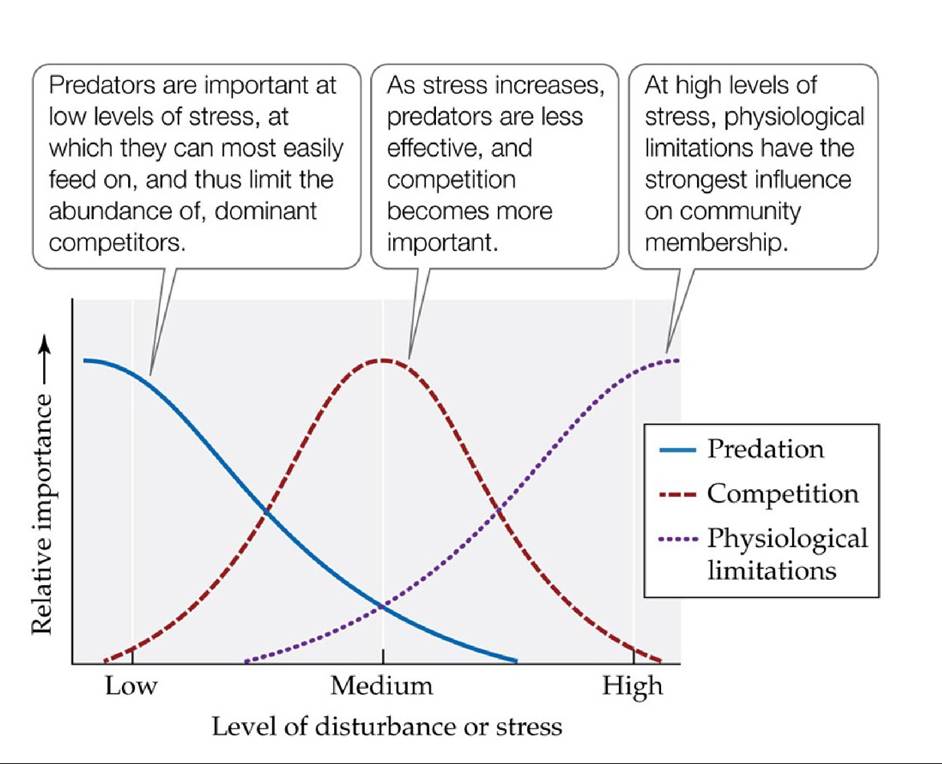
FIGURE 19.19 TheMenge-SutherlandModel Menge and Sutherland’s model of influences on community diversity is similar to the intermediate disturbance hypothesis (see Figure 19.14), but it accounts for the effect of predation separately from that of stress or disturbance. (After B. A. Menge and J. P. Sutherland. 1987. Am Nat 130: 730-757.) View larger image
Another important factor that Menge and Sutherland considered in their model was the influence of a particular kind of dispersal known as recruitment, defined as the addition of young individuals to a population. They predicted that if recruitment was low, competition might not be particularly important in determining species diversity, because resources would be less likely to be limiting. Instead, the interplay between predation under benign environmental conditions and physical stress under extreme conditions would be the most influential factor regulating community membership. If recruitment increased, however, the role of competition would also increase, ultimately resulting in predictions similar to those in Figure 19.19. Thus, Menge and Sutherland suggest that dispersal (in the form of recruitment) can be another important influence on species diversity and species composition, as shown in Figure 19.4 and demonstrated in ANALYZING DATA 19.1.
Z
ANALYZING DATA 19.1
How Do Predation and Dispersal Interact to Influence Species Richness?
A prominent theme in this chapter is that processes such as disturbance, stress, and predation can mediate resource availability, thus promoting species coexistence and species diversity. Another important theme in this and the previous chapter is that regional species pools and the dispersal abilities of species can play important roles in supplying new species to communities. What happens when we combine these concepts in an attempt to explain the factors important to species coexistence within local communities? That was the goal of research on zooplankton communities conducted by Jonathan Shurin (2001),* who explored the effects of predation and dispersal on the species diversity of local zooplankton communities.
He used experimental ponds made from plastic cattle watering tanks, which he stocked with a diversity of local zooplankton to create individual zooplankton communities. Next, he imposed one of four predation treatments on each pond: (1) no predators, (2) fish predators only (juvenile bluegill sunfish, Lepomis macrochirus), (3) insect predators only (the backswimmer bug Notonecta undulata), and (4) both fish and insect predators. Finally, Shurin applied a second type of treatment: either the ponds received dispersers of a large number of zooplankton species from the regional pool (which Shurin repeatedly added to the ponds at low densities throughout the experiment), or they received no dispersers. The experiment ran over a summer, after which time Shurin counted the number of zooplankton species in each of the pond communities. His results are shown in the graph.1. How did predation alone affect the species richness of zooplankton within the ponds? Give a plausible explanation for why this occurred. Did fish and insect predators have different effects on local species richness?
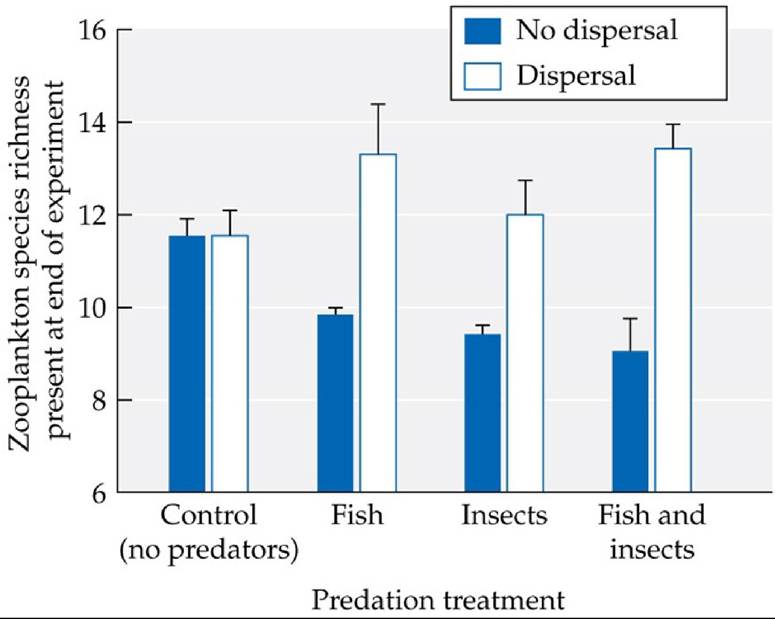
2. How does species richness change with the addition of zooplankton dispersal into the ponds? Without knowing anything about the species composition of the ponds, can you say what these results suggest about the dual effects of predation and dispersal on local species richness?
3. Suppose an additional treatment, that of doubling the number of predators, was added to this experiment. Suppose the results showed a decline in zooplankton richness (let's say six species without dispersal and ten species with dispersal). What would these results suggest about the role of dispersal in pond communities subjected to heavy predation? Considering the entire range of predation intensity, from none to intermediate to heavy, do the results fit the intermediate disturbance hypothesis? Why or why not?
*Shurin, J. B. 2001. Interactive effects of predation and dispersal of zooplankton communities. Ecology 82: 3404-3416.
The intermediate disturbance hypothesis and the Menge-Sutherland model assume that there is an underlying competitive hierarchy among species—that is, that some species are much stronger competitors than others and thus dominate communities if they are not kept in check by disruptive processes. What happens if we assume that there is no competitive hierarchy among species? If species have equivalent effects on one another, then the ability of any one species to live in a community will depend more on chance than on “conflict resolution.” Let's spend a moment discussing this alternative theory of species diversity.