Lottery and neutral models rely on equality and chance
A final group of models proposed to explain species coexistence are so-called lottery models and neutral models (Sale 1977; Chesson and Warner 1981; Hubbell 2001). As their names suggest, these models emphasize the role of chance in the maintenance of species diversity.
Lottery and neutral models assume that resources in a community made available by the effects of disturbance, stress, or predation are captured at random by recruits from a larger pool of potential colonists. For this mechanism to work, species must have fairly similar interaction strengths and population growth rates, and they must have the ability to respond quickly, by dispersing, to disturbances that free up resources. If there is a large disparity in competitive abilities among species, the dominant competitor will have a greater chance of obtaining resources and eventually monopolizing them. In lottery and neutral models, the equal chance of all species to obtain resources is what allows species coexistence.Lottery and neutral models have most often been applied to highly diverse communities. Peter Sale (1977, 1979) conducted one of the earliest and best- known tests of the lottery model on fishes of the Great Barrier Reef of Australia. Fish species diversity on this reef ranges from 1,500 species in the north to 900 species in the south. On any one small patch of reef (about 3 m, or 10 feet, in diameter), up to 75 species might be recorded. In the reef ecosystem, there is strong habitat fidelity and severe space limitation, and many individual fish spend their entire adult lives in roughly the same spot on the reef. Given these conditions, Sale asked the obvious question: How could so many species coexist in such a small space for so long?
Sale reasoned that only a portion of the coexistence among these fishes could be explained by resource partitioning, because the species tended to have very similar diets.
He noted that vacant sites or territories were highly desirable and were made available rather unpredictably by the deaths of individual occupants (due, for example, to predation, disturbance, starvation, or disease). To look at this system in more detail, Sale observed losses of occupants and recruitment to newly vacated sites among three species of territorial pomacentrid fishes (Eupomacentrus apicalis, Plectroglyphidodon Iacrymatus, and Pomacentrus wardi). He found the pattern of occupation to be random (FIGURE 19.20)—the identity of the species that had previously occupied a site had no bearing on which species was recruited to that site when it became vacant. One species, P. wardi, both lost and occupied sites at a greater rate than the other two species, but this had no effect on its overall ability to coexist with the other two species. Sale noted that one important component of this lottery system is that fishes produce many, highly mobile juveniles that can saturate a reef and take advantage of open space made available (as described for clownfish in Connections in Nature for Chapter 7). As Sale put it, “The species of a guild are competing in a lottery for living space in which larvae are tickets and the first arrival at a vacant site wins that site” (Sale 1977, p. 351).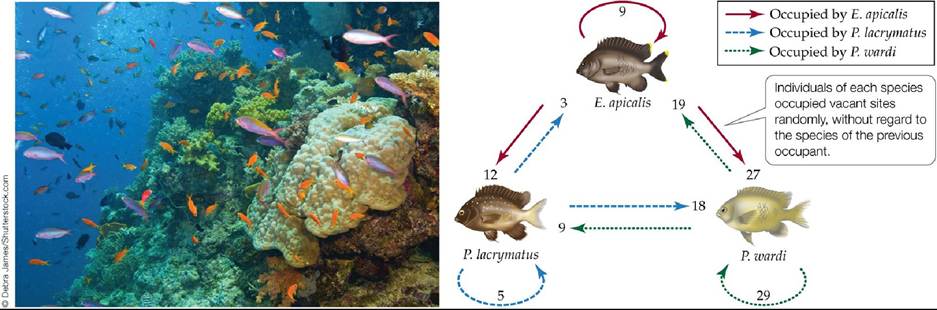
FIGURE 19.20 A Test of the Lottery Model Peter Sale tested the lottery model using coral reef fishes living on the Great Barrier Reef of Australia. By counting the individuals of three fish species (Eupomacentrus apicalis, Plectroglyphidodon Iacrymatus, and Pomacentrus wardi) that occupied vacated sites, he found that the species of the new occupant was random and unrelated to the species that had previously occupied the site. The drawings represent the original occupants of vacated sites, and the colored arrows pointing to each drawing show the number of individuals of another species (straight arrows) or the same species (circular arrows) that took over those sites when they became vacant.
(Data from P. F. Sale. 1979. Oecologia 42: 159-177.) View larger imageThe role of chance in maintaining species diversity, especially in unpredictable environments, has intuitive appeal. As long as species win the lottery every once in a while, they will continue to reproduce (i.e., buy more tickets) and be able to enter the lottery once again. It is easy to see how this mechanism might be particularly relevant in highly diverse communities such as tropical rainforests and grasslands, where so many species overlap in their resource requirements. Its relevance decreases, however, in communities where species have large disparities in interaction strength. In those communities, it appears that the “great equalizers” are processes that decrease competitive exclusion, such as disturbance, stress, or predation, or increase inclusion, such as positive interactions.
Ecologists are a long way from agreeing on any one theory to explain why certain species end up coexisting in space and time. Instead, they continue to strive for generalities while recognizing that the relative importance of different mechanisms of species diversity may depend on the characteristics of the community in question.
Up to this point in the chapter, we have focused on the causes of species diversity at the community level. We have asked, Why and how does species diversity differ among communities? In the next section, we will shift gears and instead ask what might be considered the flip side of that question. We want to know, given the variation in species diversity among communities (and the current losses of species diversity due to human activities), whether species diversity matters. In other words, what do species do in communities? Does species diversity have functional significance?
More on the topic Lottery and neutral models rely on equality and chance:
- Using logic: Truth preservation, probability, and the lottery paradox
- THE RISK-NEUTRAL EXPECTATIONS
- 7. Non-neutral differences in technology
- Some people rely on scientific data to decide whether a particular physical condition calls for a medical intervention.
- REAL-WORLD AND RISK-NEUTRAL EXPECTATIONS OF MARKETS
- The equality strategy
- Justice and equality: changing and contested concepts
- Weighing the Value of Messages Against the Value of Content-Neutral Regulations
- It can be argued that the basically theoretical background of EMH rests on three arguments which rely on progressively weaker assumptions.
- Towards Gender Equality in the Ukrainian Society
- GENDER EQUALITY AND REFORM
- Parity and Sharia Councils: The Question of Gender Equality
- Chapter 4 Testing Brantingham's Neutral Model: The Effect of Spatial Clustering on Stone Raw Material Procurement
- 4 Conversation on equality and rights
- Attempting to Alter the Legal Framework: the Arbitration and Mediation Services (Equality) Bill
- 20 Islamic law and the question of gender equality