Disturbance can prevent competition from running its course
As we saw in Concept 9.3, a disturbance such as a fire or major storm may kill or damage some individuals while creating opportunities for others. Some species can persist in an area only if such disturbances occur regularly.
Forests, for example, contain some herbaceous plant species that require abundant sunlight and are therefore found only in areas where wind or fire has created an opening in the tree canopy. Over time, a population of such plants is doomed: as trees recolonize the area, shade increases to the point at which the species are competitively excluded. Such species are called fugitive species because they must disperse from one place to another to take advantage of disturbances that open up resources and allow them to avoid competitive exclusion.Robert Paine, a marine ecologist from the University of Washington, has described how periodic disturbance allows a fugitive algal species, the sea palm (Postelsia palmaeformis), to coexist with a competitively dominant species, the mussel Mytilus Californianus (Paine 1979). The sea palm is a brown alga that lives in the intertidal zone and must attach itself to rocks to grow. It competes for attachment space with mussels. Although a sea palm can outcompete an individual mussel (by growing on top of it), the sea palm is eventually displaced by other mussels that grow in from the side. Competition with mussels causes sea palm populations to decline over time (FIGURE 14.19). Hence, if competition ran its course, mussels would drive sea palm populations to extinction. That is exactly what happens on low-disturbance shorelines (with a mean rate of 1.7 disturbances per year), where waves only occasionally tear patches of mussels from the rocks. However, sea palms can persist in shoreline areas where high-energy waves remove mussels more frequently (with a mean rate of 7.7 disturbances per year), thereby creating temporary openings for sea palm individuals.
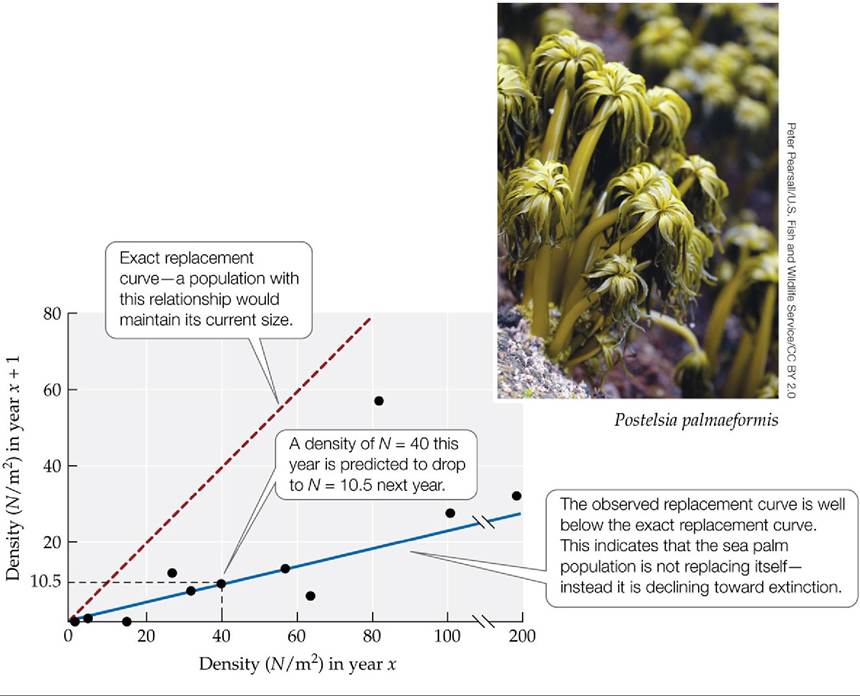
FIGURE 14.19 Population Decline in an Inferior Competitor Lacking Disturbance In this graph, each point represents an observed change in density (N, the number of individuals per square meter) from one year (year x) to the next (year x + 1) at sites where sea palms are growing in competition with mussels and lack disturbance.
These points can be used to estimate a replacement curve (solid blue line), which shows the extent to which sea palm individuals replace themselves over time without disturbance. The exact replacement curve (dashed red line) shows the densities at which the population size would not change from one year to the next.Based on the observed replacement curve (the solid blue line), how many years would it take for a sea palm population to decline from 100 individuals to fewer than 20 individuals?
(After R. T. Paine. 1979. Science 205: 685-687.) View larger image
A Case Study Revisited
Competition in Plants That Eat Animals
In plants, competition for nutrients can be especially important (see Figure 14.5), but other resources, such as light and water, can also be in short supply. Carnivorous plants live in nutrient-poor soils, and their root systems are usually less well developed compared to their noncarnivorous neighbors. These observations suggest that carnivorous plants might be especially hard-hit by belowground competition if they were denied access to their unique, alternative source of nutrients (animal prey).
Instead, contrary to what would be expected if competition for nutrients were important, Sarracenia was not especially hard-hit when neighbors were present and pitchers were deprived of prey (see Figure 14.2). In fact, when neighbors were present, pitcher plants had the same biomass regardless of whether they had access to prey. These results suggest that there was relatively little competition between Sarracenia and noncarnivorous plants for soil nutrients and that some other factor was driving the positive response these plants had to neighbor removal.
Further investigation revealed that competition for light appeared to be more important to pitcher plants. Brewer (2003) found that neighbors reduced the availability of light to Sarracenia by a factor of 10. When neighbors were removed, Sarracenia responded by greatly increasing its growth, especially if pitchers were open and the plants could capture prey (see Figure 14.2).
Hence, Sarracenia responded to higher light levels when neighbors were removed by growing more rapidly—but only if prey were available to supply the extra nutrients they needed for such growth. Overall, it appears that pitcher plants compete with their neighbors for light but avoid competition for soil nutrients by eating animals and by using changes in light levels as a cue for growth.Connections in Nature
The Paradox of Diversity
As we've seen, some field data show that superior competitors can drive inferior competitors extinct—which is exactly what the competitive exclusion principle states should happen whenever two or more species use the same set of limiting resources. Natural communities, however, contain many species that share the use of scarce resources without driving one another to extinction. Pitcher plants, for example, coexist with a diverse group of other species (FIGURE 14.20), even though they were predicted to be inferior competitors for soil nutrients. In the context of Brewer's experiments on pitcher plants, let's reconsider why superior competitors do not always drive inferior competitors to extinction.
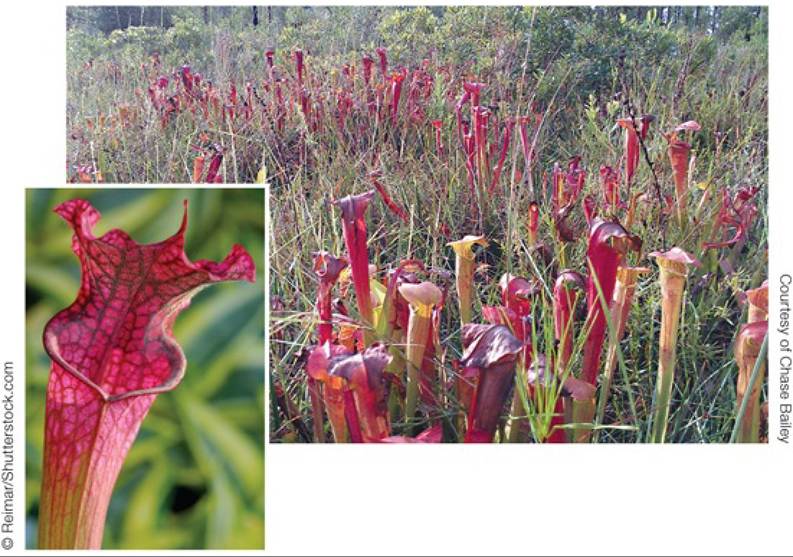
FIGURE 14.20 CoexistenceinaNutrient-PoorEnvironment Thepitcherplant Sarracenia alata, seen in the close-up at the left, coexists with noncarnivorous plants that can compete with it for both nutrients and light. View larger image
The concept of resource partitioning suggests that a number of species could coexist in nutrient-poor environments if they avoided competition for scarce nutrients by acquiring them in different ways. This idea helped to motivate Brewer's study: he wanted to know whether differences in their means of nutrient acquisition could explain the coexistence of carnivorous and noncarnivorous plants. To find out, Brewer (2003) deprived carnivorous plants of their unique source of nutrients (animal prey), thus increasing the overlap between the ways in which carnivorous and noncarnivorous plants acquired nutrients.
If competition for nutrients was important, pitcher plants that were deprived of prey should have experienced more severe competitive effects, or they should have compensated for reduced nutrient intake by increasing their production of roots or pitchers. Neither of these outcomes occurred, so Brewer sought other explanations of species coexistence.As we'll see in Concept 19.3, environmental variation provides a second mechanism for the coexistence of species in communities: if environmental conditions fluctuate over space or time (or both), species may coexist if different species are superior competitors under different environmental conditions. Tansley's bedstraw example (given in the Introduction) illustrates how differences in soils can alter the outcome of competition, thus promoting coexistence in environments that vary over space. With respect to variation over time, an inferior competitor may persist whenever competition fails to run its course. Consider a species such as the sea palm (see Figure 14.19), which competes poorly but tolerates disturbance well. Such a species may persist if a disturbance periodically “resets the clock” by decreasing the abundance of a superior competitor before that species drives the inferior competitor to extinction. Such a scenario may also apply to the pitcher plant Sarracenia The habitat in which it lives is prone to fire; pitcher plants tolerate fire well, and they use changes in light levels as a cue for growth. As a result, Sarracenia grows primarily when its competitors are reduced by fire. This growth strategy may allow it to escape competition for nutrients by reducing its demand for scarce nutrients when competition is potentially most intense (i.e., in years without fire) and increasing its demand for nutrients when competitors have been reduced (years with fire).