Changes in species interactions
When two individual organisms interact with each other, the outcome of that interaction depends on many features of their biology. An individual predator that is young and healthy may be able to catch its prey—even though the prey organism literally “runs for its life”—whereas a predator that is old or sick may go hungry.
Similarly, an individual that is in good condition may be able to compete effectively with others for resources, while an individual in poor condition may not.Because they can affect host performance, parasites can affect the outcome of interactions between their hosts and other species. Thomas Park conducted a series of experiments on factors that influenced the outcome of competition between flour beetle species. In one of those experiments, Park (1948) examined how the protist parasite Adelina tribolii affected the outcome of competition experiments using two species of flour beetles, Tribolium castaneum and T. confusum. In the absence of the parasite, T. castaneum usually outcompeted T. confusum, driving it to extinction in 12 of 18 cases (FIGURE 13.18). The reverse was true when the parasite was present: T. confusum outcompeted T. castaneum in 11 of 15 cases. The outcome of competition was reversed because the parasite had a large negative effect on T. castaneum individuals, but virtually no effect on T. confusum. Parasites can also affect the outcome of competition in the field, as when the malaria parasite Plasmodium azurophilum reduced the competitive superiority of the lizard Anolis gingivinus over its smaller counterpart, A. wattsi (Schall 1992). Finally, parasites can alter the outcome of predator-prey interactions: by decreasing the physical condition of infected individuals, parasites may make predators less able to catch their prey, or prey less able to escape predation.
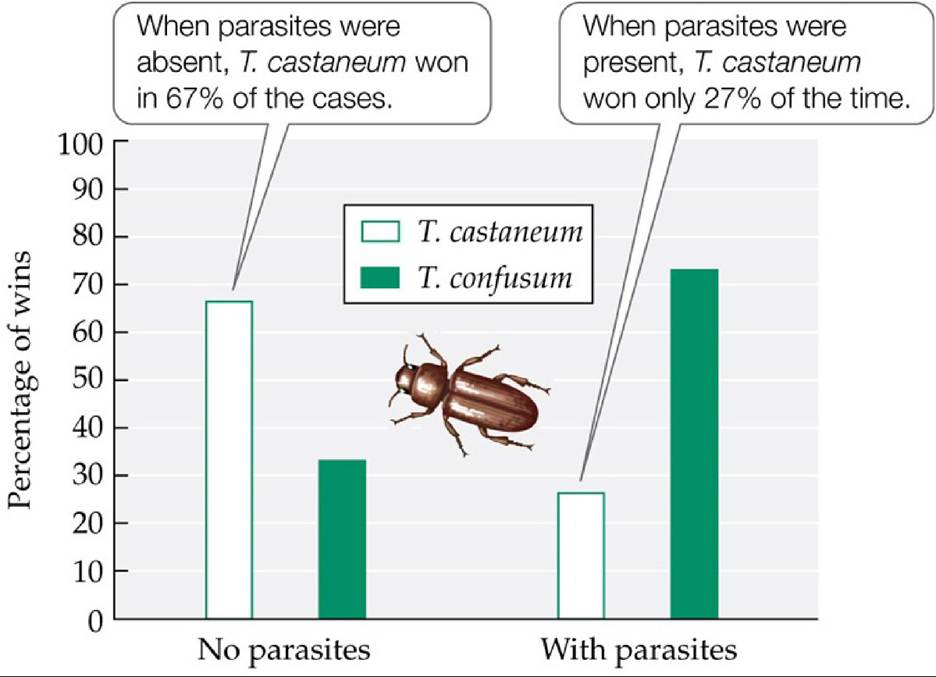
FIGURE 13.18 Parasites Can Alter the Outcome of Competition ThomasPark performed competition experiments using populations of the flour beetles Tribolium castaneum and T.
confusum that were or were not infected with a protist parasite. (After T. Park. 1948. Ecol Monogr 18: 267-307.) View larger imageIn the examples described in the previous paragraph, parasites affected the outcome of species interactions by altering the physical condition of their host. Parasites can also alter the outcome of species interactions by changing host behavior. For example, when infected by a parasite, the host may behave in an unusual manner that makes it more vulnerable to predation. There are numerous examples of this phenomenon, including protist parasites making rats less wary of cats, as described in the Case Study. Some worm parasites cause amphipods to move from sheltered areas to areas of relatively bright light, where the amphipods are more likely to be seen and eaten by fish or bird predators. In both of these cases, the parasite induces a change in host behavior that makes the host more likely to be eaten by a species that the parasite requires to complete its life cycle.
More on the topic Changes in species interactions:
- Indirect species interactions can have large effects
- SUMMARY
- Changes in community structure
- Local and regional processes interact to determine local species diversity
- Ecologists may use subsets of species to define communities
- Answers to Analyzing Data 24.1 Questions
- Some species reproduce only once, while others reproduce multiple times
- Brief Contents
- Abrams Peter A.. Competition Theory in Ecology. Oxford University Press,2022. — 336 p., 2022