Local and regional processes interact to determine local species diversity
Figure 18.5 shows that patterns of species diversity, and the processes that control them, are interconnected across spatial scales. Given these interconnections, ecologists are interested in knowing just how much variation in species diversity at the local scale is dependent on larger spatial scales.
The regional species pool provides the raw material for local species assemblages and sets the theoretical upper limit on species richness for communities in the region. But is local species richness also determined by local conditions, including species interactions and the physical environment?One way we can consider this question quantitatively is by plotting the local species richness for a community against the regional species richness for that community (FIGURE 18.6). Three basic types of relationships can be seen in such plots. First, if local species richness and regional species richness are equal (slope = 1), then all the species within a region will be found in the communities of that region. Although this pattern is theoretically possible, we would not expect to find it in the real world, for the simple reason that all regions have varying landscape and habitat features that exclude some species from some communities (e.g., lowland tree species will not be found in alpine forests). Second, if local species richness is simply proportional to regional species richness (i.e., local species richness increases with increasing regional species richness, but the relationship is not 1:1), then we can assume that local species richness is largely determined by the regional species pool, with local processes such as species interactions and physical conditions playing a more minor role.
Finally, if local species richness levels off despite an increasing regional species pool, then local processes can be assumed to limit local species richness.
The degree to which local richness levels off can tell us something about how important species interactions and physical conditions are in setting a saturation point—a limit on species richness—for communities.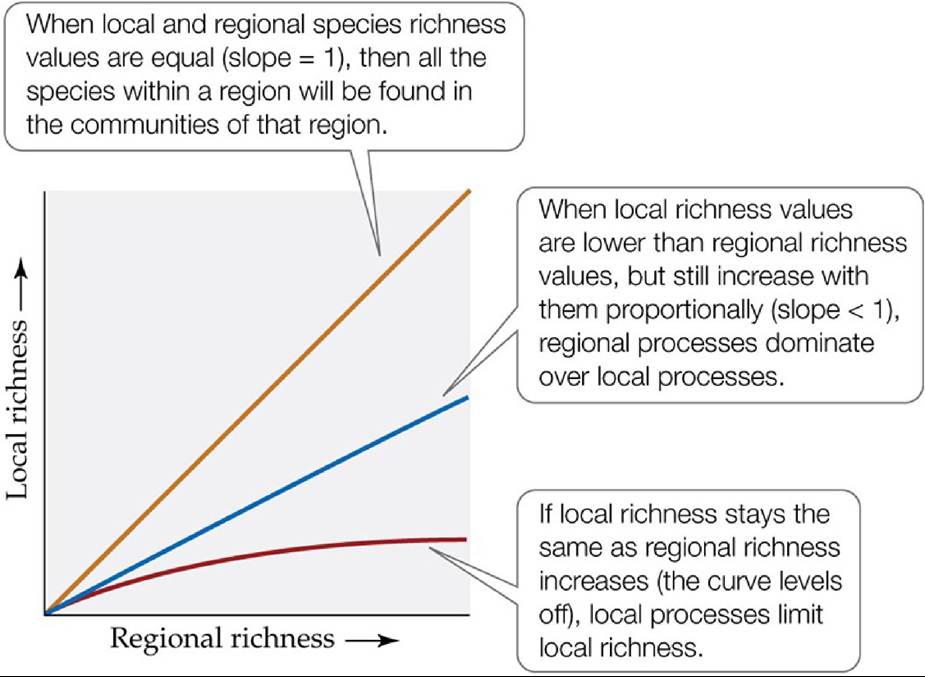
FIGURE 18.6 What Determines Local Species Richness? The relative influences of local and regional processes in a community can be determined by plotting local species richness against regional species richness.
Would you ever have a local to regional species richness relationship that had a slope of more than 1? Why or why not?
(After H. V. Cornell and J. H. Lawton. 1992. JAnimEcol 61: 1-12.) View larger image
Let's move away from these theoretical constructs and look at what real data show us about the relationship between local and regional species richness. Witman and colleagues (2004) considered this relationship for marine invertebrate communities living on subtidal rock walls at a variety of locations throughout the world (FIGURE 18.7A). At 49 local sites in 12 regions, they surveyed species richness in 0.25-m2 plots on rock walls at a 10-15 m (33-50 feet) water depth. They then compared the local species richness values they found at the sites with regional species richness values from published lists of invertebrate species capable of living on hard substrates at similar depths. A plot of local versus regional species richness at all the sites (FIGURE 18.7B) showed that local species richness was always proportionally lower than regional species richness. Furthermore, local species richness never leveled off—that is, the communities never became saturated—at high regional richness values. Instead, regional species richness explained approximately 75% of the variation in local species richness. The results of this study suggest that regional species pools largely determine the number of species present in these marine invertebrate communities.
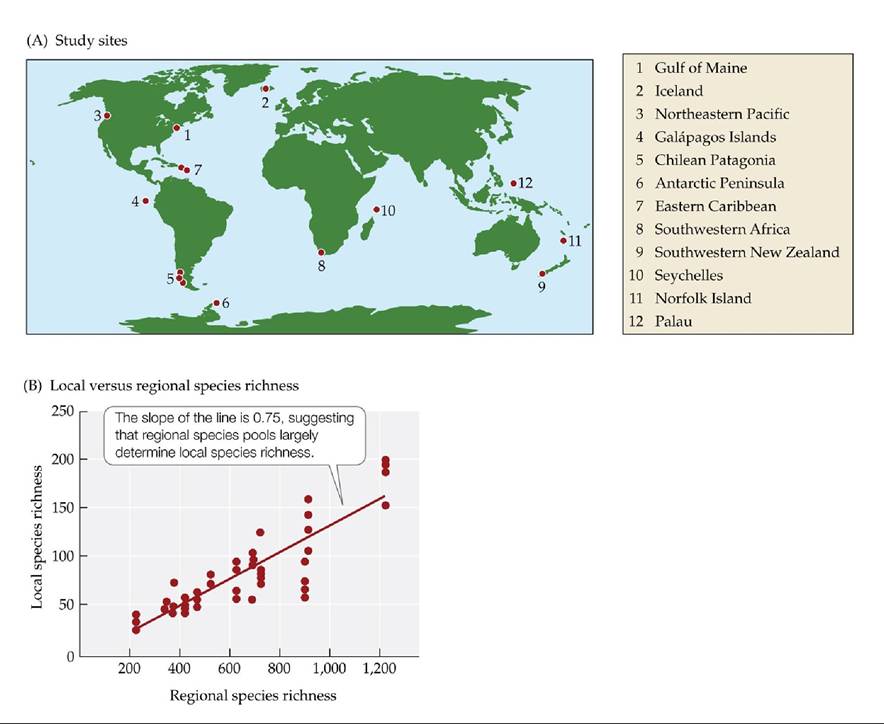
FIGURE 18.7 Marine Invertebrate Communities May Be Limited by Regional
Processes Among shallow subtidal marine invertebrate communities, regional species richness explains approximately 75% of the local species richness. (A) The 12 regions of the world where the 49 sampling sites were located. (B) A plot of local species richness against regional species richness. Each dot represents one of the 49 sampling sites. (After J. D. Witman et al. 2004. Proc Natl Acad Sci USA 101: 15664-15669. © National Academy of Sciences, U.S.A.) View larger image
Does the lack of saturation detected in this study and others indicate that local processes are unimportant in determining local species richness? The answer is no, for at least two reasons. First, there was still considerable unexplained variation among local communities within regions, which could be attributable to the effects of local processes such as species interactions, abiotic conditions, or dispersal limitation (see Figure 19.4). Second, the effects of species interactions, in particular, are likely to be highly sensitive to the local spatial scale chosen. Although the small spatial scale of Witman and colleagues' study is probably appropriate for species interacting on subtidal rock walls, other studies have used inappropriate (usually too large) spatial scales that were unlikely to detect local effects. Nevertheless, the strong influence of regional-scale processes on local species richness suggests that both marine and terrestrial communities are likely to be much more susceptible to changes such as species invasions from outside their regions than previously thought.
In the remainder of this chapter, we will explore the factors controlling variation in species diversity at global and regional biogeographic scales. Chapter 19 will delve in more detail into the causes and consequences of species diversity differences at the local scale.
More on the topic Local and regional processes interact to determine local species diversity:
- CONCEPT 18.1 Patterns of species diversity and distribution vary at global, regional, and local spatial scales.
- CONCEPT 18.3 Regional differences in species diversity are influenced by area and distance, which determine the balance between immigration and extinction rates.
- 5 Enabling Factors for Local Economic Development: Local and Regional Development Agencies
- CONCEPT 19.1 Species diversity differs among communities as a consequence of regional species pools, abiotic conditions, and species interactions.
- Space and Scale between the Local, Regional and Global
- LEDAs' enabling processes for local economic development
- ATTITUDES TOWARD MUSLIM DIVERSITY AND LOCAL NORMS
- CONCEPT 19.3 Processes such as disturbance, stress, predation, and positive interactions can mediate resource availability, thus promoting species diversity.
- In the Case Study at the opening of this chapter, we saw lower hantavirus prevalence in small-mammal communities with higher species diversity than in those with lower species diversity (see Figure 19.2).
- A population is a group of individuals of the same species that live in the same area at the same time and interact with one another.
- CONCEPT 16.2 Species diversity and species composition are important descriptors of community structure.
- Central-local relations
- Local Power Holders
- Local self-government in constitutional law