Patterns of species diversity at different spatial scales are interconnected
On our world forest tour, we saw that patterns of species diversity and composition varied at global, regional, and local spatial scales. We can think of these spatial scales as interconnected in a hierarchical way, with patterns of species diversity and composition at one spatial scale setting the conditions for patterns at smaller spatial scales (Whittaker et al.
2001). Let's start with the largest spatial scale and work downward.The global scale, as the term suggests, includes the entire world, a huge geographic area over which there are major variations with changes in latitude and longitude (FIGURE 18.5A). Species have been isolated from one another, often on different continents or in different oceans, by long distances and over long time periods. Differences in the rates of three processes—speciation, extinction, and dispersal—help determine differences in species diversity and composition at the global scale. We will consider these processes in more detail in the following section.
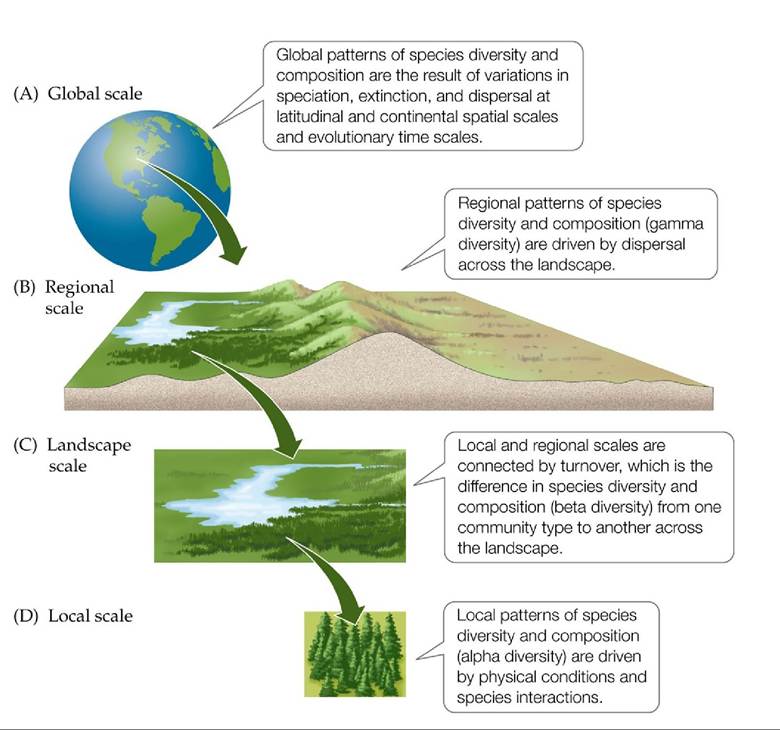
FIGURE 18.5 Interconnected Spatial Scales of Species Diversity The arrows represent the relationships between, and processes important to, species diversity and composition at (A) global, (B) regional, (C) landscape, and (D) local scales. View larger image
The regional scale encompasses smaller geographic areas in which the climate is roughly uniform and to which species are restricted by dispersal limitation (see Concept 9.3). The regional species pool, sometimes called the gamma diversity of the region, encompasses all the species contained within a region (FIGURE 18.5B). Earth's regions differ in species diversity and composition because of differences in the rates of speciation, extinction, and dispersal at the global scale, as mentioned above.
The Amazon, for example, has many more species, and thus a larger species pool, than the Canadian boreal forest.The physical geography of a region, such as the number, area, and distance from one another of mountains, valleys, deserts, islands, and lakes—referred to collectively as the landscape—is critical to within-region biogeography. Species diversity and composition vary within a region depending on how the landscape shapes the rate of extinction in, and the rates of immigration to and emigration from, local habitats (FIGURE 18.5C). Ecologists consider within-region biogeography in two related ways:
• The local scale, which is essentially equivalent to a community, reflects the suitability of the abiotic and biotic characteristics of habitats for species from the regional species pool once they reach those habitats through dispersal (FIGURE 18.5D). Species physiology and interactions with other species both influence species diversity at the local scale (sometimes called alpha diversity).
• The connection between local and regional scales of species diversity is expressed by a measurement known as beta diversity. Beta diversity tells us the change in species diversity and composition, or turnover of species, as one moves from one community type to another across the landscape (see Figure 18.5C).
Knowing how spatial scales are related to one another in a hierarchical way is important, but are there actual area values one could apply to local and regional spatial scales? For example, how much area does a region or locality encompass? The answer is highly dependent on the species and communities of interest. For example, Shmida and Wilson (1985) suggest that terrestrial plants might have a local scale of 102-104 m2 and a regional scale of 106-108 m2. But for bacteria, the local scale might be something more like 102 cm2. As we will see, the actual area we use to define species diversity measurements can be critical to our interpretation of the processes controlling biogeographic patterns.
More on the topic Patterns of species diversity at different spatial scales are interconnected:
- CONCEPT 18.1 Patterns of species diversity and distribution vary at global, regional, and local spatial scales.
- The distribution and abundance patterns of species and populations vary in their spatial extent across the landscape.
- One of the most obvious ecological patterns on Earth is the variation in species composition and diversity among geographic locations.
- In the Case Study at the opening of this chapter, we saw lower hantavirus prevalence in small-mammal communities with higher species diversity than in those with lower species diversity (see Figure 19.2).
- CONCEPT 18.2 Global patterns of species diversity and composition are influenced by geographic area and isolation, evolutionary history, and global climate.
- CONCEPT 19.1 Species diversity differs among communities as a consequence of regional species pools, abiotic conditions, and species interactions.
- CONCEPT 17.1 Agents of change act on communities across all temporal and spatial scales.
- CONCEPT 16.2 Species diversity and species composition are important descriptors of community structure.
- Species diversity varies with latitude
- Local and regional processes interact to determine local species diversity
- CONCEPT 24.1 Landscape ecology examines spatial patterns and their relationship to ecological processes.