The distribution and abundance patterns of species and populations vary in their spatial extent across the landscape.
An example of this variability is the distribution map for the herbaceous perennial Clematis fremontii (FIGURE 9.5A). Clematis has a patchy distribution across Missouri, Kansas, and Nebraska, where its populations are restricted to dry, rocky, treeless meadows or glades formed on particular limestone outcrops within the region.
Populations, such as those of Clematis, rarely occur in isolation from one another and are usually connected through dispersal. Dispersal is simply the movement of individuals into (immigration) or out of (emigration) an existing population. A group of geographically isolated populations linked together by dispersal is known as a metapopulation. For example, a cluster of meadows might be considered a metapopulation if Clematis seeds from one meadow had the potential to disperse to another meadow. In Concept 9.4, we will discuss metapopulations in more detail. At larger spatial scales, the entire geographic range, or distribution, of a species might consist of one or multiple metapopulations, depending on the extent of the area occupied by a species.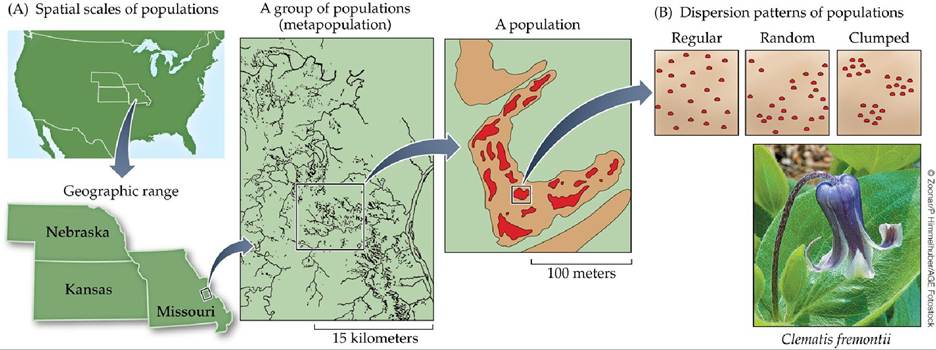
FIGURE 9.5 Many Populations Have a Patchy Distribution Thedistributionand abundance of the herbaceous perennial Clematis fremontii are patchy over different spatial scales. (A) Populations occur within limestone meadows. A group of populations makes up a metapopulation, and multiple metapopulations make up the geographic range (in this case, Missouri, Kansas, and Nebraska). (B) Individuals within a population show one of three different dispersion patterns. (A after R. O. Erickson. 1945. Ann Mo Bot Gard 32: 413-460.) View larger image
The aggregates of C. fremontii individuals found in the meadow populations provide an example of the dispersion, or spatial arrangement, of individuals within a population (FIGURE 9.5B). We can recognize three basic patterns in how the individuals of a population are positioned with respect to one another (see Figure 9.5A). In some cases, the members of a population have a regular dispersion, in which individuals are relatively evenly spaced throughout their habitat. In other cases, individuals show a random dispersion, similar to what occurs if individuals are positioned at locations selected at random. Finally, as in C. fremontii, individuals may be grouped together to form a clumped dispersion. In natural populations, clumped dispersions are more common than either regular or random dispersions. It is important to note that identifying dispersion patterns can depend on the spatial scale of the measured area. For example, clumped dispersion patterns might not be revealed except at large spatial scales.
More on the topic The distribution and abundance patterns of species and populations vary in their spatial extent across the landscape.:
- CONCEPT 18.1 Patterns of species diversity and distribution vary at global, regional, and local spatial scales.
- CONCEPT 9.2 Species vary in their distribution and abundance across their geographic range.
- Distribution and Abundance Patterns
- Patterns of species diversity at different spatial scales are interconnected
- CONCEPT 24.1 Landscape ecology examines spatial patterns and their relationship to ecological processes.
- CONCEPT 9.3 Species are limited in their distribution and abundance by habitat suitability, historical factors, and dispersal.
- CONCEPT 7.1 Life history patterns vary within and among species.
- CONCEPT 9.1 Populations are groups of individuals of the same species that vary in size over space and time.
- Habitat suitability determines distribution and abundance
- Agents of change vary in their intensity, frequency, and extent
- Species distribution models can be used to predict a species' geographic range
- The geographic ranges of species vary in patchiness
- 9 Population Distribution and Abundance