The geographic ranges of species vary in patchiness
Even within the geographic range of a species, much of the habitat is not suitable for the species. As a result, populations tend to have a patchy distribution. This observation holds at both large and small spatial scales.
On land, for example, at the largest spatial scales, climate constrains where populations of a species are located (see Concept 3.1). At smaller spatial scales, factors such as topography, soil type, and the presence or absence of other species prevent populations from being spread evenly across the landscape.As we saw with the C. fremontii example (see Figure 9.5), some species require a very particular habitat that is found only in portions of its geographic range; hence its populations have a highly patchy distribution. Other species tolerate a broader range of habitats, but their abundances still vary throughout their geographic range. The distribution of red kangaroos (Macropus rufus) in arid regions of Australia illustrates this point. The abundance of red kangaroos varies throughout their geographic range, which includes several regions of high density and several areas where red kangaroos are not found (FIGURE 9.6).
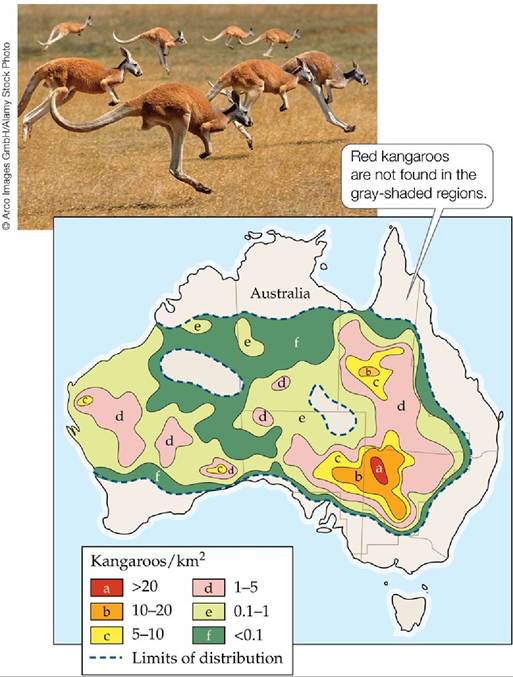
FIGURE 9.6 Abundance Varies throughout the Geographic Range of a Species The map shows abundances of the red kangaroo (Macropus rufus) throughout its range in Australia. These data were based on aerial surveys conducted from 1980 to 1982. (After G. Caughley et al. 1987. Kangaroos: Their Ecology and Management in the Sheep Rangelands of Australia. Cambridge University Press: Cambridge.) View larger image
Finally, it is important to recognize that a population may exist in a series of habitat patches or fragments that are spatially isolated from one another but are linked by dispersal. Such a “patchy” population structure can result from features of the abiotic environment, as we saw with Clematis, but can also result from human actions.
For example, the low-lying shrub-covered heathlands of England once covered large, continuous areas, but over the past 200 years the development of farms and urban areas has greatly reduced the extent of heath plant species (FIGURE 9.7). In some cases, this fragmentation results in patches that are so isolated that little dispersal can occur among them, thus breaking a single large population into a series of much smaller populations. In Concept 9.4, we will explore the occurrence and consequences of patchy population structures (metapopulations) in more detail.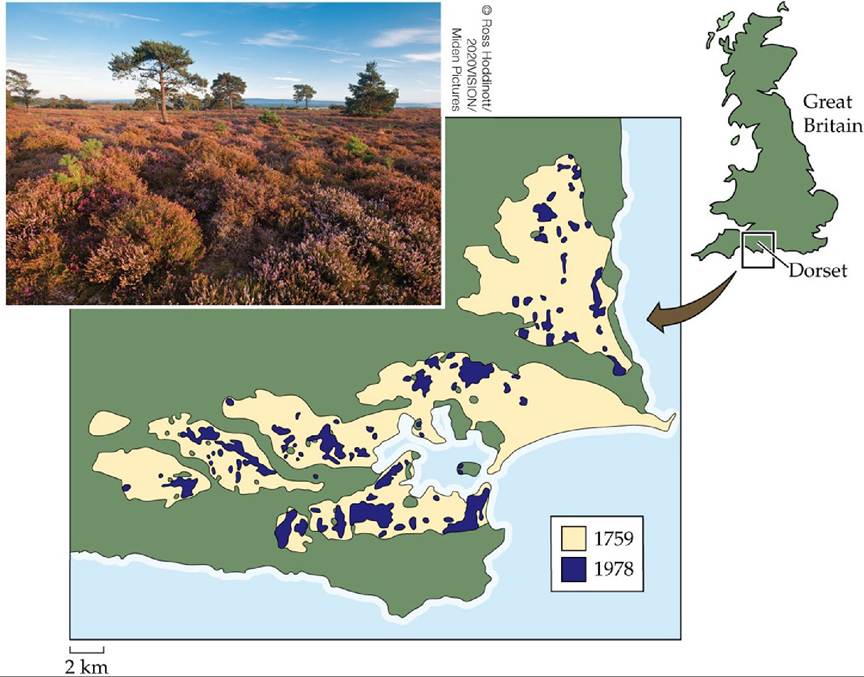
FIGURE 9.7 Fragmentation of Dorset Heathlands The low-lying shrub-covered heathlands of Dorset, England, reached their maximum extent in Roman times, 2,000 years before the present. From 1759 to 1978, the decline of this habitat type accelerated: the total area of heathlands shrank from 400 km2 to less than 60 km2, and the number of patches increased greatly.
How many patches of heathland were present in 1759? In 1978? Use your answers to estimate the average patch size in 1759 and 1978.
(After N. R. Webb and L. E. Haskins. 1980. Biol Conserv 17: 281-296.) View larger image
More on the topic The geographic ranges of species vary in patchiness:
- The geographic ranges of species vary in size
- CONCEPT 9.2 Species vary in their distribution and abundance across their geographic range.
- Species distribution models can be used to predict a species' geographic range
- One of the most obvious ecological patterns on Earth is the variation in species composition and diversity among geographic locations.
- Species interactions vary greatly in strength and direction
- Species diversity estimates vary with sampling effort and scale
- CONCEPT 4.1 Each species has a range of environmental tolerances that determines its potential geographic distribution.
- CONCEPT 7.1 Life history patterns vary within and among species.
- The distribution and abundance patterns of species and populations vary in their spatial extent across the landscape.
- CONCEPT 9.1 Populations are groups of individuals of the same species that vary in size over space and time.
- CONCEPT 14.1 Competition can be direct or indirect, vary in its intensity, and occur between similar or dissimilar species.
- CONCEPT 18.1 Patterns of species diversity and distribution vary at global, regional, and local spatial scales.
- CONCEPT 18.2 Global patterns of species diversity and composition are influenced by geographic area and isolation, evolutionary history, and global climate.
- CONCEPT 19.1 Species diversity differs among communities as a consequence of regional species pools, abiotic conditions, and species interactions.
- CONCEPT 13.1 Parasites typically feed on only one or a few host species, but host species have multiple parasite species.
- Invasive species can displace native species and alter ecosystem properties
- Where should we put our focus in preventing species loss—on the species or the habitat?
- The outcome of competition between species can be changed by a broad suite of factors, including features of the physical environment, disturbance, and interactions with other species.
- We have seen in previous chapters that disturbance, stress, and predation can modify species interactions and allow for species coexistence.
- Reference ranges for haematology and serum chemistry values for adult cats and dogs