Species interactions vary greatly in strength and direction
It should be clear by now that species interactions in a community vary greatly in their strength and direction. Some species have a strong negative or positive effect on the community, while others probably have little or no effect.
Interaction strength, the effect of one species on the abundance of another species, can be measured experimentally by removing individuals of one species (referred to as the interactor species) from the community and looking at the effect on individuals of the other species (the target species, as described in Ecologicaltoolkit 16.1). if the removal of individuals of the interactor species results in a large decrease in individuals of the target species, we know that the interaction is strong and positive. However, if the abundance of the target species increases significantly after removal, we know that the interactor species has a strong negative effect on the target species.ECOLOGICAL TOOLKIT 16.1
Measurements of Interaction Strength
We can measure interaction strength by experimentally manipulating species interactions. The usual procedure involves the removal (or sometimes the addition) of individuals of one species involved in the interaction (the interactor species) and measurement of the response of the individuals of the other species (the target species). There are multiple ways to calculate interaction strength, but one simple way is to calculate the relative interaction intensity (RII) (Armas et al. 2004) using the following equation:
Relative interaction intensity = (C — E) / (C + E) where
C = the number or biomass of target individuals in the presence
of the interactor
E = the number or biomass of target individuals in the absence of the interactor
Interaction strength can vary depending on the environmental context in which the interaction is measured. For example, Menge et al.
(1996) measured the interaction strength of sea star (Pisaster ochraceus) predation on mussels (Mytilus trossulus) in wave- exposed versus wave-protected areas of the coastline at Strawberry Hill on the coast of Oregon (see FIGURE). Sea stars were excluded from some mussel beds by cages in both exposed and protected areas. At the end of the experiment, the numbers of mussels in the cages (E) were compared with the numbers of mussels in control plots (C) that had been exposed to sea star predation (see Figure). The results (see Figure) showed that interaction strength was greater in wave-protected than in wave-exposed areas. Sea stars probably cannot feed as efficiently when subjected to the crashing waves characteristic of wave-exposed areas. Thus, this study demonstrates the importance of environmental context (in this case, wave exposure) to the strength of species interactions. It also shows how those interactions can change over relatively small spatial scales (e.g., between wave-exposed and wave-protected areas of the Strawberry Hill rocky shore).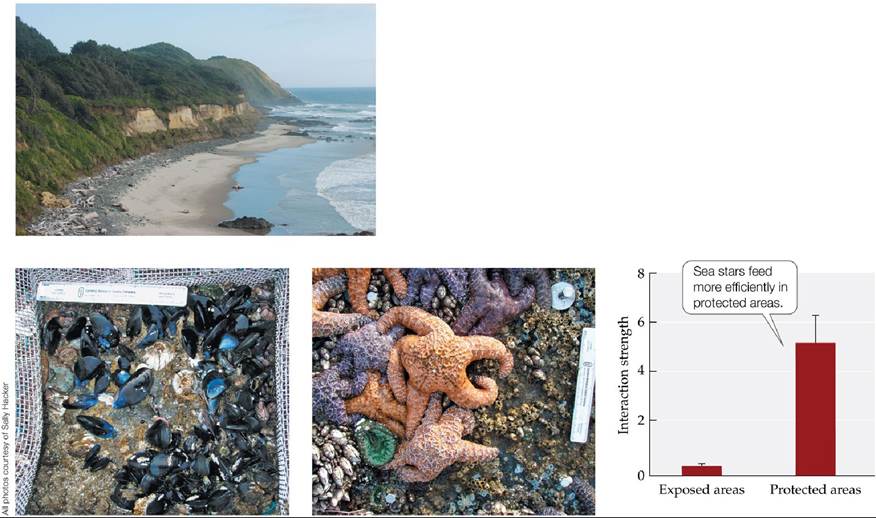
How Much Does Predation by Sea Stars Matter? It Depends (Top left) The coastline at Strawberry Hill, Oregon. Plots with (bottom left) and without (middle) cages that excluded sea stars were set up in both wave-exposed and wave-protected areas along the rocky shore. (Bottom right) When mussels were counted and interaction strengths calculated, the results showed that interaction strength was greater in protected than in exposed areas. Error bars show one standard error of the mean. (Graph after B. A. Menge et al. 1996. Food Webs: Integration of Patterns and Dynamics, G. A. Polis and K. O. Winemiller [Eds.], pp. 258-274. Chapman & Hall: New York.) View larger image
The interaction strength “dynamic” (i.e., the relative proportion of strong to weak interactions or positive to negative interactions) is not well understood for any community, because of the numbers of species involved and the many indirect interactions that emerge.
As you will see throughout Unit 5, however, we can get an idea of the importance of species to communities through both observations and experiments.There are some large or abundant species, such as trees, that are likely to have large community-wide effects by virtue of providing habitat or food for other
species. They may also be good competitors for space, nutrients, or light. These species, known as foundation species (Dayton 1971), have large effects on other species, and thus on the species diversity of communities, by virtue of their considerable size and abundance (FIGURE 16.16).
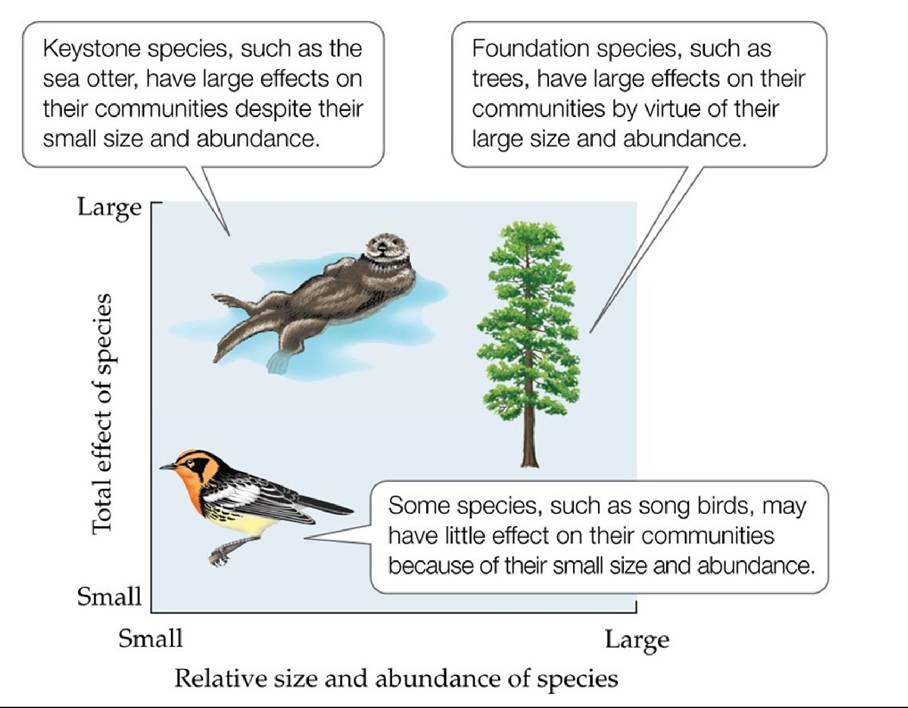
FIGURE 16.16 Foundation versus Keystone Species Species that have large effects on their communities may or may not do so by virtue of their large size and abundance. Some species (lower left-hand corner) have little overall effect relative to their size and abundance, especially if they are redundant in the community. (After M. E. Power et al. 1996b. BioScience 46: 609-620.) View larger image
Some foundation species act by “bioengineering” their environment. These species, known as ecosystem engineers (Jones et al. 1994), are able to create, modify, or maintain physical habitat for themselves and other species. Consider the simple example of the trees mentioned above. Just like any other species, trees provide food for other organisms and compete for resources. However, trees also engineer their environment in subtle but important ways (FIGURE 16.17). The trunk, branches, and leaves of a tree provide habitat for a multitude of species, from birds to insects to lichens. The physical structure of the tree reduces sunlight, wind, and rainfall, influencing temperature and moisture levels in the forest. The roots of the tree can increase weathering and aeration of the soil, and they can stabilize surrounding substrates. The tree's leaves fall to the forest floor, where they add moisture and nutrients to the soil and provide habitat for soil-dwelling invertebrates, seeds, and microorganisms.
If the tree falls, it can become a “nurse log,” providing space, nutrients, and moisture for tree seedlings. Thus, trees can have a large physical influence on the structure of a forest community, which obviously changes over time as trees grow, mature, and die.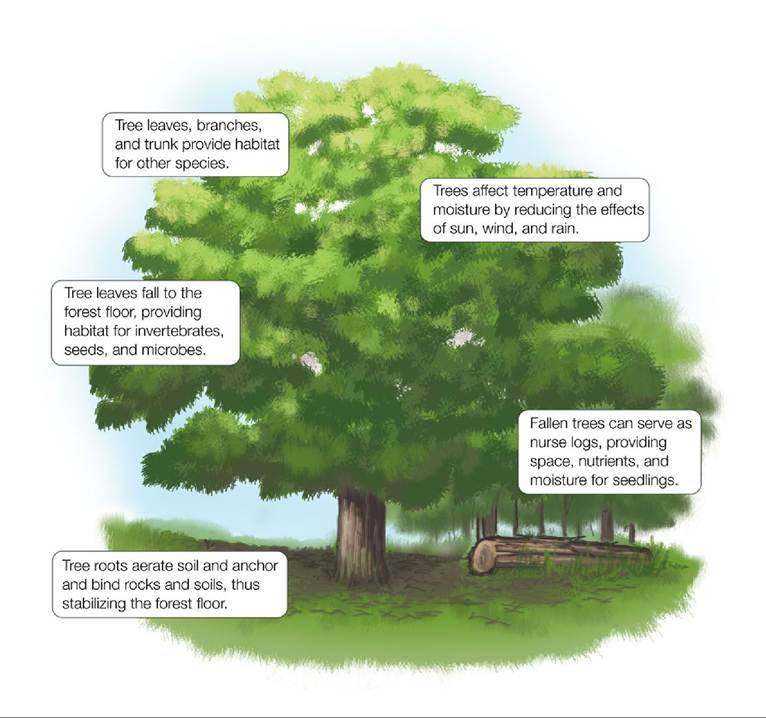
FIGURE 16.17 Trees Are Foundation and Ecosystem Engineering Species Treesnot only provide food for and compete with other species, but also act as ecosystem engineers by creating, modifying, or maintaining physical habitat for themselves and other species. (After C. G. Jones et al. 1997. Ecology 78: 1946-1957.) View larger image
Other strong interactors, so-called keystone species, have large effects not because of their abundance, but because of the vital roles they play in their communities. They differ from foundation species in that their effect is large in proportion to their size and abundance (see Figure 16.16). Keystone species usually influence community structure indirectly, via trophic means, as we saw in the case of sea otters (see Figure 16.12A and Chapter 9). Sea otters are considered keystone species because, by preying on sea urchins, they indirectly enhance the presence of kelp, which provides important habitat for many other species. We will consider the role of keystone species in more detail in Chapter
21 and the Case Study Revisited in Chapter 24.
There are also keystone species that act as ecosystem engineers. A great example is the beaver, a species in which just a few individuals can have dramatic effects on the landscape. Beavers dam streams with cut trees and woody debris. Very quickly, flooding ensues and sediment accumulates as the increasing number of woody obstacles slows the water flow. Eventually, the once swiftly flowing stream is replaced by a wetland, containing plants that can deal with flood conditions; plants that cannot do so, such as trees, are lost from the community.
At the landscape level, by creating a mosaic of wetlands within a larger forested community, beavers can increase regional species diversity significantly (FIGURE 16.18). Naiman et al. (1988) showed that there was a 13-fold increase in wetland area in one region of Minnesota (from roughly 200 to 2,600 ha) when beavers were allowed to recolonize areas where they had been hunted nearly to extinction some 60 years previously.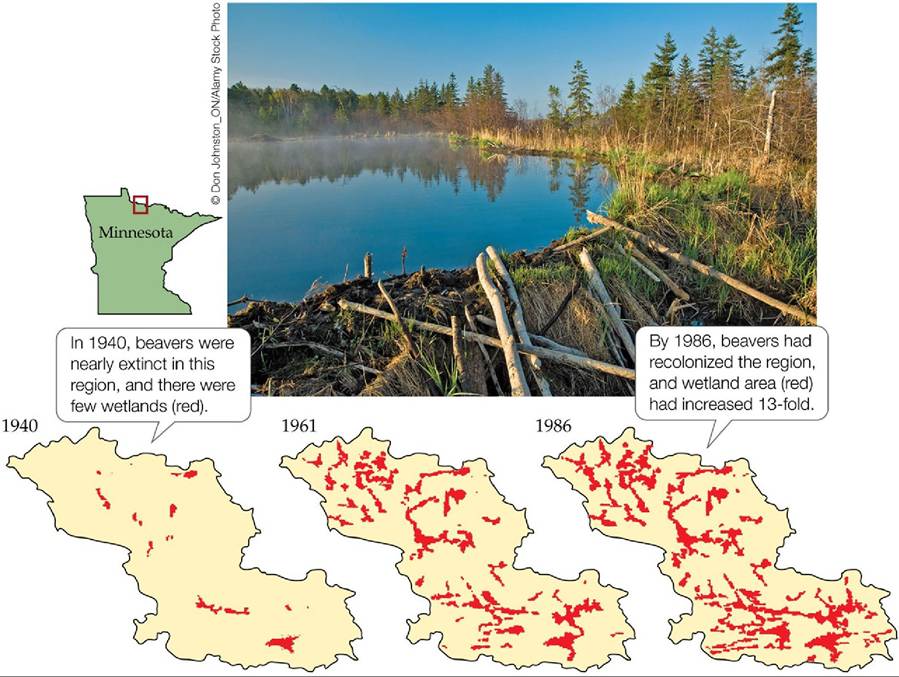
FIGURE 16.18 Beavers Are Keystone Species and Ecosystem Engineers Bydamming streams, beavers created networks of different types of wetlands (shown in red) in a 45-km2 watershed on Minnesota’s Kabetogama Peninsula, thus increasing biodiversity within the region.
Why are beavers both keystone species and ecosystem engineers?
(After R. J. Naiman et al. 1988. BioScience 38: 753-762.) View larger image
Finally, it is worth mentioning that there are species that play only a small role in a community's structure and function. Rather than being keystone species or ecosystem engineers, these species are more like bit players: they contribute to the overall diversity of the community, but their presence or absence has little significance for the ultimate regulation of the community (see Figure 16.16). Some of these species may be redundant—that is, they may have the same function in the community as other species within a larger functional group (see Figure 16.4C). Their loss from a community might have little effect as long as other species within the same functional group remain present. We will discuss the role of species in community regulation in more detail in Chapter 19.
More on the topic Species interactions vary greatly in strength and direction:
- CONCEPT 16.3 Communities can be characterized by complex networks of direct and indirect interactions that vary in strength and direction.
- Environmental temperatures vary greatly throughout the biosphere, as we saw in Chapter 2.
- CONCEPT 19.1 Species diversity differs among communities as a consequence of regional species pools, abiotic conditions, and species interactions.
- The outcome of competition between species can be changed by a broad suite of factors, including features of the physical environment, disturbance, and interactions with other species.
- The strength of competitive interactions affects coexistence
- We have seen in previous chapters that disturbance, stress, and predation can modify species interactions and allow for species coexistence.
- CONCEPT 15.1 In positive interactions, no species is harmed, and the benefits are greater than the costs for at least one species.
- Environmental context can change the outcome of species interactions
- The geographic ranges of species vary in size
- The geographic ranges of species vary in patchiness
- The way we think about species interactions changes dramatically when we consider that they are embedded in a community of multiple interactors.
- Changes in species interactions
- Medical conditions associated with TBI can vary greatly from individual to individual. Essentially, all organ systems can be affected when a child sustains a TBI.