The strength of competitive interactions affects coexistence
Now that we've seen the four possible outcomes predicted by the Lotka-Volterra competition model, let's focus on the single case in which competitive coexistence occurs. We can use Figure 14.14D to show that coexistence occurs when the values of α, β, K1, and K2 are such that the following inequality holds:
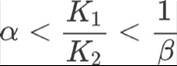
(14.4)
To see what we can learn from this inequality, consider a situation in which the competing species are equally strong competitors, indicating that α = β.
If the two species are also very similar in how they use resources, an individual of species 1 will have nearly the same effect on the growth rate of species 2 as would an individual of species 2 (and vice versa). Thus, when the two species use resources in very similar ways and thus strongly compete, α and β should both be close to 1.Suppose, for example, that α = β = 0.95. If we substitute these values for α and β into Equation 14.4, we obtain
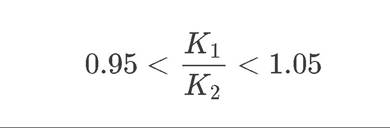
This result suggests that when species strongly compete, coexistence is predicted only when the two species also have similar carrying capacities.
In contrast, if the competing species do not compete strongly but rather differ greatly in how they use resources, α and β will be much lower than 1. To illustrate this case, suppose that α = β = 0.1. In this situation, coexistence is predicted even if the carrying capacity of one species is nearly 10 times that of the other species, namely
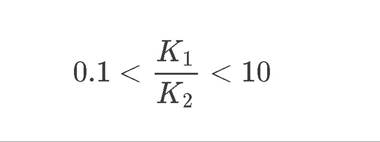
As you can demonstrate on your own, other values for the competition coefficients α and β yield similar results. Taken together, such analyses of the Lotka-Volterra competition model suggest the following refinement of the competitive exclusion principle: competing species are more likely to coexist (and hence competitive exclusion is less likely) when they do not compete strongly but rather use resources in different ways.
A variety of factors can influence how species divide their use of resources, thereby preventing one competitor from driving the other to extinction. As we'll see in the next section, some of these factors can alter the outcome of
competition entirely, turning the inferior competitor into the superior one.