Indirect species interactions can have large effects
Charles Darwin was one of the first to convey the importance of indirect interactions. In The Origin of Species (1859), Darwin set the scene by describing the role of bees in flower pollination, and hence in seed production, among native plants in the region of England where he lived.
In the book, he established the hypothesis that the number of bees is dependent on the number of field mice, which prey on the combs and nests of bees. Mice, in turn, are eaten by cats, leading Darwin to muse, “Hence it is quite credible that the presence of a feline animal in large numbers in a district might determine, through the intervention first of mice and then of bees, the frequency of certain flowers in that district!” (Darwin 1859, p. 59).It is only recently that the sheer number and variety of effects of indirect interactions have been documented (Menge 1995). In many cases, indirect effects are discovered almost by accident when species are experimentally removed to study the strength of a direct negative interaction such as predation or competition. A good example of this type of indirect effect comes in the form of an interaction web called a trophic cascade (FIGURE 16.12A). A trophic cascade occurs when the rate of consumption at one trophic level results in a change in species abundance or composition at lower trophic levels. For example, when a carnivore eats an herbivore (having a direct negative effect on the herbivore) and decreases its abundance, there may be an indirect positive effect on a primary producer that was eaten by that herbivore. One of the best- known examples is the indirect regulation of kelp forests by the sea otter (Enhydra lutris) through its direct interaction with sea urchins (Strongylocentrotus spp.) along the west coast of North America (see the Case Study Revisited in Chapter 9) (Simenstad et al. 1978). Two direct trophic interactions, those of sea otters feeding on sea urchins and sea urchins feeding on kelp, generate indirect positive effects, including that of sea otters on kelp (via their reduction of urchin abundance) and that of kelp on sea otters (via the food they provide for the urchins).
Furthermore, the kelp can positively affect the abundances of other seaweeds, which serve as habitat and food for many marine invertebrates and fishes. The indirect effects generated in this simple food web are just as important as the direct effects in determining whether the ecosystem will be a kelp forest or an urchin barren (see Figure 9.18). We will explore the effects of indirect interactions on species diversity (Chapter 19), food webs (Chapter 21), and ecosystem management (Chapter 24) in more detail later in the book.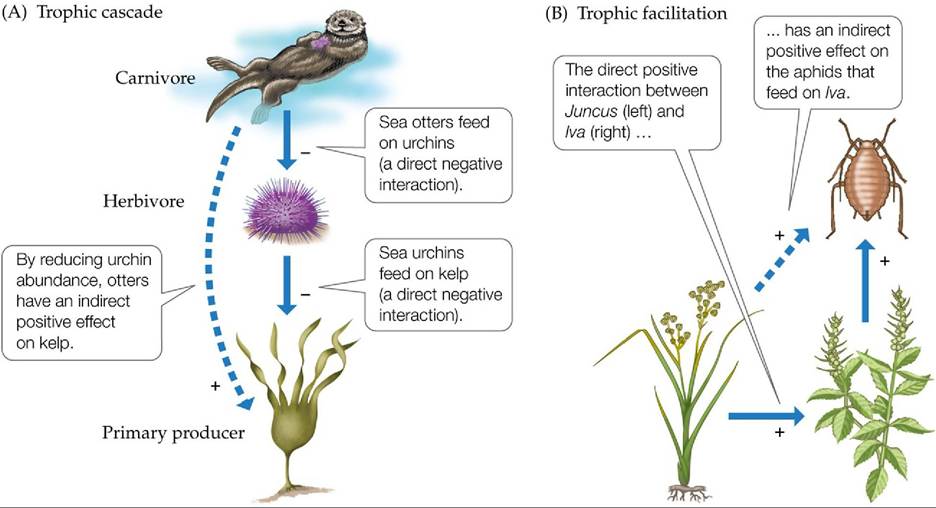
FIGURE 16.12 IndirectEffectsinInteractionWebs (A) A trophic cascade occurs when a carnivore feeds on an herbivore and thus has an indirect positive effect on a primary producer that is eaten by that herbivore. (B) Trophic facilitation occurs when a consumer is indirectly helped by a positive interaction between its prey and another species. View larger image
Indirect effects can also emerge from direct positive interactions called trophic facilitations. A trophic facilitation occurs when a consumer is indirectly helped by a positive interaction between its prey and another species (FIGURE 16.12B). An example of this type of indirect effect was demonstrated by Sally Hacker (Oregon State University) and Mark Bertness (Brown University), who studied salt marsh plant and insect interaction webs in New England. Their research showed that a commensal interaction between two salt marsh plants—a rush, Juncus gerardii, and a shrub, Iva frutescens—has important indirect effects on aphids feeding on Iva (Hacker and Bertness 1996).
To explore these findings in greater detail, let's first consider the commensal interaction between the two plant species. When Juncus was experimentally removed, the photosynthetic rate of Iva was lower (FIGURE 16.13A). In contrast, removing Iva had no effect on Juncus. In the absence of Juncus, soil salinity increased and oxygen content decreased considerably around Iva, suggesting that the presence of Juncus ameliorated harsh physical conditions for Iva.
Juncus, by shading the soil surface and thus decreasing water evaporation from the surface of the marsh, decreases salt buildup. Juncus also has specialized tissue called aerenchyma, through which oxygen can move into the belowground parts of the plant, thus keeping it from “drowning” during daily high tides. Some of the oxygen “leaks” out of the plant and can be used by other neighboring plants, such as Iva.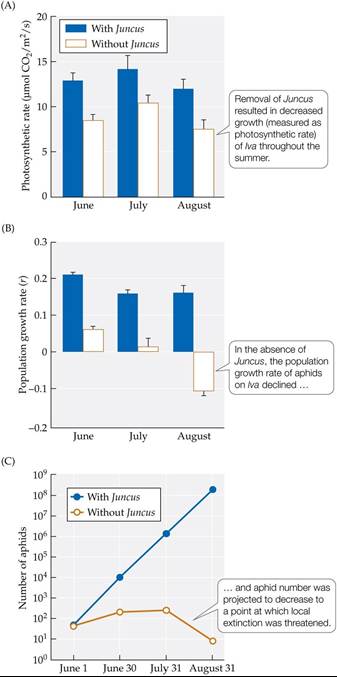
FIGURE 16.13 Results of Trophic Facilitation in a New England Salt Marsh Removal experiments demonstrated that aphids are indirectly facilitated by the rush Juncus gerardii, which has a direct positive effect on the shrub Iva frutescens, on which the aphids feed. (A) Photosynthetic rate of Iva with and without Juncus. (B) Growth rate of aphid populations with and without Juncus. (C) Projected numbers of aphids with and without Juncus. Error bars show one
standard error of the mean. (After S. D. Hacker and M. D. Bertness. 1996. Am Nat 148: 559-575.) View larger image
To understand the importance of this direct positive interaction, Hacker and Bertness (1996) measured the population growth rate of aphids on Iva growing with and without Juncus. They found that aphids had a much harder time finding shrubs in the presence of the rush but that once they did, their population growth rates were significantly higher (FIGURE 16.13B). Using the exponential growth equation, they predicted that aphids would become locally extinct in the salt marsh without the indirect positive effects of Juncus (FIGURE 16.13C). It is clear from this example that interactions in trophic facilitation webs can have both positive effects (as when Juncus improves soil conditions for Iva) and negative effects (as when Juncus facilitates aphids that feed on Iva), but it is the sum total of these effects that determines whether the interaction is beneficial or not. Given that the ultimate fate of Iva without Juncus is death, the positive effects greatly outweigh the negative.
Finally, important indirect effects can arise from interactions among multiple species at one trophic level (i.e., the horizontal interactions in Figure 16.5B). Buss and Jackson (1979), looking for an explanation for the coexistence of competitors, hypothesized that competitive networks—competitive interactions among multiple species in which every species has a negative effect on every other species—might be important in maintaining species richness in communities. A network, as opposed to a hierarchy, is an interaction web that is circular rather than linear (FIGURE 16.14A). The idea is that networks of interacting species indirectly buffer strong direct competition, thus making competitive interactions weaker and more diffuse. So, for example, species A may have the potential to outcompete species B, and species B may have the potential to outcompete species C, but because species C also has the potential to outcompete species A, no one species dominates the interaction. This is clearly an example of the “enemy of my enemy is my friend” effect described earlier. All else being equal, a hierarchical view of competition, with species A outcompeting B and B outcompeting C (FIGURE 16.14B), always results in species A dominating the interaction.
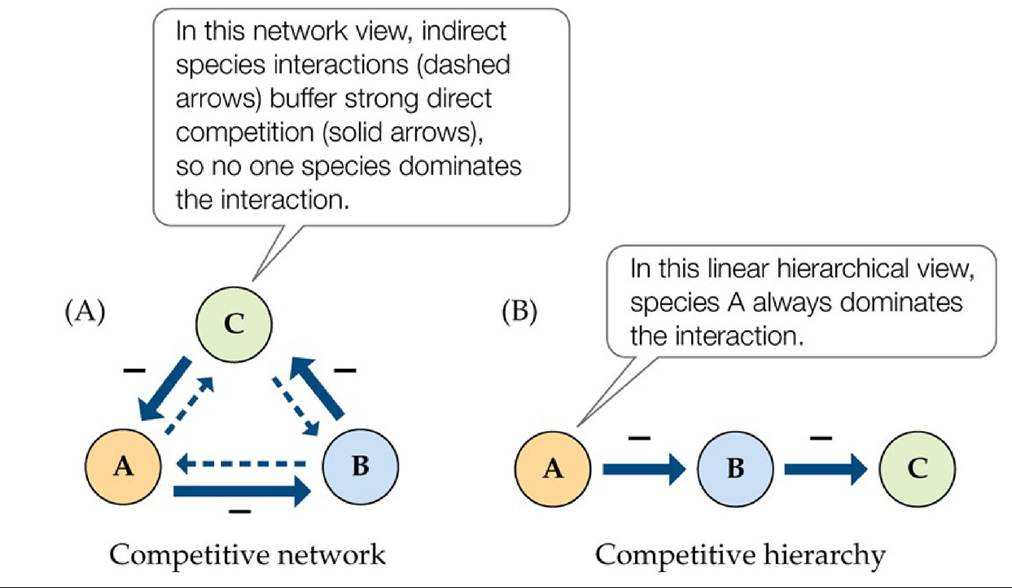
FIGURE 16.14 CompetitiveNetworksversusCompetitiveHierarchies View larger image
Buss and Jackson tested this hypothesis using encrusting invertebrates and algae that live on the undersides of coral reefs in Jamaica (FIGURE 16.15). These species compete for space by growing over one another. The researchers collected samples at the margins between species, where one species overgrows another, for as many pairs of individuals of different species as possible to determine the proportion of wins (species on top) to losses (species on the bottom) for each interaction. Their results showed that every species both
overgrew and was overgrown by at least one other species and that no one species consistently won competition for space at their borders. The species interacted in a circular network rather than a linear hierarchy. These observations demonstrate how competitive networks, by fostering diffuse and indirect interactions, can promote diversity in communities.
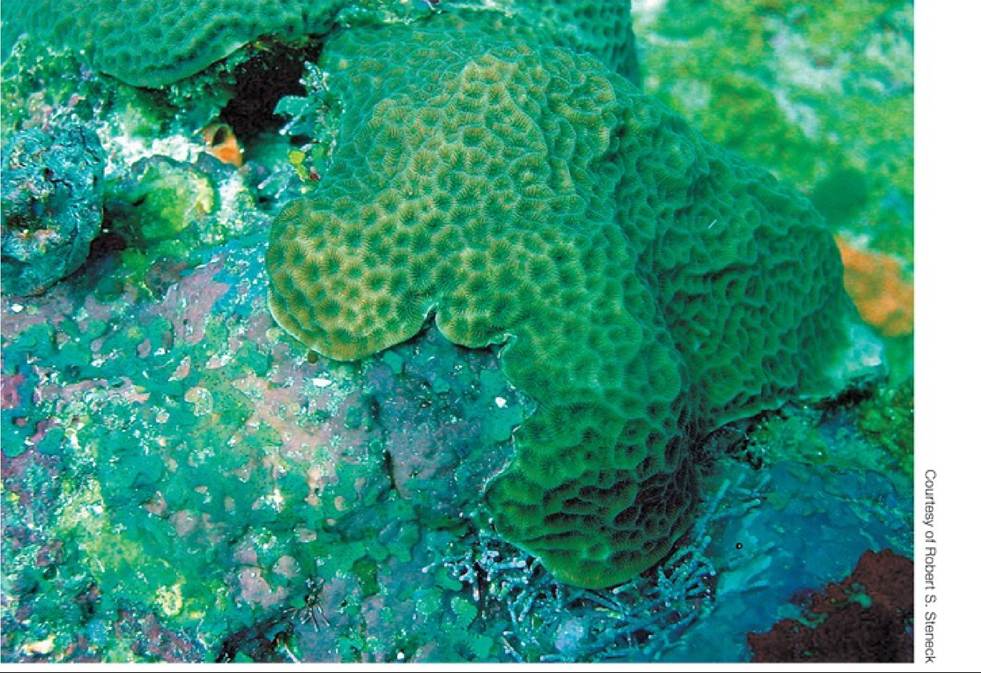
FIGURE 16.15 Competitive Networks in Coral Reef Communities Encrusting invertebrates and algae compete for space on coral reefs by overgrowing one another, but no one species consistently “wins” this competition. View larger image
More on the topic Indirect species interactions can have large effects:
- Overexploitation of species has large effects on ecological communities
- Omitting intermediate entities in models of indirect interactions
- CONCEPT 19.1 Species diversity differs among communities as a consequence of regional species pools, abiotic conditions, and species interactions.
- The outcome of competition between species can be changed by a broad suite of factors, including features of the physical environment, disturbance, and interactions with other species.
- We have seen in previous chapters that disturbance, stress, and predation can modify species interactions and allow for species coexistence.
- CONCEPT 15.1 In positive interactions, no species is harmed, and the benefits are greater than the costs for at least one species.
- The way we think about species interactions changes dramatically when we consider that they are embedded in a community of multiple interactors.
- CONCEPT 16.3 Communities can be characterized by complex networks of direct and indirect interactions that vary in strength and direction.
- CONCEPT 14.1 Competition can be direct or indirect, vary in its intensity, and occur between similar or dissimilar species.
- Environmental context can change the outcome of species interactions
- Changes in species interactions
- Species interactions vary greatly in strength and direction
- Species interactions
- Interactions of Multiple Species
- UNIT 4 SPECIES INTERACTIONS
- Edge effects change abiotic conditions and species abundances in fragments