Overexploitation of species has large effects on ecological communities
Overexploitation, the harvest of wild organisms at a rate that exceeds their replacement, can also lead to loss of diversity. For example, many of the world's people obtain their food, at least in part, directly from a natural ecosystem.
The problem is that as the human population increases and natural habitats shrink, the harvesting of many species from the wild has become unsustainable. Globally, overexploitation is contributing to the imperilment of species of fishes, mammals, birds, reptiles, and plants. Overexploitation has been the cause of the probable extinction of at least one primate, Miss Waldron's red colobus monkey (Piliocolobus waldroni), a species endemic to Ghana and Cote d'Ivoire whose last confirmed sighting was in 1978 (Oates et al. 2000; McGraw 2005).The effects of overexploitation on tropical forests have been substantial, resulting in what Kent Redford (1992) has called an “empty forest.” This phrase refers to forests that look healthy in satellite images, but in which the abundances and diversity of large vertebrates have decreased. The increased accessibility of forests as roads are built through them facilitates this overharvesting of wildlife, as does the widespread availability of guns. The enormous quantity of “bushmeat” being taken from tropical forests is sobering. Redford has calculated that 13 million mammals are killed each year in the Amazon rainforests of Brazil by rural hunters, and it is estimated that in western and central Africa, 1 million tons of forest animals are taken annually for food (Wilkie and Carpenter 1999). Vast numbers of animals are also captured from tropical forests, coral reefs, and other ecosystems and then exported legally to other countries. For example, government records indicate that from 2000 to 2006, 1.5 billion animals, most of which were for the pet trade, were imported to the United States alone (Smith et al.
2009).In the oceans, rapid and steep declines have taken place in both the abundances (FIGURE 23.12) and sizes (FIGURE 23.13) of top-level predators (Myers and Worm 2003). For every ton of fish caught by commercial trawlers, 1-4 tons of other marine life may be brought aboard by the nets. Some organisms may survive the experience and be released back into the sea; the rest make up what is called bycatch. The bycatch of certain threatened species, such as marine mammals, seabirds, and marine turtles, has received attention from fisheries managers, and in some cases, losses have been reduced through changes in gear design (see Ecological Toolkit 10.1). But bycatch remains common, and concern has been raised about the ecological effects of this unnecessary mortality on marine food webs (Lewison et al. 2004). In addition, repeated trawling on the coastal sea bottom has affected benthic species such as corals and sponges and has thereby degraded benthic habitat for many other species. Studies indicate that habitat recovery following trawling is very slow (National Research Council 2002).
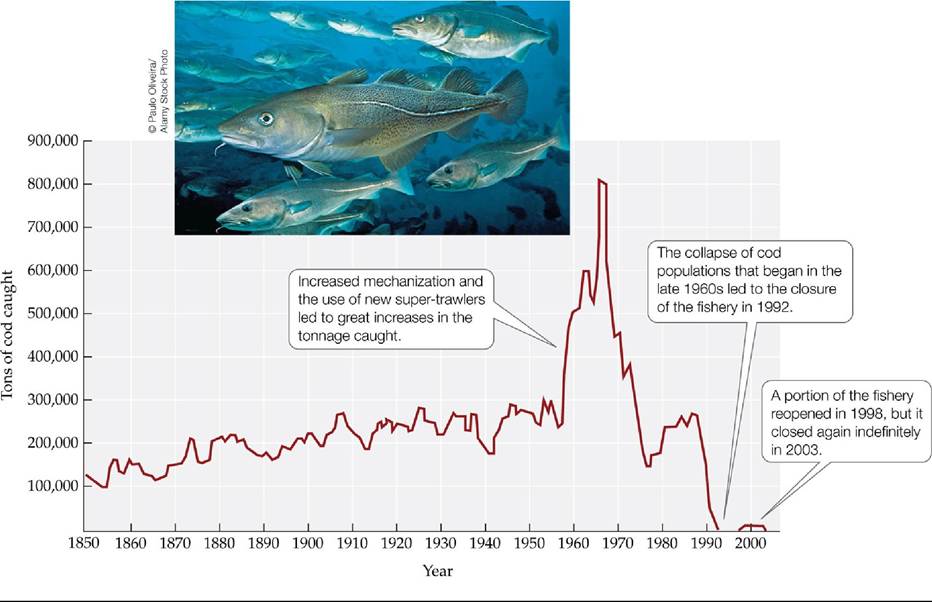
FIGURE 23.12 The Collapse of the Cod Fishery Changes over time in the amount of cod (Gadus morhua) caught off the coast of Newfoundland, Canada. Overharvesting led to the collapse of cod populations, which still have not recovered.
Based on data prior to 1950, roughly how many tons of cod could have been harvested in a sustainable manner? Explain.
(After Millennium Ecosystem Assessment. 2005. Ecosystems and Human Well-Being: Biodiversity Synthesis. World Resources Institute: Washington, DC.) View larger image
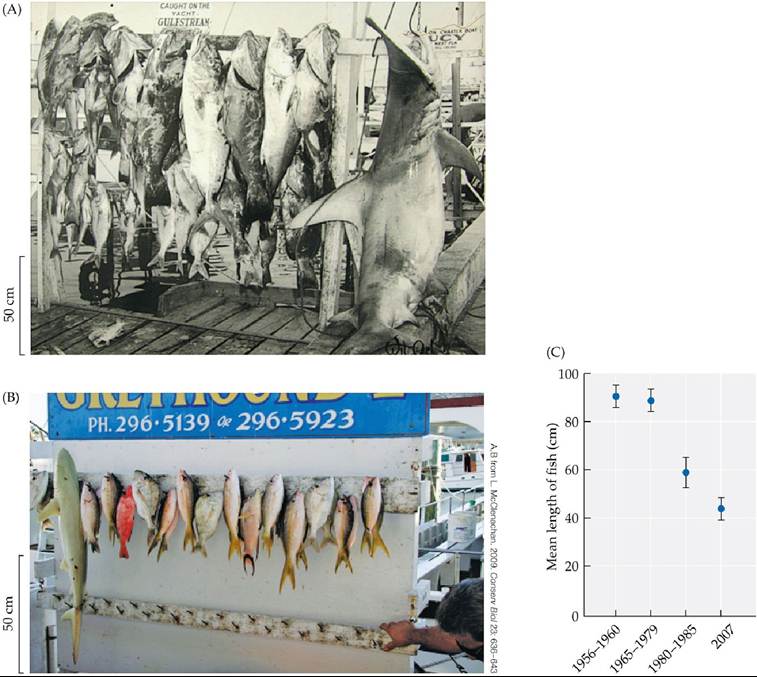
FIGURE 23.13 Overharvesting Has Led to a Decline in the Sizes of Top Marine
Predators Photographs of trophy fish caught on charter fishing boats based in Key West, Florida, in (A) 1957 and (B) 2007.
In commercial and recreational fisheries, the largest fish are often the preferred prey. (C) The total length of trophy fish declined more than 50% between 1960 and 2007. Error bars show ± one SE of the mean. (C after L. McClenachan. 2009. ConservBiol 23: 636643.) View larger imageWhenever a species has market value, it is likely to be overharvested. This results in an unfortunate confluence between human behavior (i.e., greed) and declining animal and plant populations, when economically valuable threatened species are subjected to an “anthropogenic Allee effect” (see Figure 11.15) due to more aggressive search and harvesting strategies. Many scientists and policymakers argue that the best approach to protecting overexploited species is to determine the levels of harvest that will be sustainable and to establish regulatory mechanisms to permit only those levels to be taken. In one example of how this could be done, Bradshaw and Brook (2007) describe management options that provide revenue from meat and trophy hunting of the wild banteng (Bos javanicus), a member of the cattle genus, yet do not jeopardize the prospects for the recovery of this rare species.