Invasive species can displace native species and alter ecosystem properties
As discussed earlier, the introduction of non-native species generally has negative effects on diversity. Here, we'll consider how declines in diversity can be caused by the arrival of these invasive species: non-native, introduced species that sustain growing populations and have large effects on communities.
Worldwide, 20% of endangered vertebrates are imperiled as a result of invasive species (MacDonald et al. 1989), with as many as 75% of vertebrate species on islands going extinct as a result of invasive mammals (McCreless et al. 2016).Invasive species are of particular concern where they compete with, prey on, or change the physical environment of endangered native species. The effect of the Eurasian zebra mussel (Dreissena polymorpha) on the freshwater mussel species of North America is a prime example (see Figure 19.5). North America is the center of diversity for freshwater mussels (bivalves of the order Unionoida), with 297 species, a third of those in the world. Prior to the invasion of the zebra mussel in the late 1980s, North American freshwater mussels were already in trouble. Most of these species are globally imperiled, many are endemic and thus naturally rare, and all are threatened by water pollution and river channelization. Competition with zebra mussels has brought about steep declines in populations of native freshwater mussels (60%-90%), including some regional extinctions (Strayer and Malcom 2007).
Invasive predators can also contribute to extinctions. In Lake Victoria, introduction of the Nile perch (Lates niloticus) has reduced the diversity and abundance of the native cichlid fishes, a group that shows adaptive radiation (a phenomenon discussed in Concept 6.4), with many species in specific habitats. Historically, about 600 species of cichlids had been recorded, most of which were endemic to Lake Victoria.
The Nile perch is a large predator, and its introduction into the lake in the early 1960s as a food source for human populations has contributed to the extinction of roughly 200 cichlid species. Before the introduction, the cichlids made up 80% of the biomass of fish in the lake; the Nile perch now accounts for 80% of the biomass. As is often the case, more than one factor is driving the cichlids' decline: pollution and overfishing augment the negative effect of predation by the Nile perch (Seehausen et al. 1997).In many ecosystems, habitat loss and degradation have increased vulnerability to invasion by non-native species, which in turn may lead to consequences that further degrade the ecosystem. The tropical dry forest of Hawaii, for example, harbors more than 25% of Hawaii's threatened plant species. The area of tropical dry forest has been reduced by 90% since human settlement. The arrival of invasive feral hogs, rats, and plants has made a bad situation worse. In addition to outcompeting and displacing local plants, invasive grasses are an excellent source of fuel for fires. As a result, the frequency of fires has increased (see Analyzing Data 9.1), furthering the decline of Hawaiian dry forests but favoring the spread of the fire-adapted, introduced grasses.
Ecosystem properties such as nitrogen cycling (see Figure 22.11) can be altered by some invasive species. One such species is kudzu (Pueraria montana), an invasive vine that covered more than 3 million ha (7.4 million acres) in the southeastern United States at its peak spread. This species disrupts communities by outcompeting other plants for light (see Figure 14.4). In addition, kudzu can fix up to 235 kg of nitrogen per hectare per year, an amount that far exceeds the atmospheric deposition of nitrogen in the eastern United States (7-13 kg N/ha/year).
To examine the extent to which nitrogen fixation by kudzu affects the nitrogen cycle, Hickman et al. (2010) measured the nitrogen mineralization rate in plots with and without kudzu (as discussed in Concept 22.2, the nitrogen mineralization rate provides an estimate of the rate at which nitrogen is supplied to plants).
On average, nitrogen mineralization rates increased more than sevenfold in plots invaded by kudzu (FIGURE 23.11), indicating a large effect on soil nitrogen supply. In addition, more than twice as much of the gas nitric oxide (NO) was released from the soil in plots invaded by kudzu as in plots lacking kudzu (see ANALYZING DATA 23.1 to test whether NO emissions at one of the study sites differ statistically between plots with kudzu and plots lacking kudzu). In the atmosphere, NO participates in chemical reactions that produce ground-level ozone, a pollutant that affects human health and agricultural production (see Concept 25.4). Modeling results suggest that kudzu has the potential to increase the number of high-ozone event days by as many as 7 days per summer across broad regions of the southeastern United States (Hickman et al. 2010). Additionally, the greater supply of soil nitrogen fosters greater spread of invasive plants.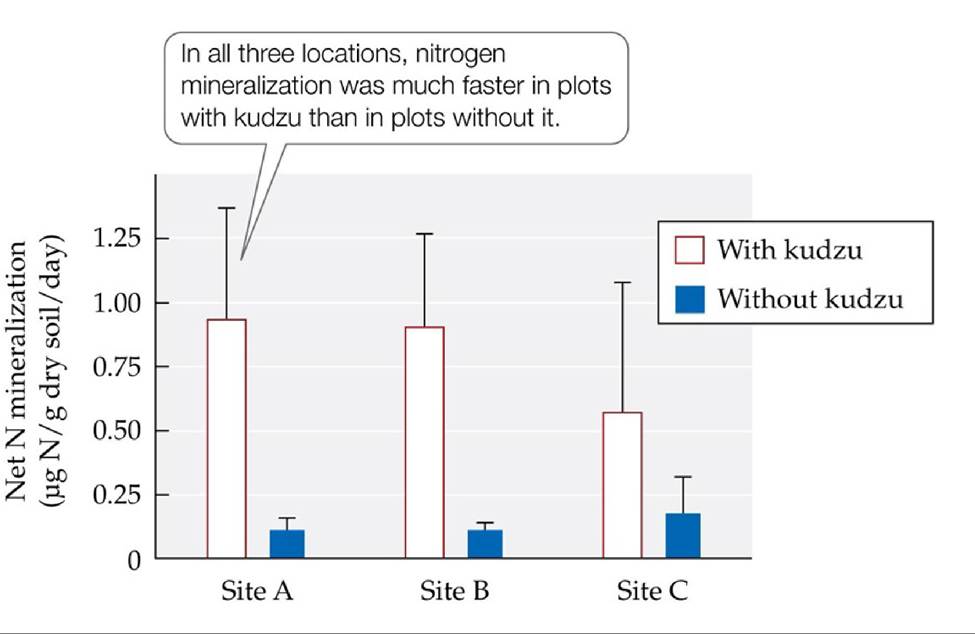
FIGURE 23.11 Invasive Species Can Alter the Nitrogen Cycle AtthreesitesinGeorgia, net nitrogen mineralization rates (an index of how rapidly nitrogen cycling occurs in an ecosystem) were much higher in soils supporting kudzu than in soils with native vegetation. Error bars show one SE of the mean. (After J. E. Hickman et al. 2010. ProcNatlAcadSci USA 107: 10115-10119.) View larger image
ANALYZING DATA 23.1
Do Nitric Oxide Emissions Differ Statistically between Plots with and without Kudzu?
Hickman et al. (2010)* examined the impact of the invasive species kudzu (Pueraria montana) on nitric oxide (NO) emissions at three study sites in Georgia. NO is an important contributor to pollutant ozone formation. At each site, NO emissions were recorded from four plots with kudzu and four plots lacking kudzu.
Data from one study site are presented in the table. In this
exercise, you will perform a statistical test (the f-test) to determine whether NO emissions in plots invaded by kudzu are significantly different from NO emissions in plots lacking kudzu.
| 2 Nitric Oxide Emissions (ng N/cm /hr) | |
| Plots with kudzu | Plots lacking kudzu |
| 4.1 | 2.0 |
| 1.7 | 0.9 |
| 6.1 | 1.1 |
| 2.8 | 0.9 |
la. What is the sample size (n) for plots with kudzu and plots without kudzu?
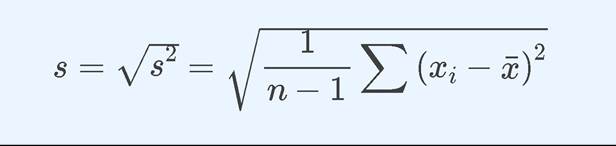
lb. Using the definitions provided below, calculate the mean (x) and standard deviation (s) of NO emissions for plots invaded by kudzu and for plots lacking kudzu. What do your results suggest?
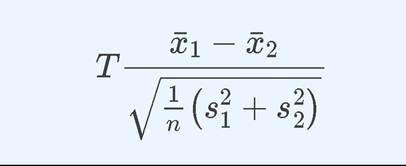
2. The f-test provides a standardized way to determine whether the means of two treatments differ enough from one another to be considered “significantly different.” The f-test is based on calculation of the T statistic, defined in the Definitions list. Calculate the T statistic using the data provided above.
3. Determine the “degrees of freedom” and “p value” associated with the value you obtained for T. Interpret the results of your f-test.
Definitions
Mean: For n data points x1, x2, x3,.., xn, the (arithmetic) mean (x)
equals

Standard deviation: For n data points x1, x2, x3,..., xn, the standard deviation (s) equals
T statistic: When comparing the means of two samples, each of size n, the T statistic equals
*Hickman, J. E., et al. 2010. Kudzu (Pueraria montana) invasion doubles emissions of nitric oxide and increases ozone pollution. Proceedings of the National Academy of Sciences U.S.A. 107: 10115-10119.
As we saw in the Case Study of the invasive alga Caulerpa taxifolia in Chapter 16, control or eradication of invasive species is difficult, labor-intensive, and expensive, but at times it may be warranted in the interest of protecting economically or culturally valuable native species or natural resources. The best strategy for combating invasive species is to prevent their arrival through careful screening of biological materials at international borders. But once potentially invasive species are present, control measures are best implemented immediately; constant vigilance and quick action are key to minimizing their effects (Simberloff 2003).
More on the topic Invasive species can displace native species and alter ecosystem properties:
- CONCEPT 19.1 Species diversity differs among communities as a consequence of regional species pools, abiotic conditions, and species interactions.
- CONCEPT 13.1 Parasites typically feed on only one or a few host species, but host species have multiple parasite species.
- CONCEPT 23.3 Primary threats to diversity include habitat loss, invasive species, overexploitation, pollution, disease, and climate change.
- Species distribution models can be used to predict a species' geographic range
- CONCEPT 13.5 Parasites can alter the outcomes of species interactions, thereby causing communities to change.
- Where should we put our focus in preventing species loss—on the species or the habitat?
- The outcome of competition between species can be changed by a broad suite of factors, including features of the physical environment, disturbance, and interactions with other species.
- We have seen in previous chapters that disturbance, stress, and predation can modify species interactions and allow for species coexistence.
- Protection of surrogate species can provide protection for other species with similar habitat requirements
- CONCEPT 16.2 Species diversity and species composition are important descriptors of community structure.
- CONCEPT 15.1 In positive interactions, no species is harmed, and the benefits are greater than the costs for at least one species.
- In the Case Study at the opening of this chapter, we saw lower hantavirus prevalence in small-mammal communities with higher species diversity than in those with lower species diversity (see Figure 19.2).
- Species supply is the “first cut” to community membership
- Species diversity is an important measure of community structure
- Processes that mediate resources can allow species to coexist