Species supply is the “first cut” to community membership
In Concept 18.1, we saw that the regional species pool provides an absolute upper limit on the numbers and types of species that can be present within communities (see Figure 18.6).
Not surprisingly, we saw that regions of high species richness tend to have communities of high species richness (see Figure 18.7). This relationship is due to the role of the regional species pool and, more specifically, the role of dispersal in “supplying” species to communities (see Figure 19.4A). Nowhere is the controlling effect of dispersal on community membership more evident than in the invasion of communities by non-native species.As ecologists are beginning to learn, humans have greatly expanded the regional species pools of communities by serving as vectors of dispersal. For example, we know that many aquatic species travel to distant parts of the world, which they could not otherwise reach, in the ballast water carried by ships (FIGURE 19.5A). Seawater is pumped into and out of ballast tanks, which serve to balance and stabilize cargo-carrying ships, all over the world. Most of the time, the water —along with the organisms it contains (from bacteria to planktonic larvae to fish)—is taken up and released close to ports, where some of the organisms have the opportunity to colonize nearshore communities. An estimated 10,000 marine species are transported in the ballast water of oceangoing vessels each day. Ballast water introductions have increased substantially over the past few decades because ships are larger and faster, so more species can be taken up and more survive the trip. In 1993, Carlton and Geller listed 46 known examples of ballast-water-mediated invasions in the previous 20 years. One species, the zebra mussel (Dreissena polymorpha), arrived in North America in the late 1980s in ballast water discharged into the Great Lakes (FIGURE 19.5B).
As a nonnative, invasive species, it has had community-changing effects on inland waterways and native species. Another example of a ballast water introduction with negative ecological consequences, which we learned about in the Case Study in Chapter 10, was the release of the comb jelly Mnemiopsis leidyi into the Black Sea. These introductions highlight the important role that dispersal plays in allowing a non-native species to gain a foothold in a community and potentially cause community-wide effects.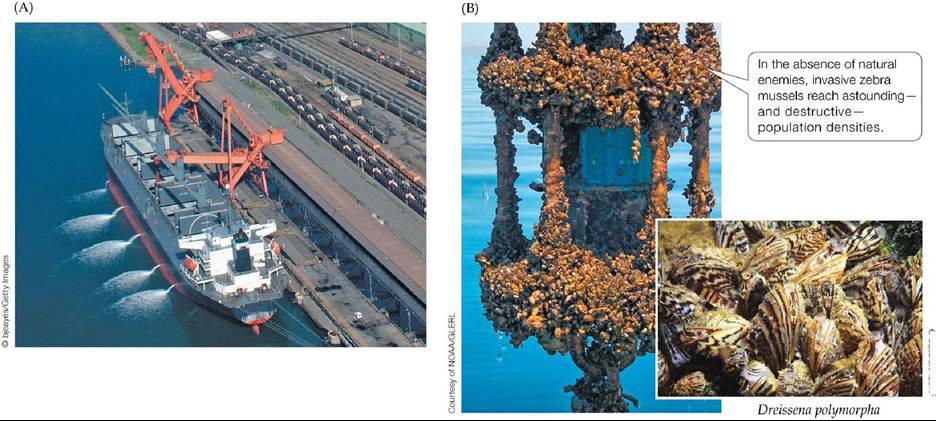
dyεSI-∕un∣enbB ©
FIGURE 19.5 Humans Are Vectors for Invasive Species (A)Largeandfastoceangoing ships can carry marine species to all parts of the world in their ballast water. (B) The zebra mussel, a destructive invader of the inland waterways of the United States, was carried there from Russia in ballast water. View larger image
Next let's turn our attention to the role of local conditions, particularly the abiotic and biotic characteristics of communities that help determine their structure.