Pollution, disease, and climate change erode the viability of populations
Human developments and activities result in air and water pollution and climate change, and are causing declines in populations of many species. Additionally, the emergence of new diseases and the transmission of diseases from domesticated animals into wildlife is having detrimental impacts on biodiversity.
The effects of all these factors exacerbate declines in species already reduced by habitat loss, invasive species, or overexploitation.Pollutants released by human activities are omnipresent in air and water. These pollutants become contributors to habitat degradation and diversity loss where they are present at levels that cause physiological stress. We will see in Concept
25.3 how some of these pollutants degrade habitats, reduce populations, and threaten the persistence of species.
One example of an emerging pollution threat is the growing concentration of persistent endocrine-disrupting contaminants (EDCs), particularly in the marine environment. As we saw in the Case Study Revisited in Chapter 21, persistent organic pollutants such as DDT, PCBs, flame retardants, and organophosphates from agricultural pesticides, some of which are EDCs, end up in marine food webs, where they are bioaccumulated and biomagnified, particularly in top predators. The number of chemicals found in marine mammals, the number of individuals affected, and the concentrations found have risen markedly in the last 40 years (Tanabe 2002). The orcas of British Columbia have been described as “fireproof killer whales” because of the extremely high levels of flame-retardant chemicals (polybrominated diphenyl ethers, or PBDEs) found in their bodies (FIGURE 23.14). These EDCs have been observed to interfere with reproduction, neurological development, and immune function in mammals (Ross 2006). Through their influence on hormones EDCs can turn males into females in some fish species, including the endangered pallid sturgeon (Scaphirhynchus albus) in the Mississippi River.
Such problems for species already at low numbers do not improve the outlook for their future.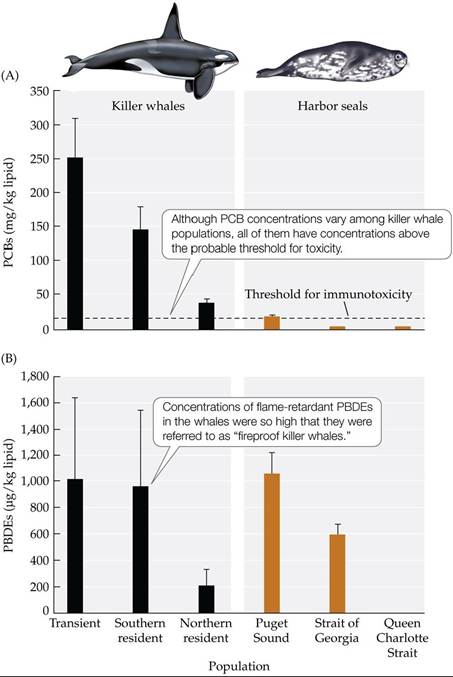
FIGURE 23.14 Persistent Organic Pollutants That Disrupt the Endocrine System Are a
Growing Threat to Marine Mammals In British Columbia, the concentrations of PCBs (A) and PBDEs (B) found in killer whales (Orcinus orca) and harbor seals (Phoca vitulina) are very high.
Error bars show one SE of the mean. (After P. S. Ross. 2006. Can JFishAquatSci 63: 224-234, based on data from P. S. Ross et al. 2000. Mar Pollut Bull 40: 504-515; P. S. Ross et al. 2004. Environ Toxicol Chem 23: 157-165; S. Rayne et al. 2003. Environ Sci Technol 36: 2847-2854; P. S. Ross, unpublished data.) View larger image
Disease has also contributed to the decline of many endangered species. In a striking example, an emerging disease caused by the fungus Batrachochytrium dendrobatidis has decimated amphibian populations around the globe (Skerratt et al. 2007) (see also the Case Study Revisited in Chapter 1). In the 1930s, the final decline to extinction of the thylacine, or Tasmanian wolf (Thylacinus cynocephalus), was hastened by an undetermined disease. The Tasmanian devil (Sarcophilus harrisii) appears to be similarly threatened because of the spread of a facial tumor disease (Hawkins et al. 2006), with populations in some parts of Tasmania decreasing by 50% annually. In the North American prairie, the endangered status of the black-footed ferret (Mustela nigripes) was exacerbated by canine distemper (Woodroffe 1999).
Z >
Climate Change Connection
Impacts on Diversity
Although hundreds of species have shifted their distributions to higher latitudes or elevations in response to global warming (Parmesan 2006), only a few cases are known at this time in which species are imperiled directly by climate change (e.g., Bramble Cay melomys, a small rodent [Waller et al. 2017]). However, the number of extinctions associated with climate change is expected to increase (Thomas et al. 2004; Wiens 2016).
Throughout this book, we've emphasized that climate change has influenced and will continue to influence diversity in multiple ways. Warmer temperatures can directly impact physiological activity and behavior, influencing reproduction and mortality of individuals. We saw an example of this with changes in the length of time lizards can be active, alterations due to climate warming. As a consequence of climate change, the probability of population extinctions increases because of constraints on the amount of time the lizards can forage, which may explain local extinction of some lizard populations in Mexico (Sinervo et al. 2010). Climate change may affect how species interact and the intensity of those interactions, as exemplified by some aquatic ecosystems which have experienced increases in food web connections in a warmer world (Woodward et al. 2010). Changes in the type (antagonistic vs. facilitative) and intensity of biotic interactions make prediction of the fates of species in a warmer world challenging.We saw in Concept 12.3 that the distribution of organisms and diversity in communities can be influenced by predation. If predators and prey respond differently to climate change, the influence of predation on diversity can be positive or negative, depending on which species is more sensitive. If prey are more sensitive to warmer temperatures than predators, then climate change will accentuate the negative impact of predation on diversity. This hypothesis was supported in the rocky intertidal zone by Christopher Harley (2011). Using a combination of experiments and observational studies employing variation in both space and time to examine variation in climate, Harley demonstrated a decrease in diversity of shellfish communities (barnacles and mussels) in the rocky intertidal zone consistent with greater predation and a restriction of habitat associated with climate change. The main predator, a sea star, was less sensitive to warming than barnacle and mussel species.
The reduction in habitat increased the susceptibility of the prey species to predation, contributing to the local extinction of some species under warmer conditions. We will explore climate change in greater depth in Chapters 24 and 25.4______________________________________________________________________________________________________________________________ >
As the human population passed the 7 billion mark, our impact on the environment had already caused all of the world's biomes to be affected by the threats we have just described. However, the importance of these threats varies among biomes (FIGURE 23.15). Habitat loss is greater in the tropics than in the polar zones, for example, but climate change is having more of an effect in the polar zones than in the tropics. What can conservation biologists offer as solutions to these threats from so many fronts?
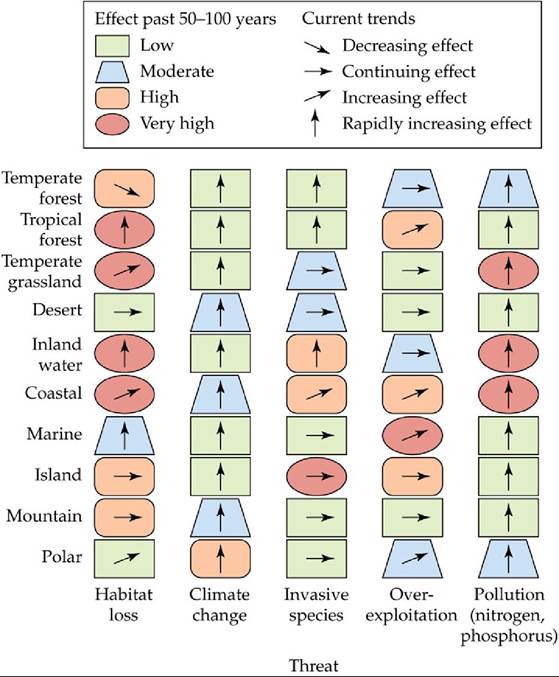
FIGURE 23.15 Different Biomes Face Different Principal Threats The effects of different types of threats on different biomes over the past 50-100 years were examined as part of the Millennium Ecosystem Assessment, an international collaboration among more than 1,000 ecologists commissioned by the United Nations. The color and shape of each box indicates the effect of the threat to date; the direction of the arrow indicates the trend in that threat.
At a global scale, what factors have been the most important threats to diversity over the past decades, and what factors are projected to be the most important in the future? How do these current and future threats differ between terrestrial and marine biological zones?
(After Millennium Ecosystem Assessment. 2005. Ecosystems and Human Well-Being: Biodiversity Synthesis. World Resources Institute: Washington, DC.) View larger image