Evidence of climate change is substantial
Climate change is distinguished from climate variation by the presence of significant directional trends lasting at least three decades. Based on analyses of records from numerous climate-monitoring stations, atmospheric scientists have determined that Earth is currently experiencing significant climate change (IPCC 2021) (FIGURE 25.11A).
Between 1880 and 2020, the average annual global surface temperature increased 0.97°C ± 0.2°C (1.8°F ± 0.4°F), with the greatest change occurring in the past 50 years. This rapid rise in global temperature is unprecedented in the past 10,000 years, although temperature changes at similar rates may have occurred at the onset and end of some glacial cycles (see Figure 25.6). The first two decades of the twenty-first century were the warmest decades of the previous 1,000 years, and 2016 was the warmest year since recordkeeping started. In association with this warming trend, there has been a widespread retreat of mountain glaciers, thinning of the polar ice caps, and thawing of permafrost. Sea level is rising at a rate greater than any estimated from the past 3,000 years (Kopp et al. 2016), posing a serious threat to coastal communities.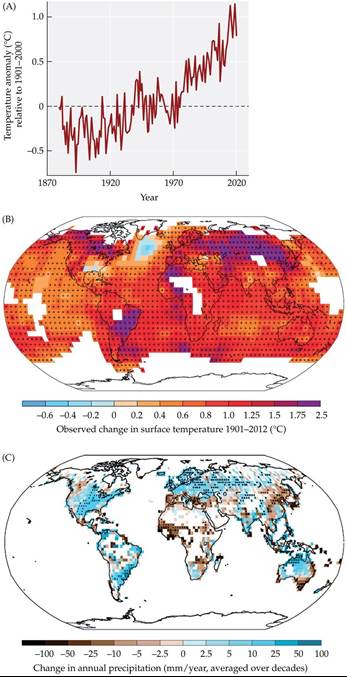
FIGURE 25.11 Changes in Global Temperature and Precipitation (A)Averageannual global temperature anomalies (relative to the average global temperature for 1961-1990) between 1880 and 2021, averaged from numerous air and sea surface temperature records and normalized to sea level. (B) Regional trends in average annual temperatures for 1901-2012. (C) Trends in global precipitation from 1951 to 2010. (A, data from NOAA National Centers for Environmental Information, Climate at a Glance: Global Time Series. y⅜ https://www.ncdc.noaa.gov/cag/;
B,C from IPCC. 2013. Climate Change 2013: The Physical Science Basis. Cambridge University Press: Cambridge.) View larger image
This warming trend has been heterogeneous across the globe, with most regions warming, others not changing significantly, and some even cooling (FIGURE 25.11B). The warming trend has been greatest in the middle to high latitudes of the Northern Hemisphere. Warming in the Arctic is four times greater than what has been recorded for Earth as a whole (Rantanen et al. 2022). Changes in terrestrial precipitation have also occurred, with more precipitation in portions of the high latitudes of the Northern Hemisphere and drier weather in the subtropics and tropics (FIGURE 25.11C). The frequencies of some extreme weather events, such as hurricanes (including massive storms such as Hurricane Katrina in 2005 and Hurricane Sandy in 2012) are increasing, fueled by warmer sea temperatures, droughts, and heat waves (IPCC 2013).
More on the topic Evidence of climate change is substantial:
- Evidence of climate change is substantial
- Climate change will continue to have ecological consequences
- What are the causes of the observed climate change?
- Ecological responses to climate change are occurring
- Monitoring Climate Change
- Climate variation over years and decades results from changes in atmospheric pressure cells
- Article 7.4 Eurobonds: a change of gear
- Oxygen concentrations vary with elevation, diffusion, and consumption
- Introduction
- Taxation