Climate change will continue to have ecological consequences
What will the projected 1.1°C-4.8°C change in average global temperature over the next 80 years mean for biological communities? We can get a sense of what such a temperature change might mean by comparing it with the climate variation associated with elevation in mountains.
A median value for the projected temperature change (2.9°C) would correspond to a 500-m (1,600-foot) shift in elevation. In the Rocky Mountains, this change in climate would correspond approximately to a full replacement in vegetation zone, from subalpine forest (dominated by spruce and fir) to montane forest (dominated by ponderosa pine; see Figure 3.11). Thus, if we assume perfect tracking of climate change by the current vegetation, climate change during the twenty-first century would result in an elevational shift in vegetation zones of 200 to 860 m. Similar predictions for latitudinal climate shifts suggest movement of biological communities 500 to 1,000 km toward the poles.Climate-biome correlations, such as those described in Concepts 3.1 and 4.1, are useful as a demonstration of what could happen with climate change, but it would be naive to use them to predict what will actually happen to biological communities. We know that biological composition is influenced by a multitude of factors, including climate—particularly climate extremes—as well as species interactions, the dynamics of succession, dispersal ability, and barriers to dispersal (as described in Unit 5). Because the ongoing climate change will continue to be rapid relative to the climate changes that have shaped current biological communities, it is unlikely that the same assemblages of organisms will form the communities of the future.
Paleoecological records reinforce the suggestion that novel communities may emerge with climate change by showing that some plant communities of the past were quite different from modern plant communities.
Jonathan Overpeck and colleagues used pollen records to reconstruct large-scale vegetation changes since the most recent glacial maximum in eastern North America (18,000 years ago) (Overpeck et al. 1992). They found not only that community types had made latitudinal shifts as the climate warmed, but also that community types without modern analogs existed under climate regimes that were unique and no longer present (FIGURE 25.16). Overpeck and his colleagues concluded that future vegetation assemblages would follow similar trends, given the predicted rapid rate of global warming and the potential for the emergence of unique climate patterns with no current analogs.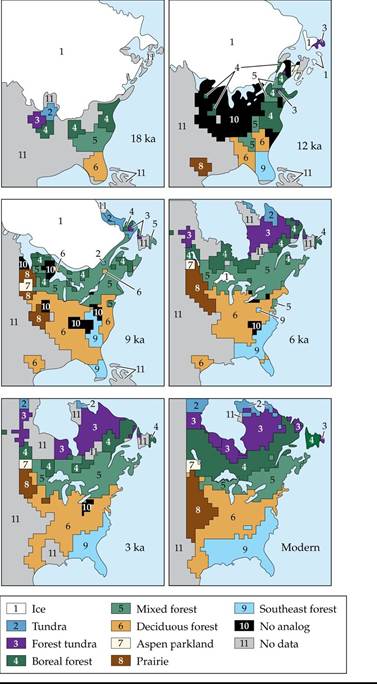
FIGURE 25.16 Past Changes in Plant Communities Vegetation types in eastern North America have changed since the last glacial maximum, 18,000 years ago (ka = thousand years ago). Vegetation composition was determined from pollen preserved in sediments.
What factors may have led to the development of vegetation types different from those found in North America today following retreat of the continental glacier?
(From J. T. Overpeck et al. 1992. Geology 20: 1071-1074.) View larger image
The rate of climate change will require rapid evolutionary change or the ability to disperse to new environments. Climate Change Connection 6.1 presents evidence that organisms with rapid life cycles have undergone evolutionary change in response to climate change. For more long-lived species, evolutionary responses are less likely, and thus for those species dispersal may be the only way to avoid extinction. Organisms’ dispersal abilities, and barriers to their dispersal associated with anthropogenic habitat fragmentation, will be important constraints on their responses to climate change. Plant dispersal rates are, on average, much slower than the predicted rate of climate change. In order to track the projected change in climate over the twenty-first century, plant species populations will need to move 5 to 10 km per year.
Plant species that have animal-dispersed seeds, and which can establish viable populations and grow to reproductive maturity in a relatively short time, may be able to disperse rapidly enough to keep pace with climate change. However, this kind of dispersal strategy is common mainly in ruderal (weedy) herbaceous plants. Shrubs and trees have much slower rates of dispersal; as a result, there may be significant time lags in their response to climate change.For most animals, mobility is not a problem, but their habitat and food requirements are intimately associated with the presence of specific vegetation types. In addition, barriers to dispersal may prevent organisms of all kinds from migrating in response to climate change. Dams, for example, may prevent fish from moving to water with more suitable temperatures. Fragmentation of habitat by human development may pose significant barriers to dispersal for some species (see Concept 24.2). Without habitat corridors through which they can disperse, species face a greater probability of local extinction in the face of climate change. Projections of the risk of extinction due to climate change, based on multiple published studies, indicate as many as 17% of Earth's species could be lost (Urban 2015).
In addition to affecting the geographic ranges of species, climate change will affect ecosystem processes, such as NPP, decomposition, and nutrient cycling and retention. Both photosynthesis and respiration are sensitive to temperature, and because their balance determines NPP, the direct effects of climate warming on NPP may be relatively minor. As indicated in Concept 20.2, however, variation in NPP is related to water and nutrient availability and vegetation type, all of which may be affected by climate change. Changes in precipitation patterns and evapotranspiration rates resulting from climate change may strongly influence both water and nutrient availability. Because of the heterogeneity of climate change, and of the resulting changes in vegetation types, both increases and decreases in NPP may occur.
Thus, the effect of climate change on NPP will probably not be uniform. The effect of warming on nutrient supplies will be most pronounced in mid- to high-latitude terrestrial ecosystems, where low temperatures constrain rates of nutrient cycling and soils have large pools of nutrients. As a result, climate change may lead to increases in NPP in some temperate forest ecosystems.Biological indicators of global climate change are diverse, and they are increasing over time. Experiments, modeling, and comparisons with historical and paleoecological records provide clues to how Earth's biota will respond to climate change. Substantial uncertainties in predicting the effects of climate change still exist, however, many of which are associated with other environmental changes that are occurring at the same time. In the next section, we'll look at two such anthropogenic changes that are having profound effects on ecosystems: emissions of sulfur and nitrogen into the atmosphere.
More on the topic Climate change will continue to have ecological consequences:
- Reviewers
- FIVE COMPONENTS OF LEGAL COMPETENCIES
- Background Context
- With the project in Zimbabwe in tatters, my colleagues and I began scouting for other places where introducing Saving for Change would make sense. Several countries in West Africa met our criteria:
- REVIEW OF FORENSIC ASSESSMENT INSTRUMENTS
- XAT 2009
- THE THEORY AND PRACTICE OF EMPIRE-BUILDING
- Zimbabwe Village Savings and Loan Associations
- Youth as a Conveyer of Discomforting Memories
- CHAPTER ONE The New Jerusalem: Kiev