What are the causes of the observed climate change?
As we saw in Chapter 2, climate change may result from changes in the amount of solar radiation absorbed by Earth's surface or in the amount of absorption and reradiation of infrared radiation by gases in the atmosphere.
Changes in absorption of solar radiation may be associated with variation in the amount of radiation emitted by the sun, in Earth's position relative to the sun, or in the reflection of solar radiation by clouds or surfaces with high reflectivity (albedo), such as snow and ice.The warming of Earth by atmospheric absorption and reradiation of infrared radiation emitted by Earth's surface is known as the greenhouse effect (see Figure 2.4). This phenomenon is associated with radiatively active greenhouse gases in the atmosphere, primarily water vapor, CO2, CH4, and N2O. The effectiveness of these gases in absorbing radiation depends on their concentrations in the atmosphere as well as their chemical properties. Water vapor contributes the most to the greenhouse effect, but its atmospheric concentration varies greatly from region to region, and changes in its average concentration have been small. Of the remaining greenhouse gases, which tend to be more evenly distributed in the atmosphere, CO2 contributes the most to greenhouse warming, followed by CH4 (which has about 30% of the effect of atmospheric CO2, although on a per molecule basis it is 30 times more effective than CO2) and N2O (which has about 10% of the effect of CO2, but is around 280 times more effective than CO2 on a per molecule basis).
As we saw in our discussion of the global biogeochemical cycles of C and N, atmospheric concentrations of CO2, CH4, and N2O are increasing substantially, primarily as a result of fossil fuel combustion and land use change (FIGURE 25.12).
Are increases in anthropogenic emissions of these greenhouse gases responsible for global climate change? To evaluate the underlying causes of climate change, its potential effect on ecological and socioeconomic systems, and our options for limiting climate change associated with human activities, the World Meteorological Organization and the United Nations Environment Programme established the Intergovernmental Panel on Climate Change (IPCC) in 1988. The IPCC convenes panels of experts in atmospheric and climate science to evaluate trends in climate and the probable causes for any changes observed. These experts use a combination of sophisticated modeling and analysis of data from the scientific literature to evaluate potential underlying causes of observed climate change, as well as to predict future climate change scenarios. The IPCC releases assessment reports periodically to enhance the understanding of climate change among scientists, policymakers, and the general public. In recognition of their efforts to spread “knowledge about man-madeclimate change,” the IPCC was awarded the Nobel Peace Prize in 2007.
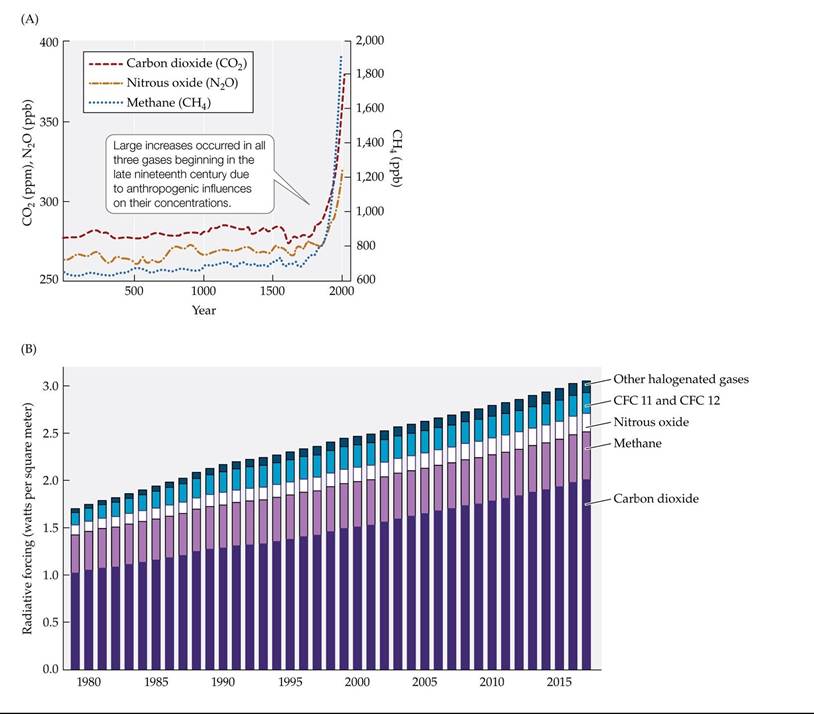
FIGURE 25.12 AtmosphericconcentrationsofGreenhouseGases (A) Long-term trends in the concentrations of CO2, CH4, and N2O. Concentrations prior to 1958 were determined from ice cores; concentrations since 1958 have been measured directly. (B) Contributions of greenhouse gases to warming (radiative forcing), showing that CO2 is the main contributor to the temporal change. (A after P. Forster et al. 2007. In Climate Change 2007: The Physical Science Basis, S. Solomon et al. [Eds.], pp. 129-234. Cambridge University Press: Cambridge; B from GlobalChange.gov.) View larger image
In its third assessment report, released in 2001, the IPCC concluded that the majority of the observed global warming is attributable to human activities (FIGURE 25.13). While this conclusion is still occasionally debated in the political arena, it is backed by the majority of the world's leading atmospheric scientists.
The certainty of an anthropogenic cause of climate change has increased with each new IPCC report, with the 2013 report stating, “It is extremely likely (95%-100% probability) that human influence has been the dominant cause of the observed warming since the mid-20th century.” Paul Crutzen, who was awarded the Nobel Prize in Chemistry for his work on stratospheric ozone loss, suggested that we have entered a new geologic period, which he called the Anthropocene epoch (anthropo, “human”; cene, “recent”; epoch, “geologic age”) to indicate the extensive impact of humans on our environment, particularly the climate system (Crutzen and Stoermer 2000).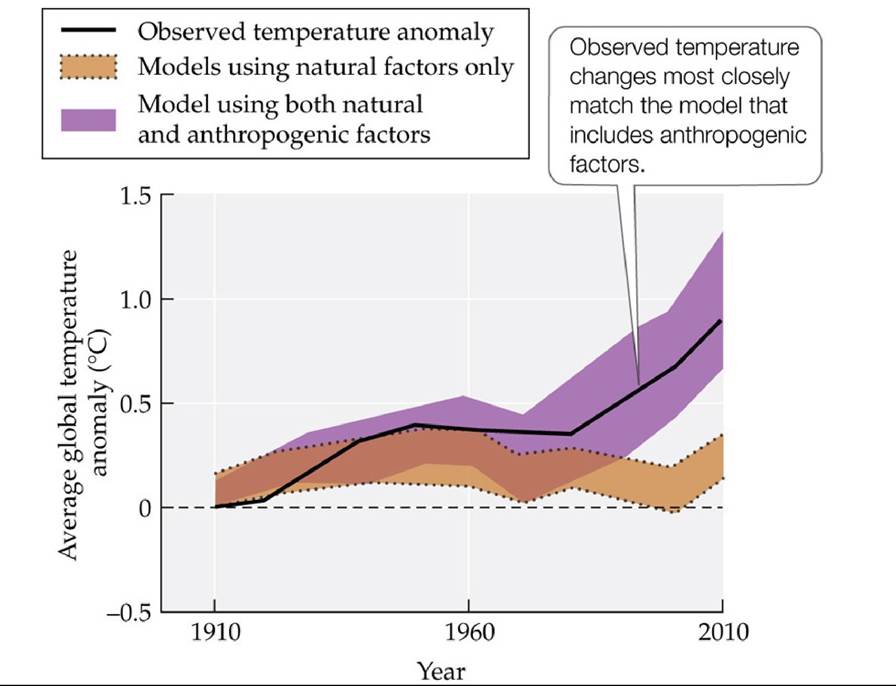
FIGURE 25.13 ContributorstoGlobalTemperatureChange IPCC scientists compared observed global temperature changes between 1910 and 2010 with the results of computer models. The models predicted the temperature changes that would have been expected in that period due to natural climatological factors only, including variation in solar radiation and in atmospheric concentrations of aerosols from volcanic eruptions, and due to both natural and anthropogenic factors, including emissions of greenhouse gases and sulfate aerosols. These comparisons suggest that anthropogenic factors have played a large role in the observed
warming. (After IPCC. 2013. Climate Change 2013: The Physical Science Basis. Cambridge University Press: Cambridge.) View larger image
Will the climate continue to grow warmer? The IPCC's models project an additional increase in average global temperature of 1.1°C-4.8°C over the twenty-first century (IPCC 2021). The range of variation in this estimate is associated with uncertainties about future rates of anthropogenic greenhouse gas emissions and about the behavior of the terrestrial-atmospheric-oceanic system. Model simulations incorporating different economic development scenarios have predicted vastly different future rates of emissions.
Aerosols in the atmosphere represent another source of uncertainty in the models' predictions. Aerosols, which reflect solar radiation, have a cooling effect on global temperatures. For example, emissions of large amounts of aerosols associated with major volcanic eruptions have had notable cooling effects at a global scale. While some aerosols have been increasing in the atmosphere (e.g., dust, in association with land use change and desertification), others have been decreasing (e.g., SO42-, due to decreasing anthropogenic SO2 emissions). Water in the atmosphere may play contradictory roles: clouds may have a cooling effect, while water vapor, which may increase because of greater evapotranspiration, may increase greenhouse warming. Despite these uncertainties in predicting the magnitude of future climate warming, the probability that global temperatures will continue to rise is extremely high. Even if anthropogenic CO2 emissions were halted completely, global temperatures would continue to rise for decades or even centuries due to the reduced capacity of the ocean to absorb heat (Frolicher et al. 2014).
More on the topic What are the causes of the observed climate change?:
- Other Aspects of Climate Change
- Effects of Climate Change
- Monitoring Climate Change
- Climate change will continue to have ecological consequences
- Evidence of climate change is substantial
- Climate Change
- Ecological responses to climate change are occurring
- Climate Change
- Global Climate Change
- Pollution, disease, and climate change erode the viability of populations
- 32 ARE STATES RESPONSIBLE FOR CLIMATE CHANGE IN THEIR OWN RIGHT?
- CONCEPT 23.3 Primary threats to diversity include habitat loss, invasive species, overexploitation, pollution, disease, and climate change.
- We tend to imagine the Arctic and subarctic regions as ahistorical wildernesses, frozen spaces scarcely touched by the modern world, newly under threat from resource extraction, geopolitical contests and, above all, climate change.
- Part IV of this handbook applies theories and accounts of collective responsibility to real-world problems, including collective responsibility for: war, global poverty, climate change, conspiracy theories, environmental injustice, and institutional racism.
- CONCEPT 17.2 Succession is the process of change in species composition over time as a result of abiotic and biotic agents of change.