Edge effects change abiotic conditions and species abundances in fragments
As intact habitat is fragmented, an abrupt boundary between two dissimilar patch types is created. The total length of habitat boundary, or edge, increases as fragmentation increases.
Edge effects are the diverse abiotic and biotic changes that are associated with habitat boundaries (FIGURE 24.15). The effect of edge formation is a change in the physical environment over a certain distance into the remaining fragment. As a result, biological interactions and ecological processes can change as well, as you can explore in ANALYZING DATA 24.1. The impact of the edge on the environment changes over time, so we can separate the immediate responses to fragmentation and edge formation from the responses that develop later (see Figure 18.24).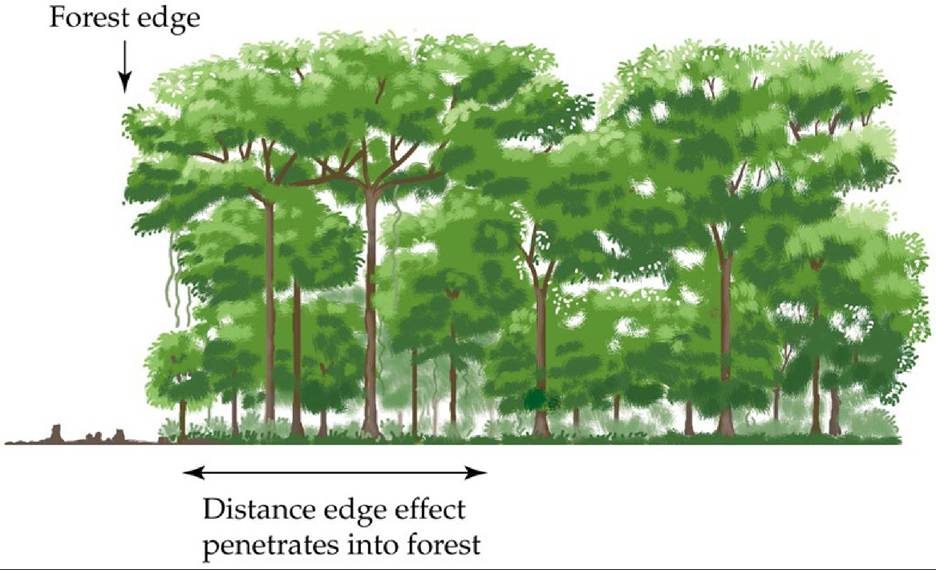
FIGURE 24.15 Edge Effects Deforestation creates new forest edges, exposing trees that once were surrounded by forest to edge effects such as increased light levels, higher temperatures, greater wind speeds, decreased soil moisture, and invasion of disturbance-adapted
plants and animals. Some edge effects penetrate a few tens of meters into the forest fragment, while others penetrate hundreds of meters (see Analyzing Data 24.1). View larger image
ANALYZING DATA 24.1
How Far Do Edge Effects Penetrate into Forest Fragments?
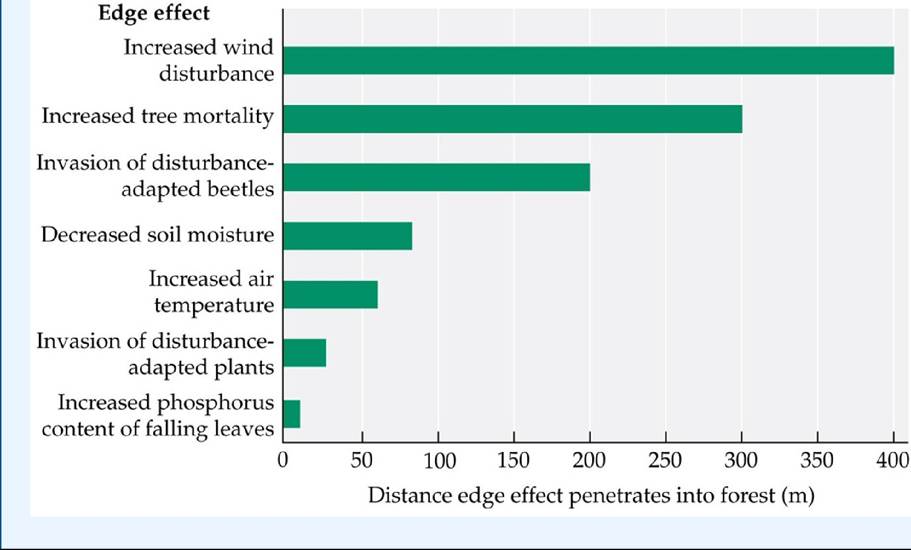
When an intact forest is first fragmented, abiotic conditions change near the edge of the patch of forest that remains, giving rise to biotic changes (see Figure 24.15). In a landmark study on edge effects, William Laurance and his colleagues (2002)* synthesized 22 years of data from the Biological Dynamics of Forest Fragments Project, the world's largest ecological experiment (see the Case Study in Chapter 18). The graph shows some of the changes they measured in Amazon rainforest fragments.
1. According to the graph, how far from the edge must a tree be located if it is not to experience an increase in wind disturbance?
2. If the tree mortality effect penetrated 300 m on each side of an 800 ? 800-m forest fragment, tree mortality would increase in what percentage of the fragment's area?
3. Are edge effects such as those shown here likely to cause other changes (not shown) in species interactions, community structure, or ecosystem processes? Explain.
*Laurance, W. F., and 10 others. 2002. Ecosystem decay of Amazonian forest fragments: A 22-year investigation. Conservation Biology 16: 605-618.
Analyzing Data 24.1 and the Case Study Revisited in Chapter 18 describe edge effects seen in large-scale experiments in Brazil. The effects of abiotic changes at a forest edge were also illustrated by a study of microclimates 10 to 15 years after the clear-cutting of an old-growth Douglas fir forest in the Pacific Northwest (Chen et al. 1995). Edges were generally characterized by higher temperatures, higher wind speeds, and more light penetration. Daily temperature extremes were also greater at the edges because more heat was lost from the forest edge at night than in the interior forest. The biotic consequences of these abiotic changes included higher rates of decomposition, more windthrown trees and thus more woody debris on the forest floor, and greater seedling survival of some tree species (Pacific fir) and the same or lower in others (Douglas fir and western hemlock).
Habitat edges provide habitat diversity that can facilitate or inhibit ecological functions. Edges can either enhance or inhibit dispersal of organisms. Dispersal of organisms can be greater for some species and lower for others at edges. Novel species interactions may take place at the junctions of two ecosystems. Some species may benefit from foraging in one habitat and reproducing in another.
Invasive species are commonly more abundant in habitat edges, influencing the population dynamics for native species (Fagan et al. 1999). For example, birds adapted to the forest interior often have lower breeding success when their nests are close to habitat edges. This lower breeding success can result from higher rates of egg predation by raccoons, crows, and other predators as well as higher rates of nest parasitism, especially by cowbirds. In the tallgrass prairie of Wisconsin, Johnson and Temple (1990) studied the reproductive success of five species of ground-nesting birds. They found that the closer nests were to a wooded edge of the prairie habitat, the greater the probability of nest predation by medium-sized predators and of nest parasitism by cowbirds, and the lower the rate of reproductive success. Similar patterns have been observed in other prairies, in Scandinavian forests, in eastern deciduous forests, and in the tropics (Paton 1994). Some biologists have characterized edges as “biological traps” as a result of the increased risks that some species face there (Battin 2004).