Fragmented habitats are biologically impoverished relative to intact habitats
When habitat is fragmented, some species go locally extinct within many of the fragments. Reasons for the loss of species include loss of habitat, which can involve changes in climate, shelter, and nesting sites; lower resources; and the impact of genetic and stochastic factors on small populations.
Mutualisms may be disrupted if pollinators are missing or as mycorrhizal fungi fail to persist in a particular fragment. Local extinction or decline is not inevitable; indeed, some species flourish under the changed conditions that follow fragmentation.Fragmentation often leads to losses of top predators, giving rise to trophic cascades (see Concept 21.3), sometimes with large consequences for the remaining community as we saw with the Lago Guri example. Another example of such a cascade that has implications for human health is the growing risk of Lyme disease as a result of forest fragmentation in the northeastern United States. Brian Allan and colleagues found that forest fragments of less than 2 ha (5 acres) were very densely populated with white-footed mice (Peromyscus leucopus). Fragments of that size did not support substantial predator populations, and the mice had few competitors there. White-footed mice are the most important reservoir of Borrelia burgdorferi, the spirochete bacterium that causes Lyme disease. Ticks are the vector of this disease. Tick nymphs collected in these small fragments were significantly more likely to carry the disease, and occurred at higher densities, than nymphs in larger fragments (FIGURE 24.14). The outcome—an increased risk of human infection with Lyme disease—is ultimately a result of the biological impoverishment of habitat fragments (Allan et al. 2003).
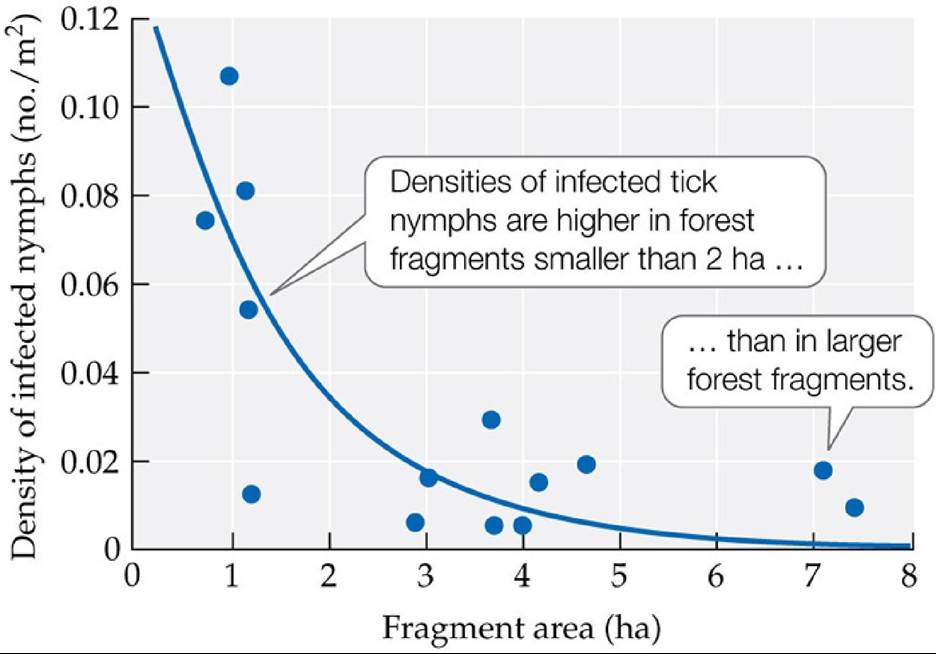
FIGURE 24.14 Habitat Fragmentation Can Have Consequences for Human Health The loss of predators from small forest fragments in New York State has led to elevated populations of white-footed mice in those fragments. As a result, densities of tick nymphs infected with the spirochete bacterium that causes Lyme disease are higher than in larger forest areas. (After B. F. Allan et al. 2003. ConservBiol 17: 267-272.) View larger image