In 1986, a massive hydroelectric project in the Caroni River valley of Venezuela inundated a large area of uneven terrain to create a reservoir known as Lago Guri (FIGURE 24.10).
The result was the formation of scores of islands of tropical dry forest surrounded by water. This change in the landscape presented an opportunity for John Terborgh and his students and colleagues to study the effects of fragmentation in a tropical dry forest ecosystem.
They found that small- and medium-sized islands were lacking the top predators found on the mainland, primarily wild cats (ocelots, jaguars, and pumas), raptors, and large snakes (Terborgh et al. 2006). As a result, generalist herbivores, seed predators, and predators of invertebrates were 10 to 100 times more abundant on the islands than in the remaining intact forest. Species that increased in abundance included leaf-cutter ants, birds, rodents, frogs, spiders, howler monkeys, porcupines, tortoises, and lizards. The increased abundances of these species had a dramatic effect on the vegetation of these islands: tree recruitment decreased and tree mortality increased because of high rates of herbivory, primarily by leafcutter ants (FIGURE 24.11). What lessons can we take from this “experiment” that apply to other fragmented ecosystems?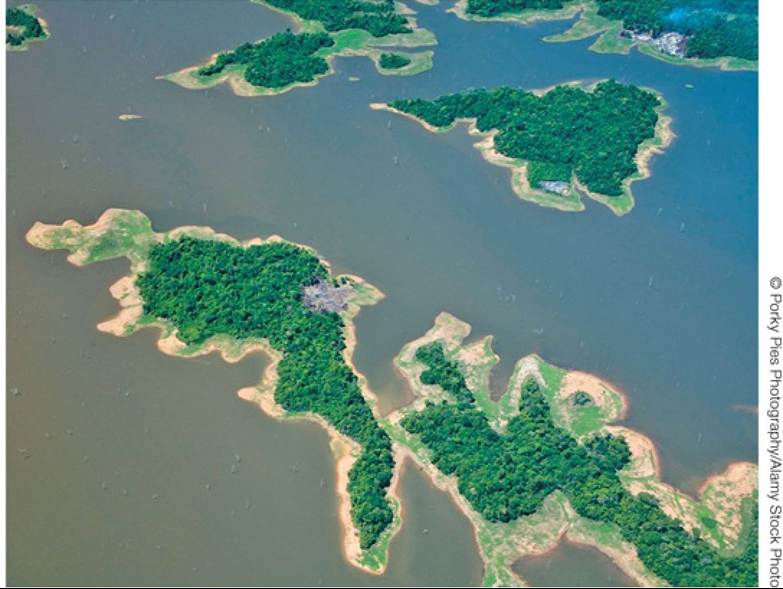
FIGURE 24.10 ThelslandsofLagoGuri An aerial view of Lago Guri, Venezuela. This lake was formed when 4,300 km2 (1.1 million acres) of forested land were inundated by a hydroelectric dam, leaving isolated islands of tropical forest. View larger image
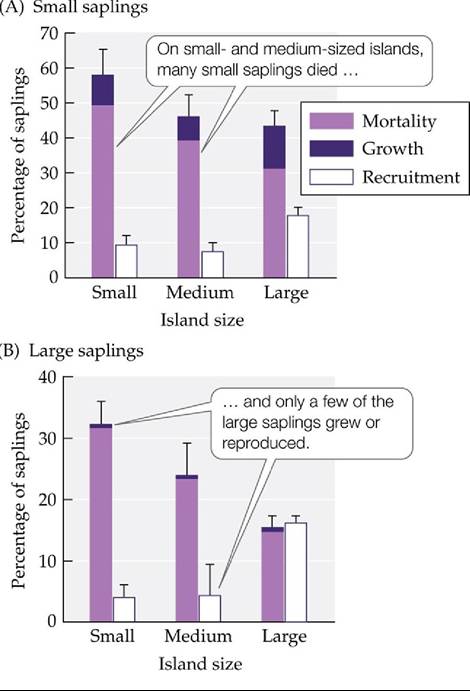
FIGURE 24.11 Effects of Habitat Fragmentation by Lago Guri Thehighabundancesof herbivores on small and medium-sized islands in Lago Guri caused a dramatic decline in sapling establishment and survival. The bars show the percentages of (A) small saplings and (B) large saplings in study plots that left their size class through either mortality or growth to a larger size, as well as the number of saplings recruited to each size class, over a 5-year period.
Error bars show one SE of the mean. (After J. Terborgh et al. 2006. JEcol 94: 253-263.) View larger imageHabitat loss and fragmentation are among the most widespread and important human-caused changes occurring in Earth's landscapes (FIGURE 24.12). When large blocks of habitat are cleared of forests, flooded by dam construction, divided by roads, or converted to human land uses, there are several consequences for the landscape and the species living there. The first is the direct loss of habitat area. Reductions in the amount of suitable habitat available have contributed to the declines of thousands of species, including the red- cockaded woodpecker (see the Case Study in Chapter 23). Second, as the
remaining habitat becomes divided into smaller and smaller patches, it is increasingly degraded and influenced by edge effects, as the Biological Dynamics of Forest Fragments Project showed (see the Case Study in Chapter 18). Third, fragmentation results in the spatial isolation of populations, making them vulnerable to the problems of small populations described in Concept 10.3.
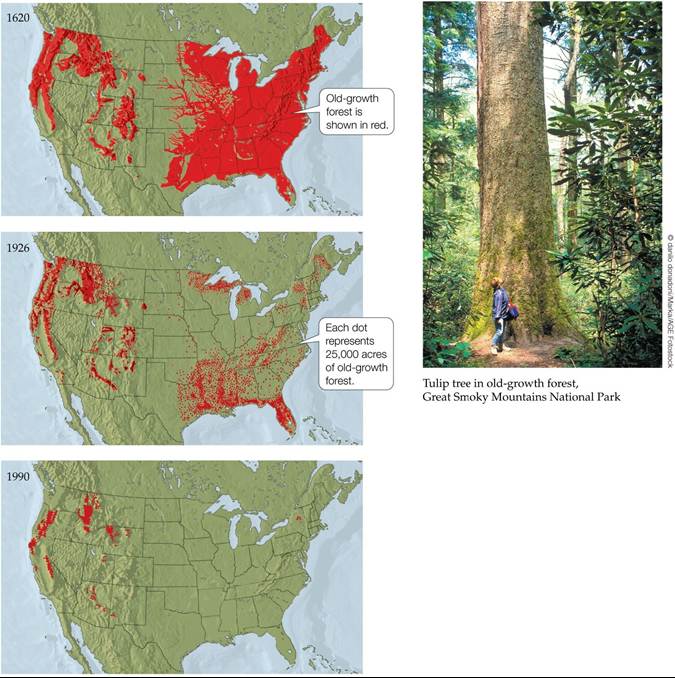
FIGURE 24.12 Loss and Fragmentation of U.S. Old-Growth Forests Beginning in 1620, vast regions of old-growth forest (also known as ancient or virgin forest) in the United States were cut down to provide lumber and to make room for agriculture, housing, and other forms of development. (Adapted from A. Gould et al. 2001. In Global Systems Science: A New World View. The Lawrence Hall of Science. University of CA, Berkeley. © The Regents of the University of California. ¾j⅜ http://www.globalsystemsscience.org/studentbooks/anwv/ch3/. Based on C. O. Paullin. 1932. Atlas of Historical Geography of the United States. Carnegie Institution of Washington and the American Geographical Society of New York: Washington, DC, and New York; R. Findley and J. P. Blair. 1990. Nat Geogr 178: 106-136.) View larger image
The process of habitat loss and fragmentation may take place over many decades.
A typical pattern begins with a clearing in a forest, which is then widened bit by bit until only isolated habitat fragments remain (FIGURE 24.13). Roads are often catalysts of habitat conversion, though human access along rivers can also serve to accelerate deforestation. The principal drivers of habitat fragmentation are conversion of land for agriculture and urban expansion.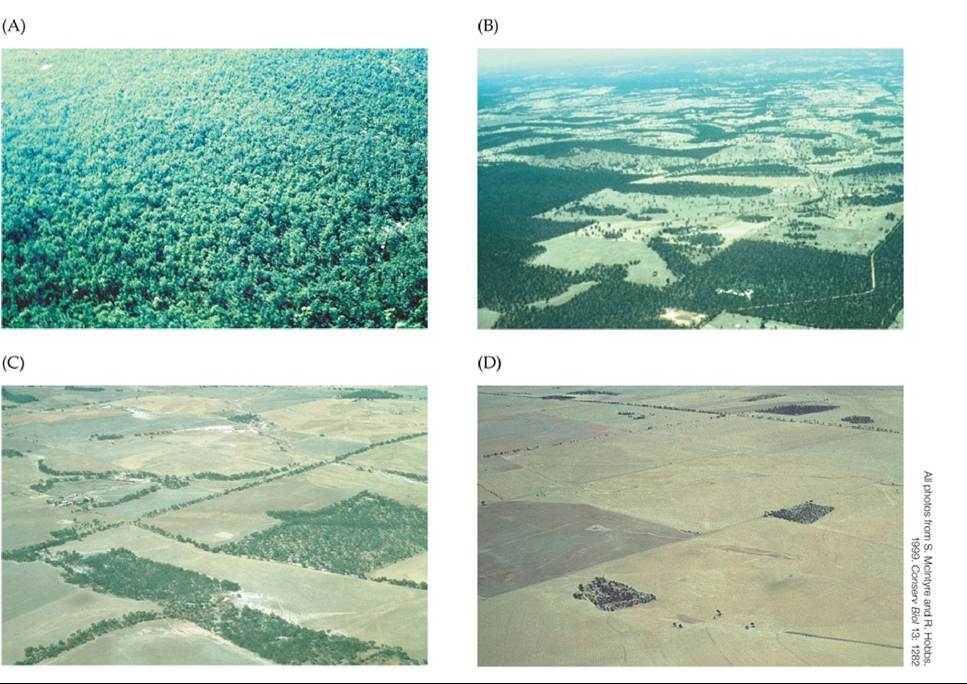
FIGURE 24.13 The Process of Habitat Loss and Fragmentation Historicallyintact habitats are gradually reduced with increased human presence. These contemporaneous photographs (taken from different locations) illustrate a process that typically takes decades to complete. (A) An intact eucalyptus forest in Western Australia. (B) Areas within the forest have been cleared for grazing. (C) The forest has become further fragmented over time. (D) Only a few remnants of forest remain. View larger image
Habitat fragmentation is a reversible process. The northeastern United States, for example, has more forest cover than it did a century ago as a result of agricultural abandonment—but it will take centuries before these young forests contain as many species as were found in the old-growth forests that once covered the region. Furthermore, the global trend is toward net loss of forests (FAO and UNEP 2020) and toward increasingly fragmented forest, grassland, and riverine ecosystems.