Species diversity varies with latitude
If you recall our Google Earth-style tour of the globe in the previous section, it was clear that plant species diversity and community composition changed dramatically with latitude: species diversity was highest at tropical latitudes and decreased toward the poles.
Wallace and other nineteenth-century European scientific explorers became keenly aware of this pattern as they collected thousands of species in the tropics and compared them with their more meager European collections. As more data have accumulated over the last 200 years, the latitudinal gradient in species diversity has been more firmly established(FIGURE 18.12). Willig and colleagues (2003) tallied the results of 162 studies on a variety of taxonomic groups extending over broad spatial scales (20° latitude or more) that considered whether diversity and latitude showed a negative relationship (with diversity decreasing toward the poles), a positive relationship (increasing toward the poles), a unimodal relationship (increasing toward mid-latitudes and then declining toward the poles), or no relationship. Negative relationships were by far the most common.
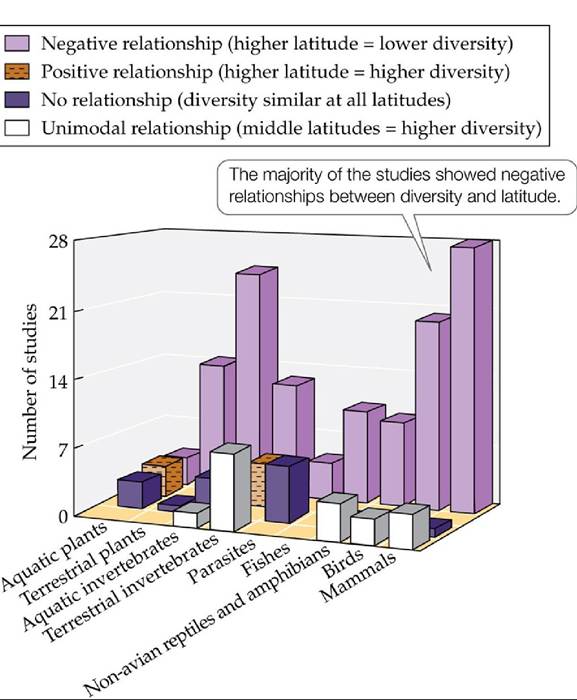
FIGURE 18.12 Studies of Latitude and Species Diversity Confirm Conventional
Wisdom The relationship between species diversity and latitude (measured at 20° increments), tallied for a variety of taxonomic groups, shows that most are negative correlations (i.e., increasing species diversity with decreasing latitude). (After M. R. Willig et al. 2003. AnnuRevEcol Syst 34: 273-309.) View larger image
In addition to this undeniably strong latitudinal gradient, biogeographers have observed an important pattern of longitudinal variation. Gaston et al. (1995) measured the numbers of families along multiple transects running north to south and separated by 10° longitude.
Families of seed plants, amphibians, reptiles, and mammals all increased in number toward the equator and declined at higher latitudes in both the Northern and Southern Hemispheres. These researchers determined, however, that the number of families also depended on the longitude chosen. Their observations showed that there were areas of particularly high species richness at some locations, sometimes secondary to latitude. These areas are known as biodiversity hot spots in situations in which they are under threat from humans.Of course, not all groups of organisms show decreases in species richness at higher latitudes; some groups display the opposite pattern. Seabirds, for example, have their highest diversity at temperate and polar latitudes (Harrison 1987) (FIGURE 18.13A). Seabirds of the Antarctic and subantarctic include penguins, albatrosses, petrels, and skuas (FIGURE 18.13B). In the Arctic and subarctic, auks replace penguins, and gulls, terns, and grebes are common. In the tropics and subtropics, seabird diversity declines: the seabird community there is composed mostly of pelicans, boobies, cormorants, and frigatebirds. This pattern of seabird diversity correlates well with marine productivity, which is substantially higher in temperate and polar oceans than in the tropics (see Figure 20.7). The same pattern of diversity has been observed in marine benthic communities, which also experience much higher productivity at higher latitudes.
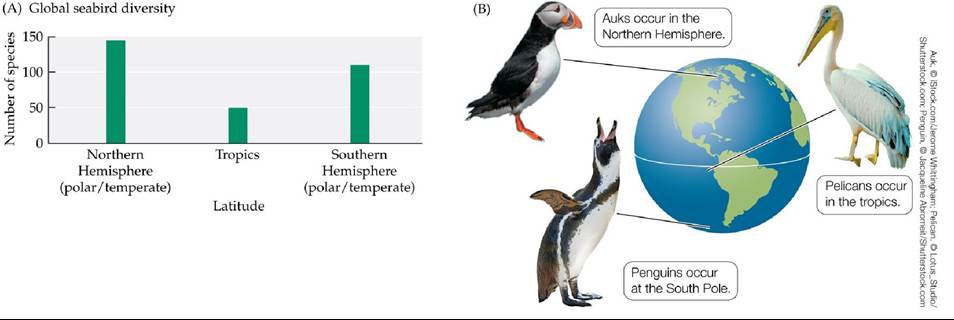
FIGURE 18.13 SeabirdsDefyconventionalWisdom Globalseabirdspeciesrichness shows a latitudinal pattern opposite to that of most faunas. (A) Species richness among seabirds is high in temperate and polar regions and much lower in the tropics. (B) Species composition
also shows strong latitudinal differences. (A, data from P. Harrison. 1987. A Field Guide to Seabirds of the World. Penguin Random House: London.) View larger image
As we will see, productivity differences are one possible cause of latitudinal gradients in species diversity. Let's turn now to some other possible explanations.
More on the topic Species diversity varies with latitude:
- In the Case Study at the opening of this chapter, we saw lower hantavirus prevalence in small-mammal communities with higher species diversity than in those with lower species diversity (see Figure 19.2).
- CONCEPT 19.1 Species diversity differs among communities as a consequence of regional species pools, abiotic conditions, and species interactions.
- CONCEPT 16.2 Species diversity and species composition are important descriptors of community structure.
- Patterns of species diversity at different spatial scales are interconnected
- Species diversity is an important measure of community structure
- Some relationships between species diversity and community function are positive
- The intermediate disturbance hypothesis considers species diversity under variable conditions
- Species diversity estimates vary with sampling effort and scale
- One of the most obvious ecological patterns on Earth is the variation in species composition and diversity among geographic locations.
- 19 Species Diversity in Communities
- Resource Mediation and Species Diversity
- Local and regional processes interact to determine local species diversity
- Can Species Diversity Suppress Human Diseases? A Case Study
- CONCEPT 19.4 Many experiments show that species diversity affects community function.
- CONCEPT 19.2 Resource partitioning is theorized to reduce competition and increase species diversity.
- CONCEPT 18.1 Patterns of species diversity and distribution vary at global, regional, and local spatial scales.
- CONCEPT 18.3 Regional differences in species diversity are influenced by area and distance, which determine the balance between immigration and extinction rates.
- CONCEPT 19.3 Processes such as disturbance, stress, predation, and positive interactions can mediate resource availability, thus promoting species diversity.