Can Species Diversity Suppress Human Diseases? A Case Study
On May 14, 1993, a 19-year-old cross-country track star, riding in the back seat of his family's car, began struggling to breathe. The family immediately stopped at a convenience store to call for help, and the young man was rushed to a hospital in Gallup, New Mexico.
The ambulance crew tried to revive him, but he died soon after reaching the emergency room. A chest X-ray showed that his lungs were filled with fluid. The deputy medical investigator based in Gallup was called in, and over the course of 2 weeks, he determined that at least five other residents of the area, which included members of the Navajo Nation living in the Four Corners region (where New Mexico, Arizona, Colorado, and Utah intersect), had also mysteriously died in the same sudden manner. After interviewing families of the victims, the medical examiner determined that all had experienced flu-like symptoms and then acute respiratory distress as a result of their lungs being filled with fluid. The disease appeared to be infectious and viral.By early June 1993, the Viral Special Pathogens Branch of the Centers for Disease Control and Prevention had determined that the culprit was a previously unknown species of hantavirus, a pathogen carried by rodents. It was given the name Sin Nombre virus (SNV) or “the nameless virus.” Rodents shed the virus in their urine, feces, and saliva, which if aerosolized, can be inhaled by humans. It was subsequently determined that the new viral strain was carried by a species of deer mouse (Peromyscus maniculatus) whose populations had recently boomed in the Four Corners region (FIGURE 19.1). Research showed that deer mouse populations had increased 20-fold in some locations, triggering the transmission of SNV infections in humans (see Concept 10.1 and Figure 10.9).
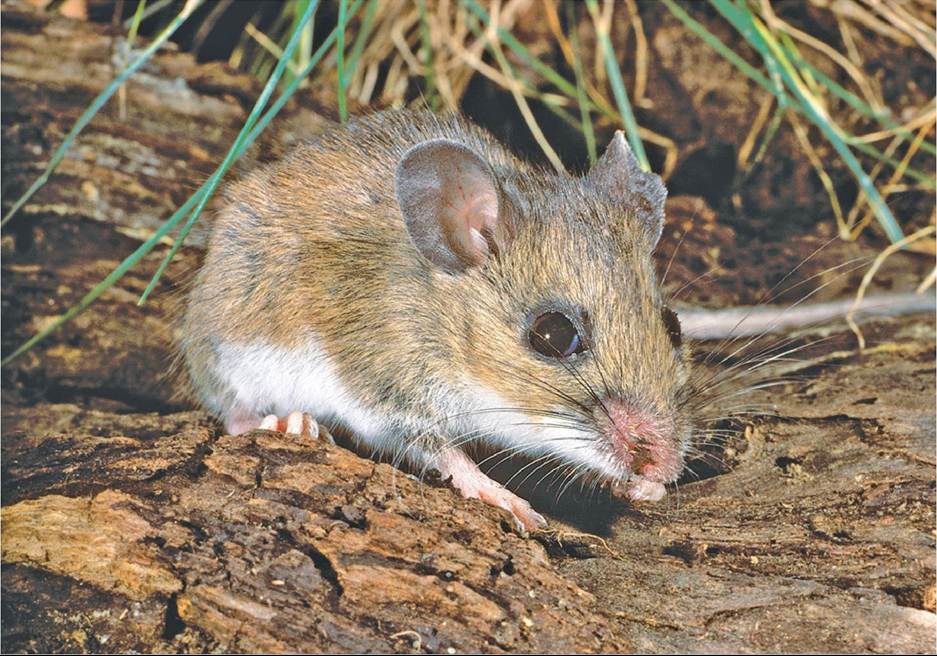
FIGURE 19.1 Deer Mice Trigger Hantavirus Infection in Humans Canthenumberof small-mammal species affect the transmission of hantavirus by the deer mouse? © E.R.
Degginger/Alamy Stock Photo View larger imageOver the last 70 years, the number of emerging diseases affecting humans has substantially increased. Of these diseases, 62% are zoonotic—hosted by wildlife and infectious to humans. Diseases such as the Zika virus, Ebola virus, and avian influenza are all zoonotic diseases that have emerged over the last few decades. The most recent evidence for the coronavirus SARS-CoV-2 (COVID-19) is that it is a zoonotic disease, having been transmitted to humans from wild animals sold at the Huanan Seafood Wholesale Market in Wuhan, China. The factors that affect zoonotic disease emergence are complex and sometimes disease specific but often include human-caused events such as species invasions, climate change, pollution, and land use conversion. One seemingly unlikely factor, that of declining species diversity, is starting to be recognized as an important mechanism that may facilitate the emergence and transmission of zoonotic diseases.
It turns out that hantaviruses provide a nice model system for studying how the loss of species diversity within a community may affect disease emergence and transmission. A number of observational studies have linked hantavirus infection prevalence in deer mouse host populations with declining small-mammal species diversity. For example, in a field study in Oregon, the one variable that was significantly linked to SNV infection prevalence was small-mammal species diversity, with the prevalence of SNV rising from 2% to 14% as species diversity declined (Dizney and Ruedas 2009). A similar study in Utah came to the same conclusion. These researchers too found a negative correlation between smallmammal diversity and SNV infection prevalence in deer mice (Clay et al. 2009).
These observational studies are supported by an experimental study of hantaviruses in rodent communities of Panama. In their study, Gerardo Suzan and colleagues (2009) conducted a small-mammal removal experiment in replicate field plots, where zoonotic hantaviruses are native and common.
Smallmammal diversity was reduced through trapping of species that were not host to the virus. They found that plots with reduced small-mammal diversity had an increase in rodent host individuals and also that more of those individuals were infected by hantavirus (FIGURE 19.2).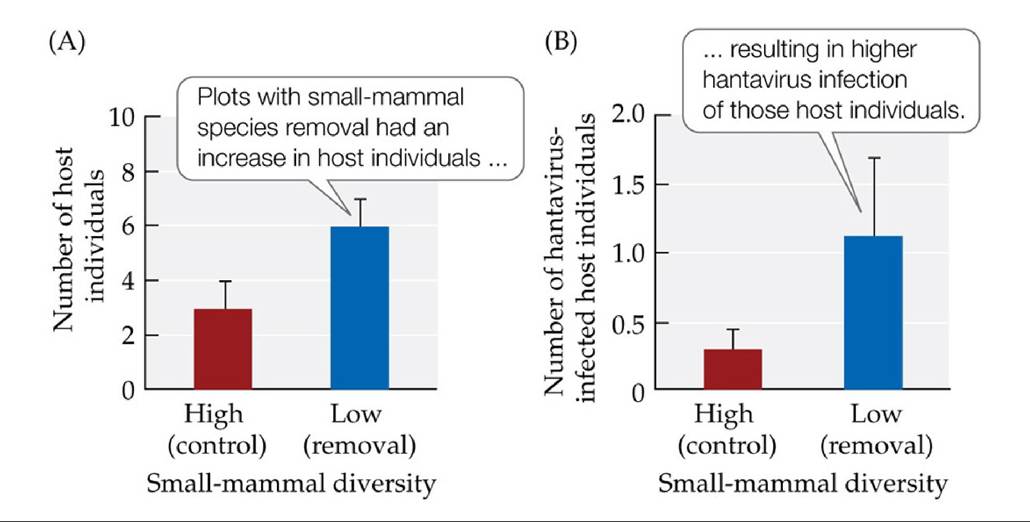
FIGURE 19.2 Disease Transmission Increased with Species Diversity Loss An experiment in Panama showed that plots with small-mammal diversity removal (low-diversity plots) increased in (A) the number of rodent host individuals and (B) the number of hosts infected with the hantavirus compared with the control (high-diversity plots). Error bars show one standard error (SE) of the mean. (After F. Keesing et al. 2010. Nature 468: 647-652.) View larger image
The observational and experimental evidence presented here point to the role of species diversity in buffering the transmission of zoonotic pathogens to wildlife and ultimately humans. But what explains the effect of species diversity in disease transmission? As we will see, the response of the host to changes in species diversity makes all the difference in the answer to this question.
More on the topic Can Species Diversity Suppress Human Diseases? A Case Study:
- In human medicine, certain systemic drugs used to treat diseases can have profound negative effects on hearing and balance.
- Reviewers
- Changes in community structure
- AVIAN CHOLERA