Some relationships between species diversity and community function are positive
The consequences of species diversity to communities were first proposed by both Robert MacArthur (1955) and Charles Elton (1958), who theorized that species richness should be positively related to community stability.
A community is thought to have stability when it remains, or returns, to its original structure and function after some perturbation (see Concept 17.4). The diversitystability theory remained “conventional wisdom” until the mid-1970s, when it was tested mathematically using food web models that varied in species richness and complexity (considered in more detail in Concept 21.4). But it was not until 40 years later that the theory was first tested experimentally.David Tilman and colleagues used a set of experimental plots on abandoned agricultural land at Cedar Creek, Minnesota, to explore the relationship between plant species richness and measures of community function (FIGURE 19.21A). In the first study, Tilman and Downing (1994) noticed that some of their experimental plots at Cedar Creek seemed to be responding to a drought differently than others. A survey of their plots showed that plots with higher species richness were better able to withstand the drought than plots with lower species richness (but the same density of plants) (FIGURE 19.21B). Drought- induced total plant biomass decrease was less in species-rich plots than in species-poor ones, resulting in a positive, curvilinear relationship between species richness and drought resistance (measured as the difference between biomass before and after the drought). Tilman and Downing reasoned that a curvilinear relationship would be expected if additional species beyond some threshold (the point at which the curve levels off; roughly 10-12 species in this study) had little additional effect on drought resistance. These species could be considered redundant in the sense that they had essentially the same effects on drought resistance as other species.
Tilman and Downing suggested, however, that once the number of species in a plot declined below that threshold, each additional species lost from the plot would result in a progressively greater negative effect of drought on the community.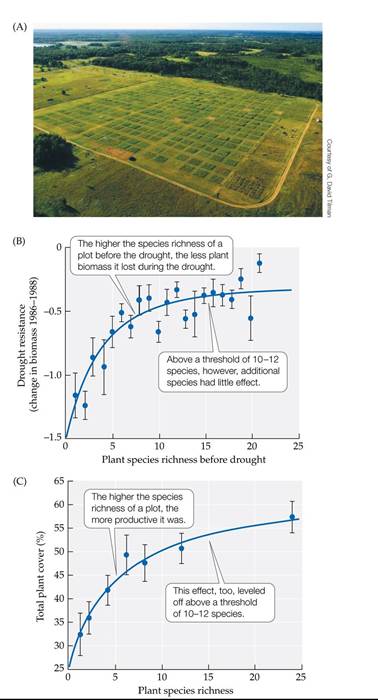
FIGURE 19.21 Species Diversity and Community Function (A) Tilman and colleagues used their prairie plots at the Cedar Creek site in Minnesota to test the effects of species richness on community function. (B) First, they measured the effects of a drought on plant biomass in plots that varied in species richness. (C) They then created plots that varied in species richness, though all had the same density of individual plants, and measured biomass in those plots after 2 years of growth. Error bars show ± one standard error (SE) of the mean. (B after D. Tilman and J. A.
Downing. 1994. Nature 367: 363-365; C after D. Tilman et al. 1996. Nature 379: 718-720.) View larger image
To test this idea more rigorously, Tilman et al. (1996) conducted a well- replicated experiment in which species diversity was directly manipulated. In the same prairie ecosystem, a series of plots that differed in plant species richness, but not in the number of individual plants, was created by randomly selecting sets of species from a pool of 24 species. Each plot was provided with the same amounts of water and nutrients. When biomass in the plots was measured after 2 years of growth, the results confirmed the curvilinear effect of species richness on biomass (FIGURE 19.21C) and additionally showed that nitrogen was more efficiently used as species richness increased.