There is debate over diversity-function relationships and their explanations
Although experiments documenting the relationships between species diversity and community function continue to increase in their sophistication, ecologists have debated over the generality of the relationships and their underlying mechanisms.
Naeem and colleagues (1995) summarized at least three possible relationships between species diversity and community function and their corresponding hypotheses. Two variables distinguish these hypotheses: the degree of overlap in the ecological functions of species, and variation in the strength of the ecological functions of species.The first hypothesis, known as the complementarity hypothesis, proposes that as species richness increases, there will be a linear increase in community function (FIGURE 19.22A). In this case, each species added to the community will have a unique and equally incremental effect on community function. We might expect this type of pattern if we assume that species are equally partitioning their functions within a community. For example, as more and more species are added to the community, each of their unique individual functions will accumulate and increase the overall community function.
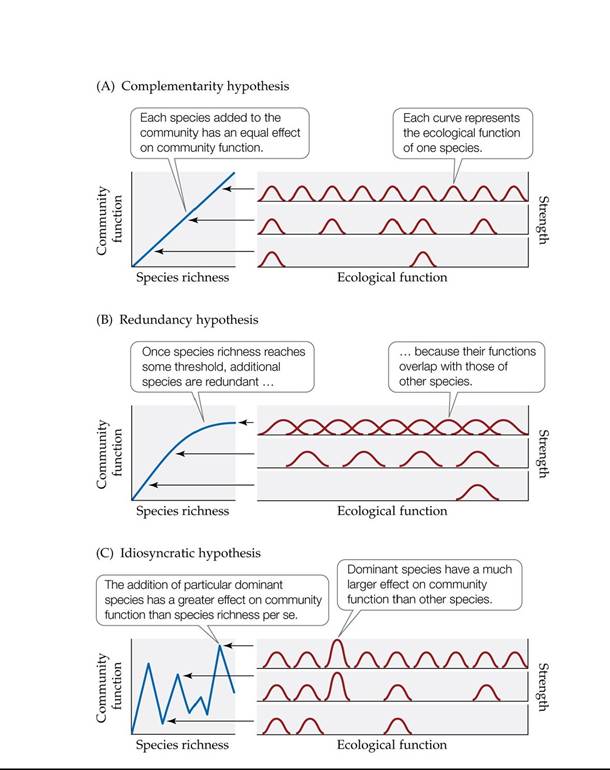
FIGURE 19.22 Hypotheses on Species Richness and Community Function Atleast three possible relationships between species diversity and community function and their corresponding hypotheses have been proposed. Two variables distinguish these hypotheses: the degree of overlap in the ecological functions of species, and variation in the strength of the ecological functions of species. (After G. Peterson et al. 1998. Ecosystems 1: 6-8.) View larger image
The second hypothesis, known as the redundancy hypothesis, relies on assumptions similar to those of the complementarity hypothesis, but it places an upper limit on the effect of species richness on community function (FIGURE 19.22B).
This model best fits the results of Tilman and colleagues described above (see Figure 19.21), in which the functional contribution of additional species reaches a threshold. This threshold is reached because as more species are added to the community, there is overlap in their function—essentially, there is redundancy among species. In this model, species can be thought of asbelonging to certain functional groups (see Figure 16.4C). As long as all the important functional groups are represented, the actual species composition of the community is of little importance to its overall function.
The third hypothesis, known as the idiosyncratic hypothesis, proposes that the ecological functions of some species have stronger effects than others do and that they vary dramatically (FIGURE 19.22C). Some species have a large effect on community function, while other species have a minimal effect. The addition of dominant species to a community will therefore have a large effect on community function, producing a curve with an idiosyncratic shape, as shown in Figure 19.22C. If communities are assembled in such a way that there are only a few dominant species (e.g., keystone or foundation species; see Figure 16.16), then one would expect community function values to vary dramatically with species richness—that is, there would be peaks and valleys in community function values, depending on whether the dominant species were present or not. As species richness increases, however, the chance that the dominant species will be present also increases. As a result, the variation in community function values should eventually stabilize.
Although these models provide a theoretical foundation for understanding how species contribute to community function, testing them is logically challenging because of the number of species involved and the variety of community functions that could be considered. In many ways, these models and tests are at the heart of modern community ecology, not only because they tell us something about how communities work, but also because they may be able to tell us what the future holds for communities that are both losing (by extinction) and gaining (by invasions) species through human influence.
A Case Study Revisited
Can Species Diversity Suppress Human Diseases?
The potential value of understanding how species diversity controls community function is limitless when we consider the services communities provide to humans. As we have seen, these services are numerous and diverse. One potential service that has been overlooked until recently is the role species diversity plays in infectious disease emergence and transmission. As we saw in the Case Study at the opening of this chapter, Suzan and colleagues (2009) showed that plots with reduced small-mammal diversity increased in both host rodent species abundance and the number of SNV-infected rodent individuals (see Figure 19.2). How can species diversity have this effect on disease transmission? Several hypotheses have been proposed. First, if the species that are lost within the community compete with or prey on the host species, then their loss can lead to an increase in the population density of the host and the pathogen. Second, it might be that hosts in more species-diverse situations are simply more likely to come into contact with individuals of other species than their own species (conspecifics), reducing the probability of transmission. Finally, it may be that more diverse communities allow hosts to build up greater resistance to diseases because those hosts are exposed to similar pathogens in other species within the community.
The research to date on the effects of species diversity on hantavirus transmission best supports the first two hypotheses. In the case of the experimental plots in Panama, the data support the first hypothesis; there was an increase in the number of rodent individuals that led to an increase in the number of SNV-infected hosts (see Figure 19.2). Presumably, as the number of smallmammal competitors declined, the rodent host species were able to take advantage of greater resources and their numbers increased. More host individuals then led to greater hantavirus disease transmission.
However, the results from the observational studies in Utah and Oregon showed a different pattern that more closely supports the second hypothesis. In those studies, the lower smallmammal diversity increased infection prevalence by simply increasing the encounter rate, rather than density, of individuals of the same host species.Disentangling the effect of higher density from the effect of reduced species diversity can be difficult. One study, using the trematode parasite Schistosoma mansoni and its snail host, manipulated species richness while keeping density constant (Johnson et al. 2009). The researchers showed that the presence of other snail species reduced parasite transmission even when the density of the host remained constant. In this case, the multispecies treatments reduced the encounter rate of the snail host with its trematode parasite by providing alternative but suboptimal host species. Other studies have shown that which species are lost within a community can make a difference in disease transmission, supporting principles of the idiosyncratic hypothesis (see Figure 19.22C). It is clear that the number of examples of species diversity loss and disease transmission is increasing, but the generalities that can be drawn from these examples are still unfolding.
By applying basic principles of ecology to zoonotic disease transmission, we can see that we cannot underestimate the role of species diversity in regulating community integrity. We must consider what might seem like inconsequential and esoteric details, such as the number of species that coexist within communities. In this case, species richness makes all the difference, not only in protecting humans from disease transmission, but also in thwarting
emerging and potentially dangerous diseases in the future.
Connections in Nature
Managing Pathogens by Managing Biodiversity
As more evidence accumulates that changes in biodiversity can trigger infectious diseases, there is interest in managing for these outbreaks.
Management can come in many forms depending on the pathogen in question. Beyond the obvious recommendation that genetic and species diversity be maintained within ecosystems, there are other management suggestions that can help provide early warning signs or reduce the risk of emerging pathogens altogether.First, it is critical to survey potential “emergence hot spots” where land use changes and agricultural intensification reduce diversity and have the potential to trigger endemic wildlife pathogens, potentially causing them to jump to new host species, including livestock and humans. In fact, research shows that almost half of the zoonotic diseases that have emerged since 1940 have occurred in regions where major changes in land use, agriculture, or wildlife hunting practices have occurred (Jones et al. 2008). In addition, taking care to reduce disease transmission of captive wildlife should be a special focus, given the recent evidence that coronavirus SARS-CoV-2 (COVID 19) was transmitted to humans from captive wild animals sold at a market in China.
Second, the research also suggests that another 20% of diseases emerging since the 1940s have arisen through the widespread use of antibiotics and the production of resistant strains of microbes. Antibiotics are thought to select for resistant microbes both by eliminating the diversity of nonresistant microbial strains and by eliminating species that suppress those strains. The observation that a more diverse microbiome can suppress strains that are resistant to antibiotics suggests that avoiding the overuse of these pharmaceuticals in medicine and agriculture is critical in preventing emerging diseases.
Finally, managing emerging diseases will involve considering the complex ways that factors such as climate change, invasive species, and pollution interact with biodiversity loss to increase the emergence and transmission of diseases. Despite the many questions that remain, it is clear that managing for biodiversity is a critical component in protecting human populations from potential disease epidemics.