SUMMARY
CONCEPT 19.1 Species diversity differs among communities as a consequence of regional species pools, abiotic conditions, and species interactions.
19.1.1 Describe how regional species' pools and dispersal abilities contribute to community membership.
The regional species pool and the dispersal abilities of species play important roles in supplying species to communities.
Humans have greatly expanded the regional species pools of communities by serving as vectors for the dispersal of non-native species.
19.1.2 Describe how local environmental conditions act as a “filter” for community membership.
Local environmental or abiotic conditions act as a strong “filter” for community membership because species must be physiologically adapted to those conditions of the community.
19.1.3 Describe how species interactions may act to include species in, or exclude species from, communities.
When a species depends on other species for its growth, reproduction, and survival, those other species must be present if it is to gain membership in a community.
Species may be excluded from communities by competition, predation, parasitism, or disease. When non-native species are excluded, the community has biotic resistance to the potential invasion.
CONCEPT 19.2 Resource partitioning is theorized to reduce competition and increase species diversity.
19.2.1 Define resource partitioning.
Resource partitioning theory predicts that species must use resources slightly differently if they are to avoid competitive exclusion.
19.2.2 Outline observations, experiments, and models that support resource partitioning as a mechanism of species coexistence.
One model of resource partitioning states that the less overlap there is among species in their use of resources, along a resource spectrum, the more species can coexist in the community.
The resource ratio hypothesis posits that species that use the same set of resources are able to partition them by using them in different proportions.
CONCEPT 19.3 Processes such as disturbance, stress, predation, and positive interactions can mediate resource availability, thus promoting species diversity.
19.3.1 Describe the role of disturbance, stress, and predation in mediating coexistence and promoting species diversity.
If disturbance, stress, or predation keeps dominant competitors from reaching their carrying capacity, competitive exclusion will not occur and coexistence will be maintained.
19.3.2 Define and give examples of the intermediate disturbance hypothesis and its variations, including those that consider predation and positive interactions.
The intermediate disturbance hypothesis states that intermediate levels of disturbance, stress, or predation promote species diversity by reducing competitive exclusion. At low levels of disturbance, competitive exclusion reduces species diversity, and at high levels of disturbance, high mortality reduces species diversity.
The dynamic equilibrium model predicts that species diversity will be highest when the level of disturbance and the rate of competitive displacement are roughly equivalent.
Positive interactions can promote species diversity, particularly at intermediate to high levels of disturbance, stress, or predation.
The Menge-Sutherland model is similar to the intermediate disturbance hypothesis except that it separates the effect of predation from that of physical disturbance.
19.3.3 Define and give examples of lottery or neutral models.
Lottery and neutral models assume that resources in a community made available by disturbance, stress, or predation are captured at random by recruits from a larger pool of potential
colonists, whose chances for capturing resources are equal.
CONCEPT 19.4 Many experiments show that species diversity affects community function.
19.4.1 Describe the relationships between species diversity and ecosystem functions from observations and experiments.
Evidence suggests that species diversity can control numerous functions of communities, including productivity, soil fertility, water quality and availability, atmospheric gas exchange, and responses to disturbance.
Some manipulative experiments in different communities have shown that as species diversity increases, so does community function.
19.4.2 Compare the hypotheses given to explain species diversity and ecosystem function relationships.
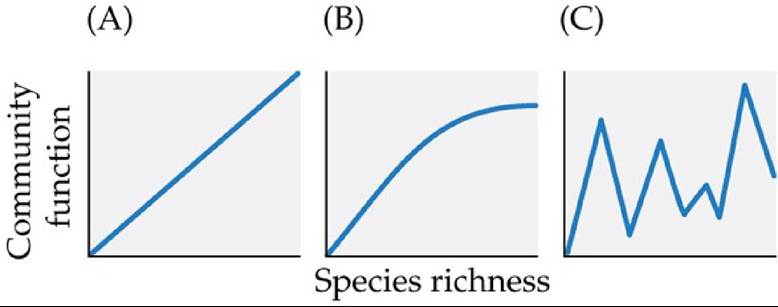
Hypotheses proposed to explain the positive relationship between species diversity and community function fall into three general categories, which include different assumptions about the degree to which individual species vary in their contribution to community function.
REVIEW QUESTIONS
1. Suppose you are an ecologist studying prairie grassland communities in Minnesota. As you are doing your fieldwork, grass seeds with hooked spines attach themselves to your shoes. You then travel to New Zealand to study the grasslands on the South Island. When you enter the customs area in the Auckland airport, the officers in charge ask if you have visited a natural area or farm recently. You say yes, and they tell you to take off your shoes and wait while they disinfect them with bleach. Given what you know about the mechanisms important to community membership, is it worth the time and money required to clean all that footwear before allowing it into New Zealand?
2. We know that species diversity varies greatly among communities. Describe how some of the models proposed to explain this variation differ in their explanations of the mechanisms involved.
3. Suppose you are studying a tropical rainforest community in Panama. You obtain a 50-year data set for the forest that records both the mortality of adult trees and the emergence of new tree seedlings. As you analyze the data, you try to determine whether there is a pattern of species replacement, in which individuals of one species generally replace one another in the same sites, rather than individuals of other species establishing.
After much work, you are convinced that no pattern of replacement exists in this forest—instead, sites are colonized in an entirely random fashion, with no one species having an advantage. What general set of models of species diversity best describes your observations, and why?4. Recent experimental work in communities has shown positive relationships between species diversity and community function. We learned that there is considerable debate about the relationships and their controlling mechanisms and that at least three hypotheses have been developed to explain them. Below are three graphs (A, B, and C) of species richness-community function relationships that vary in the shapes of their curves. Describe which hypothesis best fits each curve, and why.
HONE YOUR PROBLEM-SOLVING SKILLS
In the Case Study of this chapter, we explored the results of a study that considered the relationship between species diversity and disease transmission of the Sin Nombre virus in deer mouse populations in Oregon (Dizney and Ruedas 2009). Suppose a similar study is conducted in six parks in or around a city that vary in their degree of human disturbance. The researchers record the number of small-mammal species, the density of deer mice, and the number of deer mouse individuals infected with the Sin Nombre virus. Below is a table with the results of this hypothetical study, organized by the degree of human disturbance at the trapping locations:
| Park | Degree of human disturbance (lowest to highest) | Small-mammal species richness | Deer mouse density | Sin Nombre virus infection prevalence |
| 1 | 1 | 12 | 5 | 0.045 |
| 2 | 2 | 14 | 6 | 0.045 |
| 3 | 3 | 16 | 6.5 | 0.04 |
| 4 | 4 | 13 | 6.5 | 0.04 |
| 5 | 5 | 9 | 5.5 | 0.08 |
| 6 | 6 | 6 | 6 | 0.12 |
1.
Graph the relationship between degree of human disturbance and small-mammal species richness. What species diversity model do your data best describe, and why?2. Now graph the relationship between species richness and deer mouse density. What does the graph show? Do the data support the theory that species richness is a consequence of resource partitioning in this small-mammal community?
3. Graph both the relationship of species richness with Sin Nombre virus infection prevalence in the deer mouse and the relationship of deer mouse density with Sin Nombre virus infection prevalence in the deer mouse. Which factor seems to be more important in spreading infection in deer mice— species richness or deer mouse density? Explain why this might be so, based on theory.
LIST OF KEY TERMS
biotic resistance community functions community stability Competitive displacement complementarity hypothesis dynamic equilibrium model idiosyncratic hypothesis intermediate disturbance hypothesis lottery models neutral models niche partitioning resource partitioning resource ratio hypothesis
More on the topic SUMMARY:
- Molecular Epidemiology of Bovine Tuberculosis in Uganda
- Contents
- Animal Husbandry
- Other Mycobacterial Infections in Livestock and Wildlife in Tanzania
- REVIEW OF FORENSIC ASSESSMENT INSTRUMENTS
- PRAEDIAL SERVITUDES
- Qatar
- AAP. Guidelines for Air and Ground Transport of Neonatal and Pediatric Patients. 4th edition. — American Academy of Pediatrics,2015. — 488 p., 2015
- Somalia
- FIVE COMPONENTS OF LEGAL COMPETENCIES