Molecular Epidemiology of Bovine Tuberculosis in Uganda
Although the use of molecular diagnostic methods has been an integral part of human TB investigation schemes for some time, molecular typing of M. bovis is a fairly recent addition to the BTB diagnostic regimen in livestock in Uganda.
Funded animal TB research projects collaborate with the National TB Surveillance Program, thus allowing them access to their molecular diagnostic technologies and laboratory facilities.From the approximately 20,000 animals examined at slaughter in Ugandan abattoirs during the course of the past 10 years, 800 had lesions suggestive of BTB. Specimens from these lesions were cultured for mycobacteria, and the isolates were subsequently subjected to molecular analysis for identification of the strains. These endeavors yielded only 13 unique spoligotypes (Oloya et al. 2007a; Muwonge
Table 22.1 Summary of reports of tuberculosis caused by M. bovis in cattle, humans, and pigs in Uganda
| Region | Host | Diagnostic tool | Sample size | Positive (%) | References |
| Karamoja | Cattle | Tuberculin test | 1470 | 1.2 | Inangolet et al. (2008) |
| Kampala | Cattle | Necropsy | 3330 | 0.6 | Asiimwe et al. (2009) |
| Mbarara | Cattle | Necropsy | 97 | 13.4 | Nasaka (2014) |
| Cattle corridor | Cattle and goats | Necropsy | 1576 | 0.8 | Nalapa et al. (2015) |
| Central Uganda | Cattle | Necropsy | 61 | 31.1 | Oloya et al. (2007b) |
| Karamoja and Nakasongola | Cattle | Tuberculin test | 1864 (31a) | 45.2 | |
| Moroto | Human | Aspirate exam | 43 | 6.9 | |
| Mbarara | Human | Sputum exam | 70 | 1.4 | Byarugaba et al. (2010) |
| Mubende | Pigs | Necropsy | 997 | 0.3 | Muwonge (2012) |
| Mbarara | Cattle | Tuberculin test | 525 | 2.1 | Bernard et al. (2005) |
aNumber of herds
et al. 2012a; Asiimwe et al. 2009). This spoligotype diversity is higher and lower, respectively, than that reported in Ethiopia and Tanzania. The dominant spoligotypes (SB1470 and SB0133) belong to the Af2 clonal complex (Fig. 22.2) reported to be geographically restricted to East Africa (Berg et al. 2011). Based on the currently available data, SB1470 and SB1405 appear to be restricted to the northeastern and southwestern parts of the UCC, respectively, while SB0133 has been isolated from cattle originating from both the northeast of the UCC and western part of Uganda’s oil basin. One of the less frequently observed spoligotypes, (SB1469), has been isolated from humans, cattle, and pigs from the northeastern and central parts of the UCC (Oloya et al.
2007a; Asiimwe et al. 2009). It is important to note that with the limited data available, the molecular epidemiological picture of M. bovis in Uganda has a lot of holes to be patched. Nonetheless, the presence of identical spoligotypes in districts that are at a great distance from each other suggests the following:• Some of the M. bovis spoligotypes are ubiquitous in the UCC.
• The occurrence of identical spoligotypes in districts separated by large and/or short distances suggests the existence of an uncontrolled animal movement network in Uganda (Fig. 22.3).
• The distribution of spoligotypes, which reflects the inferred cattle movement network (Fig. 22.1), corroborates this assumption.
• If verified, the animal movement network will provide a critical base for targeted infectious disease control measures.
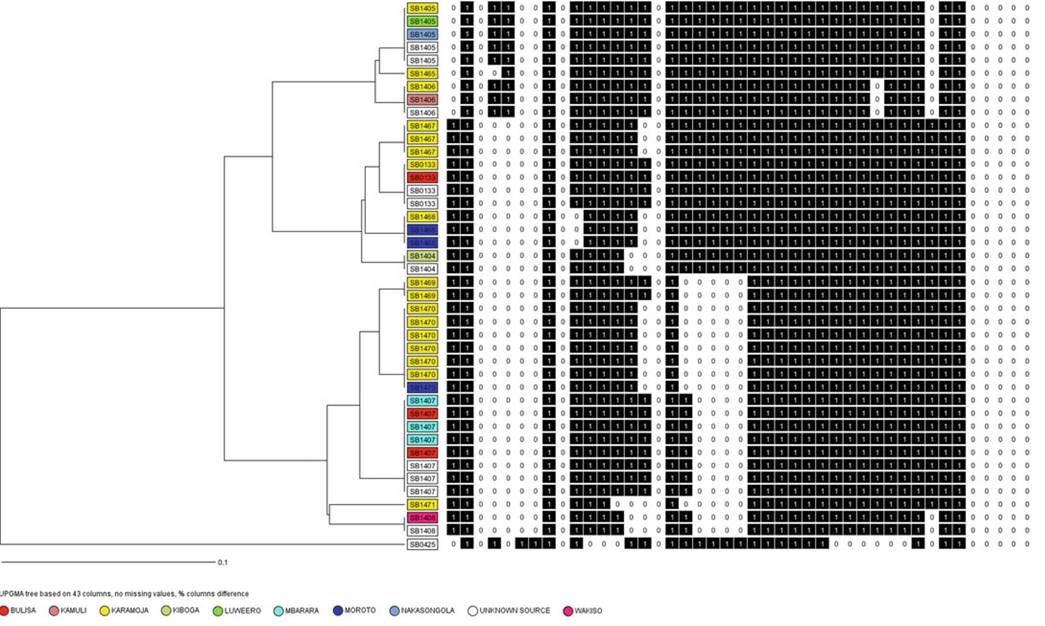
Fig. 22.2 Spoligotypes isolated in Uganda during the past 13 years. The dendrogram was generated using RIDOM ver 1.2. There are two groups of isolates in Uganda: the majority belong to the Af2 clonal complex, characterized by the loss of spacer 3-7; the rest belong to a group yet to be characterized
432 A. Muwonge et al.
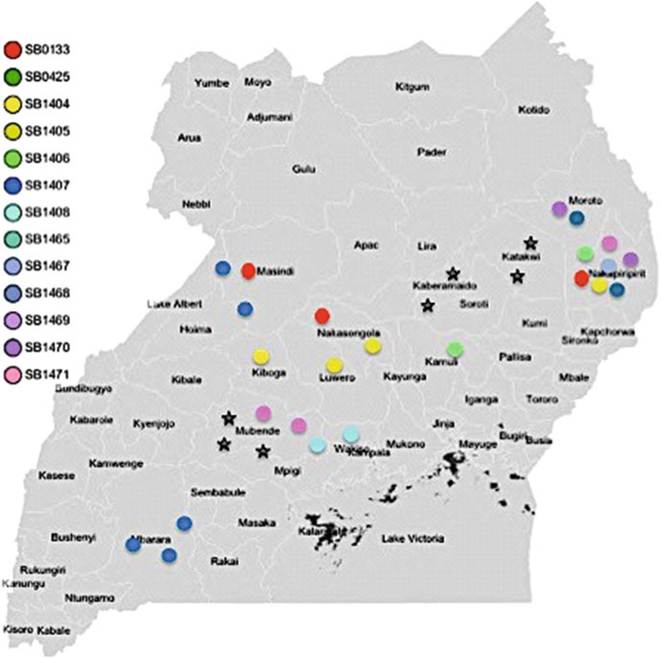
Fig. 22.3 Spatial distribution of the spoligotypes recovered in Uganda in the past 13 years. The black stars represent isolates that are not yet typed (Nalapa et al. 2015, unpublished data)
22.5
More on the topic Molecular Epidemiology of Bovine Tuberculosis in Uganda:
- Molecular Epidemiology of Bovine Tuberculosis in Uganda
- Policy Provisions for Bovine and Zoonotic Tuberculosis in Uganda
- References
- Cattle Movement Networks in Uganda
- References
- Bovine Tuberculosis in Uganda
- Chapter 23 Bovine Tuberculosis in Zambia
- Summary
- References
- References