Latitudinal gradients have multiple, interrelated causes
As we have seen, global patterns of species richness are ultimately controlled by the rates of three processes: speciation, extinction, and dispersal. Let's assume here, for simplicity's sake, that the rate of species dispersal is roughly the same worldwide.
We can then predict that the number of species at any particular location will reflect a balance, or equilibrium, between the rates of two fundamental processes: speciation and extinction. Subtracting the extinction rate from the speciation rate gives us the rate of species diversification: the net increase or decrease of species diversity over time. What ultimately controls this rate? Dozens of hypotheses have been proposed to explain species diversification with latitude, but there is very little agreement among biogeographers and ecologists. Part of the reason lies in the fact that there are multiple and confounding latitudinal gradients in area, evolutionary age, and climate that are correlated with species diversity gradients. In addition, because speciation and extinction occur at a global spatial scale and over evolutionary time scales, it is impossible to conduct manipulative experiments to isolate various factors and separate correlation from causation.In an effort to summarize the most convincing ideas, Gary Mittelbach and colleagues (2007) suggested that hypotheses proposed to explain latitudinal gradients in species richness fall into three broad categories. The first category of hypotheses is based on the assumption that the rate of species diversification in the tropics is greater than that in temperate regions (FIGURE 18.14A). The second category of hypotheses suggests that the rates of diversification in the tropics and at higher latitudes are similar, but that the evolutionary time available for diversification has been much greater in the tropics (FIGURE 18.14B).
The third category of hypotheses suggests that resources are more plentiful in the tropics because of higher productivity, and thus that species there have higher carrying capacities and a greater ability to coexist (FIGURE 18.14C). Let's take a look at each category of hypotheses in more detail.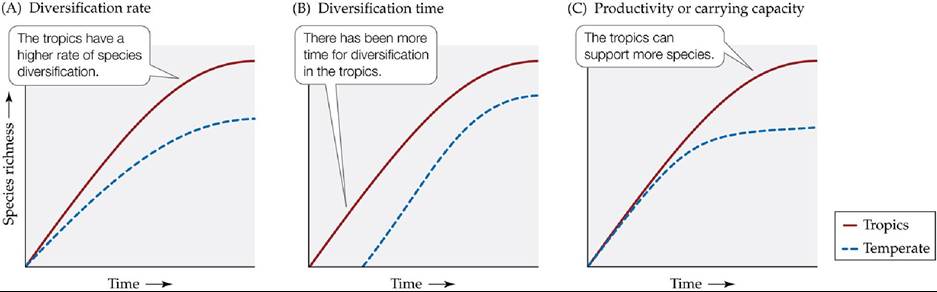
FIGURE 18.14 Hypotheses Proposed to Explain the Latitudinal Gradient in Species Richness (A) The tropics have a higher diversification rate (speciation rate - extinction rate) than temperate areas do, so they have accumulated species faster. (B) The tropics have had more time for diversification than temperate areas have, so they have accumulated more species. (C) Because their productivity is higher, the tropics have a higher carrying capacity than temperate areas, so more species can coexist there. (After G. G. Mittelbach et al. 2007. Ecol Lett 10: 315-331.) View larger image
Species Diversification Rate
There are a number of hypotheses that seek to explain why species diversification might be higher in the tropics. One hypothesis relates diversification to geographic area and temperature. John Terborgh (1973) and Michael Rosenzweig (1992) proposed that terrestrial species diversity is highest in the tropics because the tropics have the largest land area (FIGURE 18.15A). Rosenzweig calculated that the region between 26°N and S has 2.5 times more land area than any other latitude range on Earth. This makes intuitive sense, given that this latitude range is at the middle, and thus at the widest part, of the planet. Equally interesting are data showing that this very large area is also the most thermally homogeneous region on Earth (FIGURE 18.15B). A plot of average annual temperature against latitude by Terborgh showed that land temperatures are remarkably uniform over a wide area between 25°N and S, but then drop off rapidly at higher latitudes.
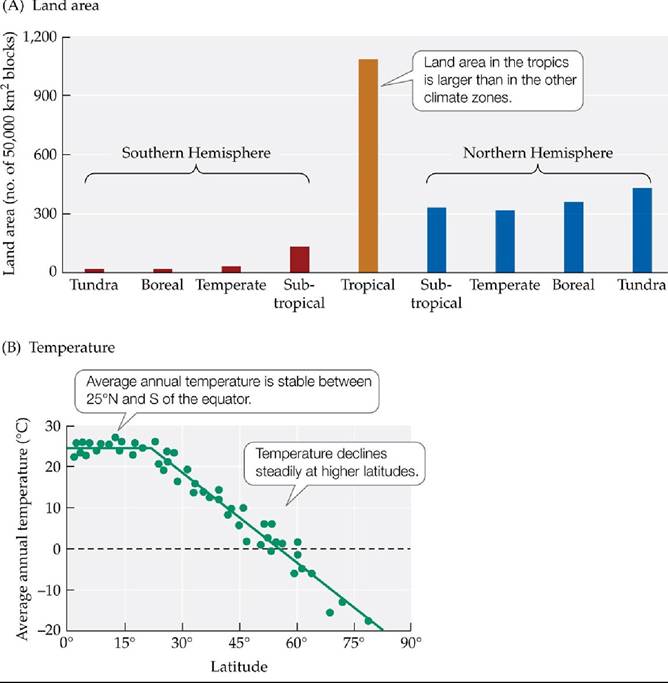
FIGURE 18.15 Do Land Area and Temperature Influence Species Diversity? Michael Rosenzweig hypothesized that two characteristics of the tropics lead to high speciation rates and low extinction rates: (A) their land area and (B) their stable temperatures.
(After M. L. Rosenzweig. 1992. JMammoi 73: 715-730.) View larger imageWhy would a larger land area and more constant temperatures foster greater species diversity? Rosenzweig suggested that these two factors combine to decrease extinction rates and increase speciation rates in tropical regions. He argued that a larger and more thermally stable area should decrease extinction rates in two ways: first, by increasing the population sizes of species (assuming that their densities are the same worldwide), and thus decreasing their risk of extinction due to chance events, and second, by increasing the geographic ranges of species, and thus decreasing their chances of extinction by spreading the risk over a larger geographic area (see Concept 10.2). He further suggested that
speciation should increase in larger areas because species should have larger geographic ranges, and thus should have a greater chance of reproductive isolation of populations (see Concept 6.4).
Species Diversification Time
The second category of hypotheses, which proposes that latitudinal gradients in species diversity are influenced by evolutionary history, was first championed by Wallace (1878). He suggested that tropical regions, because they are thought to have been more climatically stable over time (see Figure 18.15B), could have considerably longer evolutionary histories than temperate or polar regions, where severe climate conditions (such as ice ages) might have disrupted species diversification. Thus, even if rates of speciation and extinction were the same worldwide, the tropics should have accumulated more species over time merely because species should have had more uninterrupted time to evolve there.
With these ideas in mind, we can consider another possibility: that most species actually originate in the tropics and then disperse to temperate regions during warmer periods of greater climate homogeneity. The idea that the tropics serve as a “cradle” for diversity was originally proposed by Stebbins (1974). Jablonski et al.
(2006) recently examined this hypothesis by comparing modern marine bivalve faunas with marine bivalve fossils from as far back as 11 million years ago. They found that the majority of extant marine bivalve taxa originated in the tropics (FIGURE 18.16A) and spread toward the poles (FIGURE 18.16B), but without losing their tropical presence. Thus, in this particular case, we can think of the tropics as a cradle of species diversity because the majority of extant taxa originated there. But, as Jablonski and colleagues also pointed out, the tropics can serve as a “museum” as well as a cradle. If extinction rates in the tropics are low, then species that diversify there will tend to stay there “on display,” if you will. Jablonski and colleagues suggested that the current loss of biodiversity inthe tropics is likely to have profound effects because it not only compromises species richness today, but also could conceivably cut off the supply of new species to higher latitudes in the future.
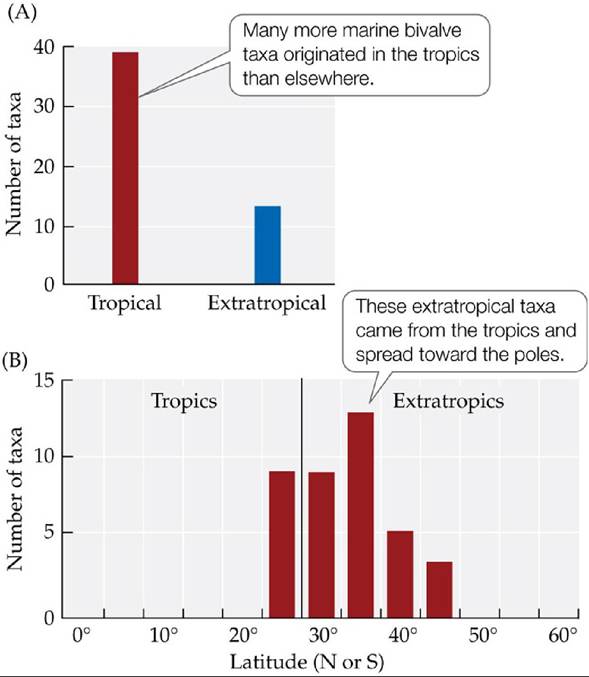
FIGURE 18.16 The Tropics Are a Cradle and a Museum for Speciation Extantandfossil marine bivalve taxa were examined to evaluate the hypothesis that longer evolutionary histories in the tropics contribute to the latitudinal gradient in species diversity. (A) Climate zones of first occurrence of marine bivalve taxa (based on families of fossils). (B) Range limits of modern marine bivalve taxa with tropical origins.
What is meant by the tropics being a cradle and a museum for diversity? (After D. Jablonski et al. 2006. Science 314: 102-106.) View larger image
Productivity
The final category of hypotheses for the latitudinal gradient in species diversity that we will consider is based on resources—in particular, productivity. The productivity hypothesis, proposed as long ago as 1959 by G. E. Hutchinson, posits that species diversity is higher in the tropics because that is where productivity is highest, at least for terrestrial systems (see Figure 20.7).
The thought is that higher productivity promotes larger population sizes because species will have higher carrying capacities. This higher productivity will lead to lower extinction rates, greater species coexistence, and overall higher species richness. The productivity hypothesis might explain why we see a reversal in the latitudinal gradient for some marine organisms, such as seabirds (see Figure 18.13), given that productivity is generally higher in temperate coastal marine habitats than in tropical regions (see Figure 20.7). But we also know that some of the most productive habitats on Earth, such as estuaries, typically have very low species diversity. Suffice it to say, the productivity hypothesis is complex and unsatisfactory in many cases. In Chapter 19, we will consider how productivity influences diversity at local scales, where manipulative experiments can give us more insight into its effects.Climate Change Connection
Latitudinal Gradients in Diversity under Climate Change
One way to explore the potential causes of latitudinal gradients in species diversity is to consider them over evolutionary time and with major changes in climate. We can ask, Did the fundamental pattern of increasing species diversity toward the tropics exist in the past, and if not, why? Philip Mannion and colleagues (2014) used the fossil record and fluctuations in past global temperatures as a window into past latitudinal and species diversity gradients and their potential causes. Their analysis showed that a tropical peak in species diversity has not been a universal pattern but has been restricted to particular intervals of time throughout the Phanerozoic when the Earth experienced colder, “icehouse” conditions (FIGURE 18.17). Likewise, they found that during warmer, “greenhouse” conditions, species diversity peaked in temperate latitudes, exhibiting a more unimodal relationship. These switches from temperate to tropical peaks in species diversity corresponded to transitions in greenhouse to icehouse climate conditions, lending support for the notion that polar to temperate glaciations could drive species to the tropics where extinctions would be lower.
Conversely, during greenhouse conditions, the tropics might become too hot for many organisms, leading to increased extinction rates and dispersal out of the tropics. One might speculate, in fact, that with global warming, latitudinal gradients in species diversity could become shallower or more unimodal as warming causes species to disperse poleward or become increasingly extinct within tropical latitudes.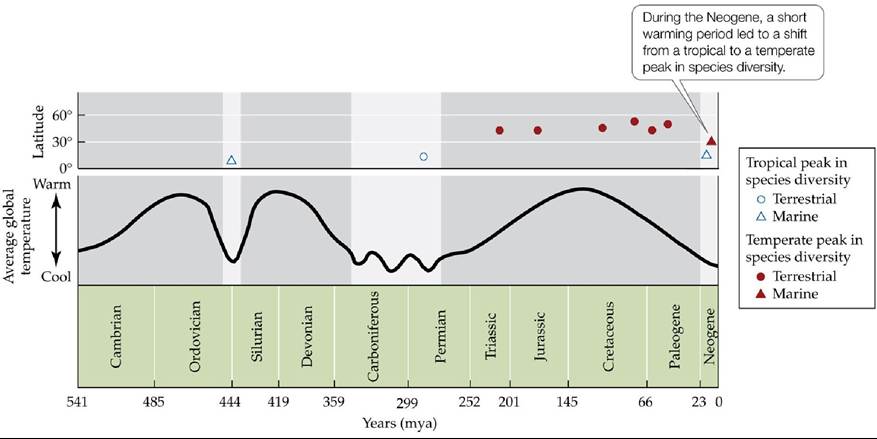
FIGURE 18.17 Latitudinal Species Diversity Gradients Vary with Climate The latitudinal species diversity gradients under fluctuating global temperature through the Phanerozoic. Tropical peaks in species diversity (open symbols) are restricted to cold, “icehouse” conditions, whereas temperate peaks in diversity (solid symbols) occur during warm, “greenhouse” intervals. Note that during the icehouse conditions of the Neogene, a short warming period during the Pleistocene interglacial period led to a peak in diversity at temperate latitudes. Circles are terrestrial examples, and triangles are marine examples. (After P. D. Mannion et al. 2014. Trends Ecol Evol 29: 42-50. CC BY 3.0) View larger image
∖._______________________________________________________________
As we have seen, biogeographic patterns have motivated and inspired some of the best and brightest scientists of modern times. Their fascination with the differences in the numbers and kinds of species at the global scale and their overwhelming drive to understand why these differences exist have resulted in some of the most influential scientific theories of all time, including that of the origin of species. In the next section, we will consider another important theory that strives to understand species diversity at smaller spatial scales.
More on the topic Latitudinal gradients have multiple, interrelated causes:
- Water flows along energy gradients
- Atmospheric circulation cells are established in regular latitudinal patterns
- Mountains influence wind patterns and gradients in temperature and precipitation
- MULTIPLE PREGNANCY
- Multiple Sclerosis
- Multiple Myeloma
- 3.4 MULTIPLE STRATEGIES AND DIVIDED COMMUNITIES
- Multiple Myeloma
- name=bookmark2992>B. Multiple Pledges
- Multiple choice questions
- Multiple choice answers