Atmospheric circulation cells are established in regular latitudinal patterns
A surface warmed by the sun emits infrared radiation and warms the air above it. As we have just seen, the heating of Earth's surface varies with latitude, and it can also vary with topography.
Such differential warming creates pockets of warm air surrounded by cooler air. Warm air is less dense (has fewer molecules per unit of volume) than cool air, so as long as a pocket of air remains warmer than the surrounding air, it will rise (a process called uplift; FIGURE 2.7). Atmospheric pressure is the force exerted by air's molecules on the air and surface below it. This pressure decreases with increasing altitude, so as a pocket of warm air rises, it expands. This expansion cools the rising air. Cool air cannot hold as much water vapor as warm air, so as the air continues to rise and cool, the water vapor contained within it begins to condense into droplets and form clouds.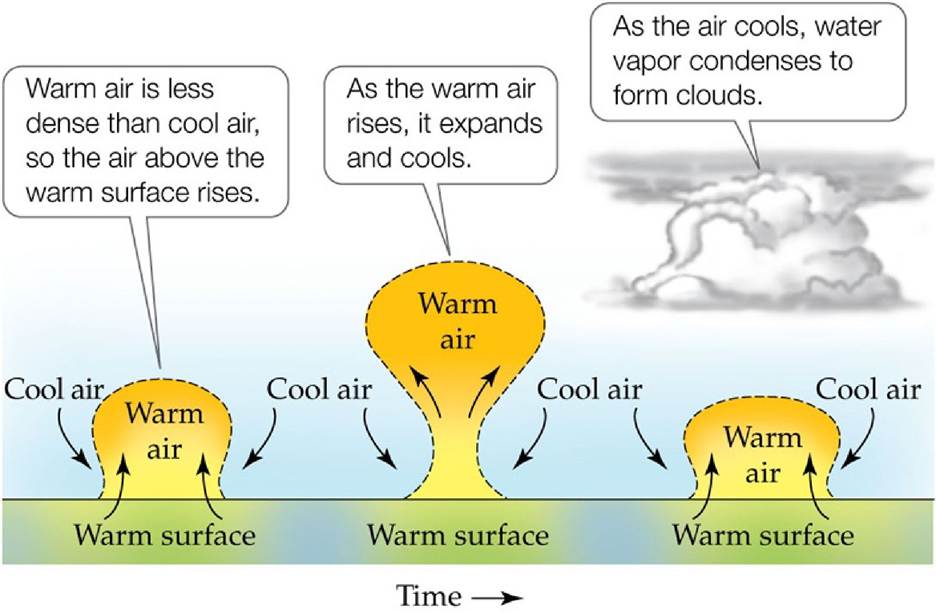
FIGURE 2.7 Surface Heating and Uplift Differential solar heating of Earth's surface leads to the uplift of pockets of air over the warmest surfaces. View larger image
The condensation of water into clouds is a warming process (another form of latent heat flux), which may act to keep the pocket of air warmer than the surrounding atmosphere and enhance its uplift, despite its cooling due to expansion. You may have observed this process on a warm summer day when bubble-shaped cumulus clouds formed thunderstorms. When there is substantial heating of Earth's surface and a progressively cooler atmosphere above the surface, the uplifted air will form clouds with wedge-shaped tops. The clouds reach to the boundary between the troposphere, the atmospheric layer above Earth's surface, and the stratosphere, the next atmospheric layer above the troposphere. This boundary is marked by a transition from progressively cooler temperatures in the troposphere to warmer temperatures in the stratosphere.
Thus, the air pocket ceases to rise once it reaches the warmer temperatures at the boundary of the stratosphere.Differential heating and storm formation explain why the tropics receive the most precipitation of any area on Earth. The tropics receive the most solar radiation and thus experience the greatest amount of surface heating, uplift of air, and cloud formation. The uplift of air in the tropics creates a band of low atmospheric pressure relative to zones to the north and south. When air rising over the tropics reaches the boundary between the troposphere and stratosphere, it flows toward the poles (FIGURE 2.8). Eventually, this poleward-moving air cools as it exchanges heat with the surrounding air and meets cooler air moving from the poles toward the equator. Once the air reaches a temperature similar to that of the surrounding atmosphere, it descends toward Earth's surface, a process known as subsidence. Subsidence creates regions of high atmospheric pressure around latitudes 30°N and S, which inhibit the formation of clouds. Thus Earth's major deserts are found at these latitudes.
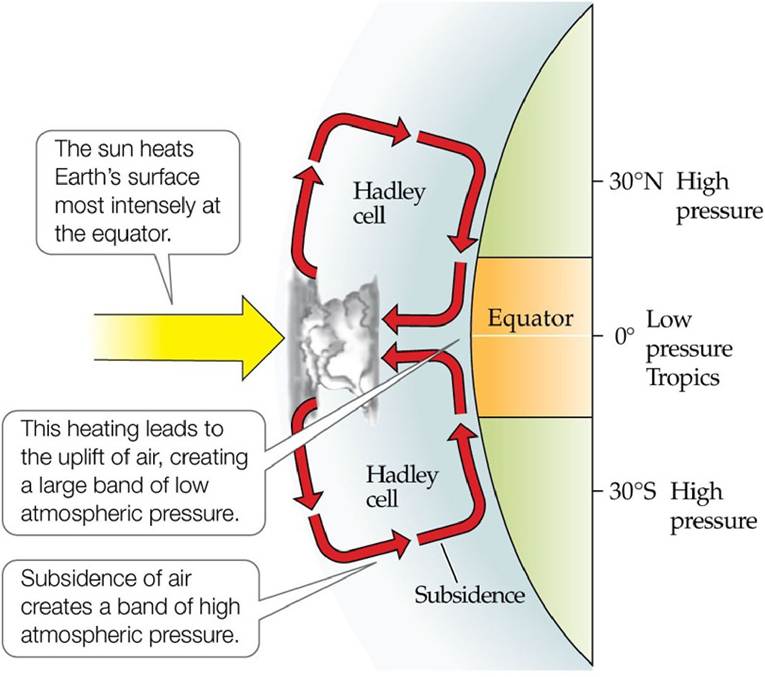
FIGURE 2.8 Tropical Heating and Atmospheric Circulation Cells The heating of Earth's surface in the tropics causes air to rise and release precipitation. View larger image
The tropical uplift of air creates a large-scale pattern of atmospheric circulation in each hemisphere known as a Hadley cell, named after George Hadley, the eighteenth-century British meteorologist and physicist who first proposed its existence. Additional atmospheric circulation cells are formed at higher latitudes (FIGURE 2.9). The polar cells, as the name indicates, occur at the North and South Poles. Cold, dense air subsides at the poles and moves toward the equator when it reaches Earth's surface. The descending air at the poles is replaced by air moving through the upper atmosphere from lower latitudes.
Subsidence at the poles creates an area of high pressure, so the polar regions, despite the abundance of ice and snow on the ground, actually receive little precipitationand are known as polar deserts. An intermediate Ferrell cell (named after American meteorologist William Ferrell) exists at midlatitudes between the Hadley and polar cells. The Ferrell cell is driven by the movement of the Hadley and polar cells and by exchange of energy between tropical and polar air masses in a region known as the polar front.
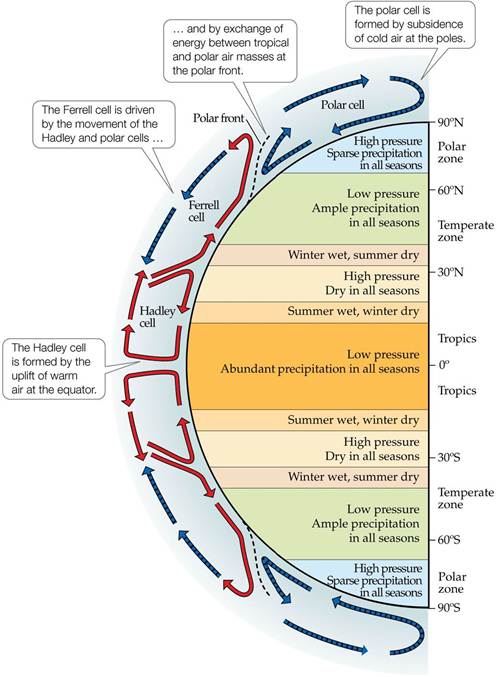
FIGURE 2.9 Global Atmospheric Circulation Cells and Climate Zones The differential heating of Earth's surface by solar radiation gives rise to atmospheric circulation cells, which determine Earth's major climate zones. View larger image
These three atmospheric circulation cells establish the major climate zones on
Earth. Between 30°N and S is the tropical zone, or simply the tropics. The temperate zones lie between 30° and 60°N and S, and the polar zones are
above 60°N and S (see Figure 2.9).