Atmospheric circulation cells create surface wind patterns
We've seen how the differential heating of Earth leads to zones of high and low atmospheric pressure. These pressure differences are important in explaining the movement of warm and cold air masses across Earth's surface.
Winds flow from areas of high pressure to areas of low pressure. Thus, the areas of high and low pressure formed by atmospheric circulation cells give rise to consistent patterns of air movement at Earth's surface, known as prevailing winds. We might expect these winds to blow in straight lines from high- to low-pressure zones. However, from the standpoint of an observer on Earth, the prevailing winds appear to be deflected to the right (clockwise) in the Northern Hemisphere and to the left (counterclockwise) in the Southern Hemisphere (FIGURE 2.10A). The apparent deflection is associated with the rotation of Earth: to an observer on Earth's surface rotating around the planetary axis, the path of the wind appears curved (FIGURE 2.10B). This apparent deflection is known as the Coriolis effect. To an observer in a fixed position in outer space, however, there is no apparent deflection in the direction of the wind.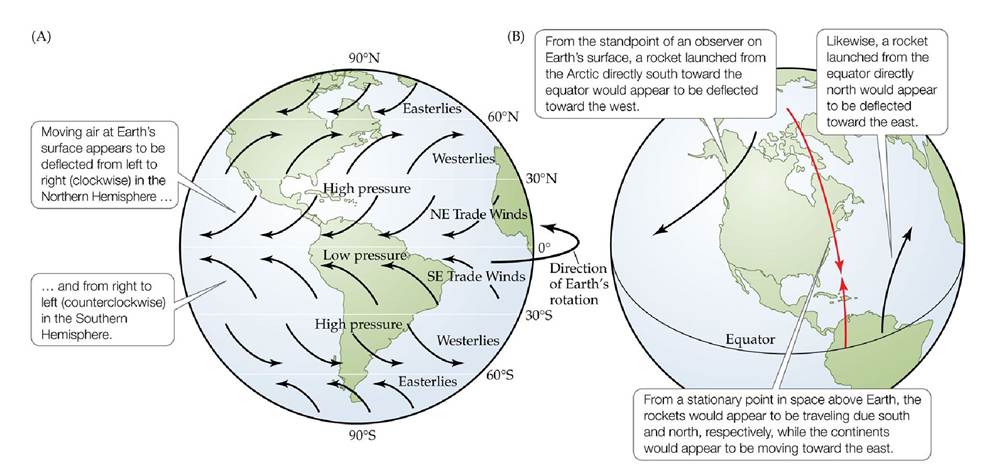
FIGURE 2.10 The Coriolis Effect on Global Wind Patterns (A)Thecorioliseffectresults from Earth’s rotation. (B) Visualization of the Coriolis effect using rockets. View larger image
As a result of the Coriolis effect, surface winds blowing toward the equator from the high-pressure zones at 30°N and S are deflected to the west from the perspective of Earth's surface. These winds are known as the trade winds because of their importance to the global transport of trade goods in sailing ships during the fifteenth through the nineteenth centuries. Winds blowing toward the poles from those zones of high pressure, called westerlies, are deflected to the east. The presence of continental land masses interspersed with oceans complicates this idealized depiction of prevailing wind patterns (FIGURE 2.11).
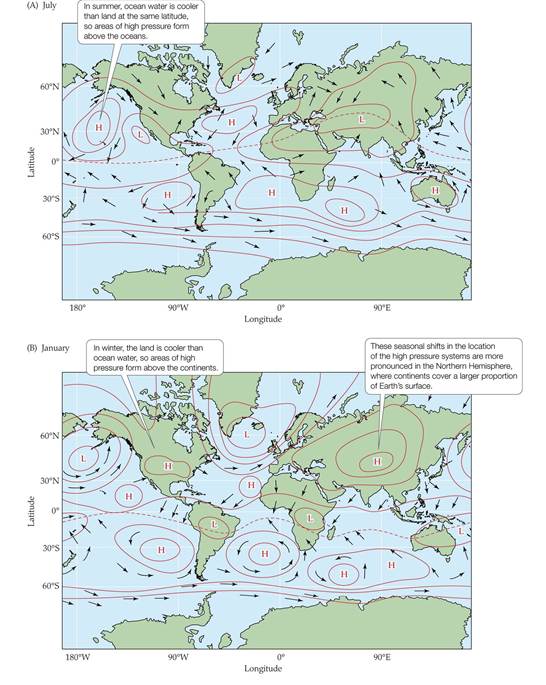
FIGURE 2.11 PrevailingWindPatterns The difference in heat capacity between the oceans and the continents leads to seasonal changes in atmospheric pressure cells that influence prevailing wind patterns. View larger image
Water has a higher heat capacity than land, so it absorbs and stores more energy with less temperature change than land. For this reason, the land surface warms up more than ocean water in summer, but in winter the oceans retain more heat, and thus remain warmer, than land at the same latitude. As a result, seasonal air temperature changes are less extreme over the oceans than they are on land. In summer, air over the oceans is cooler and denser than that over land, and semipermanent zones of high pressure (high-pressure cells) form over the oceans, particularly around 30°N and S. In winter, the opposite situation exists: the air over the continents is cooler and denser than that over the oceans, so high-pressure cells develop in the temperate zones over large continental areas.
Because winds blow from areas of high pressure to areas of low pressure, these seasonal shifts in pressure cells influence the direction of the prevailing winds. The effect of land areas on the development of these semipermanent pressure cells is more pronounced in the Northern Hemisphere than in the Southern Hemisphere because continental land masses make up a larger proportion of Earth's surface in the Northern Hemisphere.
More on the topic Atmospheric circulation cells create surface wind patterns:
- Each day we experience the weather around us: the current temperature, humidity, precipitation, wind, and cloud cover.
- Ocean currents are driven by surface winds
- Oceans cover 71% of Earth's surface and contain a rich diversity of life.
- Reviewers