Ocean currents are driven by surface winds
Wind moving across the ocean surface pushes the surface water. As a result of the Coriolis effect, the water appears to move at an angle to the wind. From the perspective of an observer on Earth, it is deflected to the right in the Northern Hemisphere and to the left in the Southern Hemisphere.
For this reason, the pattern of ocean surface currents is similar to, but not identical to, the pattern of prevailing winds. The speed of ocean currents is usually only about 2%-3% of the wind speed. An average wind speed of 10 m/s (22 miles per hour) would therefore produce an ocean current moving at 30 cm/s (0.7 miles per hour). In the North Atlantic Ocean, current velocities may be as high as 200 cm/s (4.5 miles per hour).Like air in the atmosphere, water in the ocean can move vertically as well as horizontally. Generally, the surface and deep layers of ocean water do not mix, because of differences in their temperature and salinity (concentration of dissolved salts). The surface waters—those above 75-200 m (250-600 feet)— are warmer and less saline, and therefore less dense, than the deeper, cooler ocean waters. When warm tropical surface currents reach polar regions, particularly the coasts of Antarctica and Greenland, their water loses heat to the surrounding environment and becomes cooler and denser. The water eventually cools enough for ice to form, which increases the salinity of the remaining unfrozen water. This combination of cooling and increasing salinity increases the density of the water, which sinks to deeper layers. The dense downwelling currents that result move toward the equator, carrying cold polar water toward the warmer tropical oceans.
These deep ocean currents connect with surface currents again at zones of upwelling, where deep ocean water rises to the surface. Upwelling occurs where prevailing winds blow nearly parallel to a coastline, such as off the western coasts of North and South America.
The force of the wind, in combination with the Coriolis effect, causes surface waters to flow away from the coast (FIGURE 2.12), and deeper, colder waters rise to replace them. Upwelling also occurs in the westward-flowing equatorial Pacific Ocean. As a result of the Coriolis effect, water just to the north and south of the equator is deflected slightly away from the equator, causing divergence of surface water and a zone of upwelling.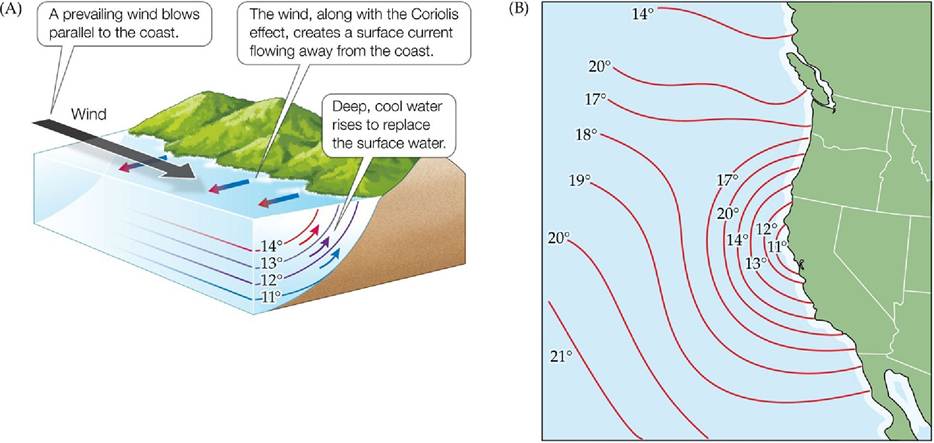
FIGURE 2.12 Upwelling of Coastal Waters (A) Wind blowing parallel to the coast causes surface water to flow away from the coast, pulling deep water upward to replace it. (B) Upwelling influences surface water temperatures off the west coast of North America. Ocean temperatures are shown in °C. View larger image
Upwelling has important consequences for the local climate, creating a cooler, moister environment. Upwelling also has a strong effect on biological activity in the surface waters. When organisms in the surface waters die, their bodies—and the nutrients they contain—sink. Thus, nutrients tend to accumulate in deep water and in sediments at the ocean bottom. Upwelling brings these nutrients back to the photic zone, the layer of surface water where there is enough light to support photosynthesis. Upwelling zones are among the most productive open ocean ecosystems because these nutrients increase the growth of phytoplankton (small, free-floating algae and other photosynthetic organisms), which provide food for zooplankton (free-floating animals and protists), which in turn support the growth of their consumers such as fish.
Ocean currents influence the climates of the regions where they flow. For example, the Gulf Stream and North Atlantic Drift, a current system that flows from the tropical Atlantic northward to the North Atlantic contributes to warmer winters in Scandinavia than in locations at the same latitude in North America.
In addition, winds blowing eastward across the Atlantic pick up heat from the ocean, which also contributes to a warmer climate in northern Europe. Winter temperatures on the west coast of Scandinavia are approximately 15°C (22°F) warmer than those on the coast of Labrador. This temperature difference is reflected in the vegetation: deciduous forests are common on the Scandinavian coast, while boreal forests of spruce and pine dominate the coast of Labrador. The Gulf Stream also keeps the North Atlantic ice-free most of the winter, whereas sea ice forms at the same latitude off the North American coast.Ocean currents are responsible for about 40% of the heat exchanged between the tropics and the polar regions. Thus, ocean currents are sometimes referred to as the “heat pumps” or “thermal conveyers” of the planet. A large system of interconnected surface and deep ocean currents that links the Pacific, Indian, and Atlantic Oceans, sometimes called the great ocean conveyor belt, is an important means of transferring heat to the polar regions (FIGURE 2.13).
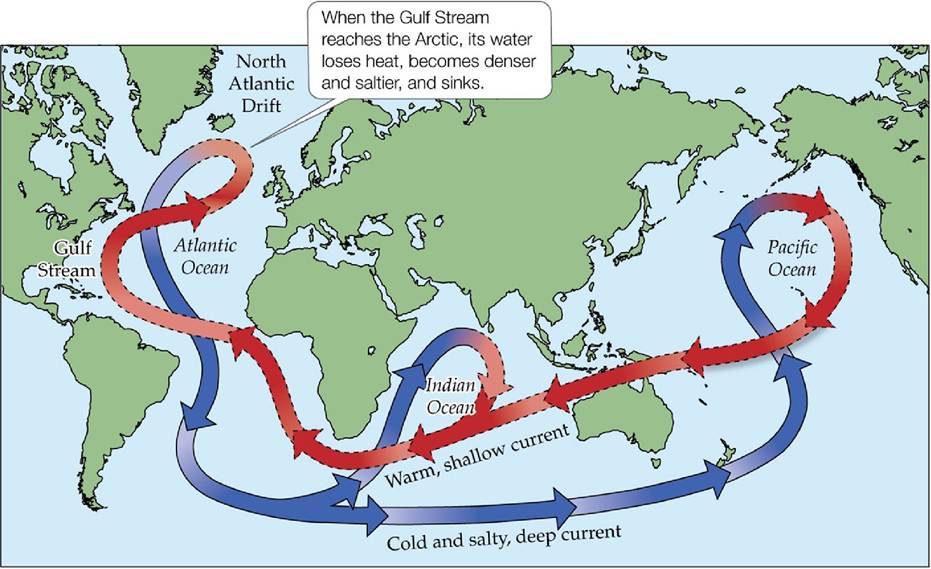
FIGURE 2.13 The Great Ocean Conveyor Belt An interconnected system of surface and deep ocean currents transfers energy between tropical and polar regions. The red arrows with dashed outlines represent shallow currents, and the blue arrows with solid outlines represent deeper currents. (After Hugo Ahlenius, UNEP/GRID-Arendal. 2007.
http://maps.grida.no/go/graphic/world-ocean-thermohaline-circulation1.) View larger image
Now that we have seen how the differential heating of Earth's surface generates prevailing winds and ocean currents, let's examine the effects of these atmospheric and oceanic circulation patterns on Earth's climates, including global patterns of temperature and precipitation.
More on the topic Ocean currents are driven by surface winds:
- The surface waters and winds of the Southern Ocean drive constantly, without interruption by land, from the west around the Antarctic continent.
- The Indian Ocean ranks among the most long-lived spaces of historical memory and the present burst of historiographical attention to this ocean should be interpreted in this context.
- PART TWO The Middle Ocean: The Indian Ocean and Its Neighbours, 4500 bc-ad 1500
- Atmospheric circulation cells create surface wind patterns
- Vegetation affects climate via surface energy exchange
- Ectoparasites live on the surface of their host
- Oceans cover 71% of Earth's surface and contain a rich diversity of life.
- TO WHAT EXTENT KNOWLEDGE ECONOMY VARIABLES COULD HAVE DRIVEN PRODUCTION
- Models with common growth driven by international knowledge spillovers
- Principle (5) and Message-Driven Governmental Regulation: A Tentative Conclusion
- was driven not only by features widely shared throughout west ern Europe but also by the region’s deep divisions.
- The previous chapter described a world where a financial accelerator first generates a lending driven boom and then its inevitable collapse.
- I The Oldest Ocean
- Establishing the Ocean