Some species reproduce only once, while others reproduce multiple times
An important life history trait influencing reproductive success is the number of reproductive events they have during their lifetime. Semelparous species (also known as monocarpic in plants) reproduce only once in a lifetime, whereas iteroparous species (also known as polycarpic in plants) have the capacity for multiple bouts of reproduction.
Many plant species complete their life cycle in a single year or less. Known as annual plants, such species are semelparous: after one season of growth, they reproduce once and die. A more complex example of a semelparous plant is the century plant (a common name applied to several species in the genus Agave) of North American deserts. These plants grow vegetatively for up to 30 years before undergoing a single intensive bout of sexual reproduction. When it is ready to reproduce, a century plant produces a single stalk of flowers that is up to 6 m (20 feet) tall and towers over the rest of the plant. The plant produces a large quantity of seeds from this single reproductive event. The portion of the plant that produces the tall stalk of flowers dies after reproduction; hence, it is semelparous. At the genetic level, however, a century plant individual may not die when it flowers if it also reproduces asexually, producing genetically identical clones that surround the original plant (FIGURE 7.21). In this sense, some century plants are not semelparous after all—the clones survive after the flowering event and will eventually flower themselves.
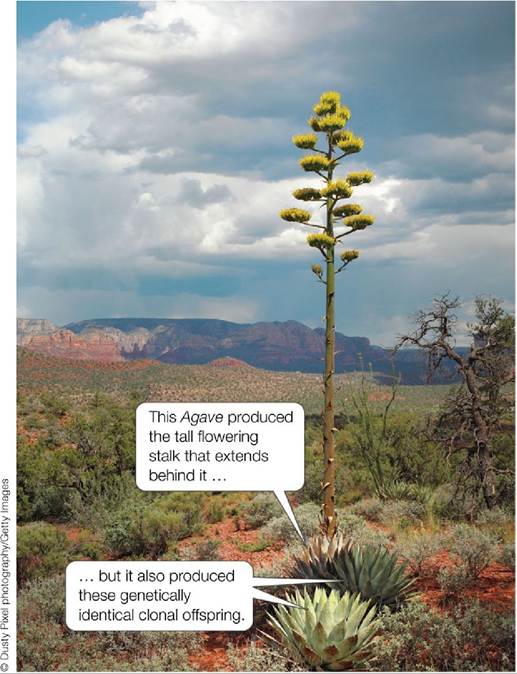
FIGURE 7.21 Agave: A Semelparous Plant? The Agave individual that produced the tall flowering stalk will die shortly after it flowers and so can be viewed as semelparous. But the individual that flowered also produced genetically identical clonal offspring.
Thus, the genetic individual will live on after flowering, and in that sense it is not semelparous after all. View larger imageA striking example of a semelparous animal is the giant Pacific octopus (Enteroctopus dofleini), which in its 3- to 5-year life span (relatively short for an octopus species) can reach about 8 m (25 feet) in length and weigh nearly 180 kg (400 pounds). The female of this marine invertebrate species lays a single clutch containing tens of thousands of fertilized eggs. She then broods the eggs for up to 6 months. During this time, the female does not feed at all; she is a constant presence over her eggs, cleaning and ventilating them. The female dies shortly after the eggs hatch, having exhausted herself in this intense period of parental investment. Other animals that exhibit semelparity include salmon, many spiders, and some insects such as butterflies.
Why would an organism that lives multiple years only reproduce once in its lifetime? Theoretically, semelparous organisms gain an advantage in total lifetime reproductive output due to the conditions affecting the trade-off between reproduction and survival. Larger organisms have higher reproductive output, and reserving reproductive maturity to the end of the life cycle results in the highest reproductive output under certain conditions. If the probability of adult mortality is above a certain threshold, and the costs of reproduction are high even at low levels of reproductive output, then semelparity will result in higher lifetime reproductive output than iteroparity. Another reason that has been proposed for the evolution of semelparity is the benefit of producing massive amounts of offspring under high predation rates. Producing more offspring than can be consumed by predators allows some to escape and maintain the population.
Most organisms do not invest so heavily in single reproductive events. Iteroparous organisms engage in multiple bouts of reproduction over the course of a lifetime. Examples of iteroparous plants are long-lived trees such as pines and spruces. Among animals, most large mammals are iteroparous. Of course, iteroparity can take a variety of forms, from plants that flower twice in a season and then die to trees that reproduce every year for centuries.
There are a multitude of different combinations of life history traits associated with reproduction and allocation of effort and resources. In the next section we consider some overarching conceptual models to match these life history patterns up with ecological conditions.
More on the topic Some species reproduce only once, while others reproduce multiple times:
- CASE 12: Incentives to Marry and Reproduce
- CONCEPT 13.1 Parasites typically feed on only one or a few host species, but host species have multiple parasite species.
- The way we think about species interactions changes dramatically when we consider that they are embedded in a community of multiple interactors.
- Interactions of Multiple Species
- CONCEPT 19.1 Species diversity differs among communities as a consequence of regional species pools, abiotic conditions, and species interactions.
- Species distribution models can be used to predict a species' geographic range
- Invasive species can displace native species and alter ecosystem properties
- Where should we put our focus in preventing species loss—on the species or the habitat?
- The outcome of competition between species can be changed by a broad suite of factors, including features of the physical environment, disturbance, and interactions with other species.
- We have seen in previous chapters that disturbance, stress, and predation can modify species interactions and allow for species coexistence.