Ecologists may use subsets of species to define communities
One common way of subdividing a community is based on taxonomic affinity— that is, by groups of species classified together because of evolutionary lineage (FIGURE 16.4A). For example, a study of a forest community might be limited to all the bird species within that community (in which case an ecologist might speak of “the forest bird community”).
Another useful subset of a community is a guild, a group of species that use the same resources, even though they might be taxonomically distant (FIGURE 16.4B). For example, some birds, bees, and bats feed on flower pollen, thus forming a guild of pollen-eating animals. Finally, a functional group is a subset of a community that includes species that function in similar ways but may or may not use similar resources (FIGURE 16.4C). For example, nitrogen-fixing plants (legumes) can be placed in the same functional group.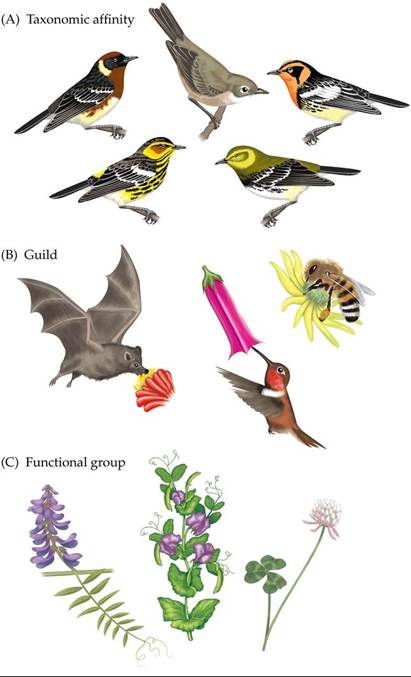
FIGURE 16.4 Subsets of Species in Communities Ecologists may use subsets of species to define communities. These examples show three ways in which such subsets could be designated. (A) All the bird species in a community could be grouped together by taxonomic affinity. (B) All the species that use pollen as a resource could be grouped together as a guild. (C) All the plant species in a community that have nitrogen-fixing bacteria (e.g., legumes) could be placed in the same functional group. View larger image
There are other subsets of communities that allow ecologists to organize species based on their trophic, or food-based, interactions (FIGURE 16.5A). Species can be organized in a food web, a representation of the trophic or energetic connections among species within a community. Food webs can be further organized into trophic levels, or groups of species that have similar ways of interacting and obtaining energy.
The lowest trophic level contains primary producers, which are autotrophs such as plants. The primary producers are fed on by organisms at the second level, the primary consumers, which areherbivores. The third level contains secondary consumers, which are carnivores, or animals that eat animals. Secondary consumers are fed on in turn by tertiary consumers, also carnivores.
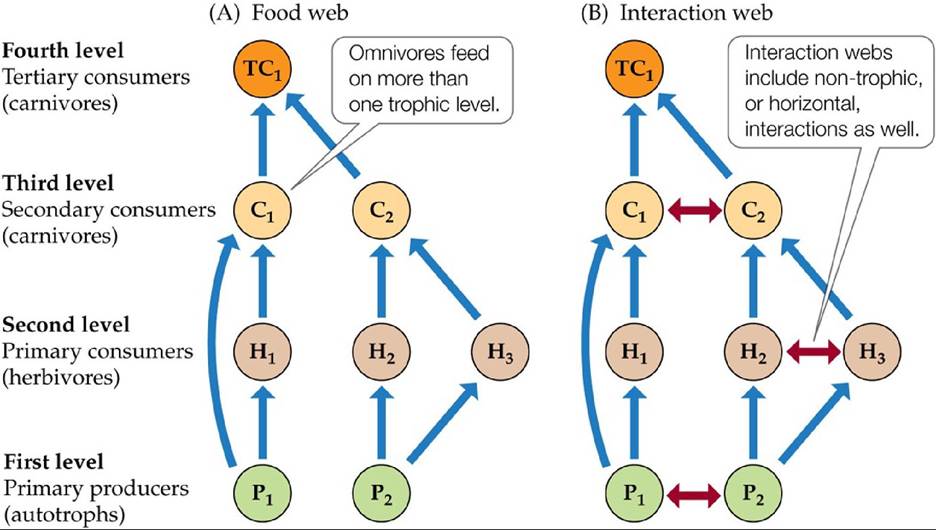
FIGURE 16.5 FoodwebsandInteractionWebs (A)Foodwebsdescribetrophicor energetic connections among species within a community. (B) Interaction webs include both trophic interactions (vertical arrows) and non-trophic (horizontal arrows) competitive and positive interactions. View larger image
Traditionally, food webs have been used as a descriptive or idealized method of understanding the trophic relationships among the species in a community. Food webs tell us little, however, about the strength of those interactions or their importance in the community. In addition, the use of trophic levels can create confusion for a number of reasons: for example, some species span two trophic levels (e.g., corals can be classified as both carnivores and herbivores because they eat zooplankton and they have symbiotic algae), some species change their feeding status as they mature (e.g., amphibians can be herbivores as tadpoles and carnivores as adults), and some species are omnivores, feeding on more than one trophic level (e.g., some fish feed on both algae and invertebrates). Moreover, idealized food webs often do not include certain important resources and consumers that are common within communities. For example, all organisms that die without being consumed become organic matter known as detritus and can be consumed by detritivores (mostly fungi and bacteria) through a process known as decomposition; see Concept 22.2. Another example is symbionts, including parasites and mutualists, which are present at almost all trophic levels (see Chapters 13 and 15).
Another characteristic of food webs is that they do not include non-trophic interactions (so-called horizontal interactions, such as competition and some positive interactions), which, as we have seen in Unit 4, can also influence community character. The concept of an interaction web has been introduced to more accurately describe both the trophic (vertical) and non-trophic (horizontal) interactions among the species in a traditional food web (FIGURE 16.5B). Despite these drawbacks, the food web concept remains a strong one, if only for its visual representation of important consumer relationships within a community.
We will learn much more about food webs in Chapter 21. Next let's consider the important properties of communities that allow us to characterize them and to distinguish one from another.
More on the topic Ecologists may use subsets of species to define communities:
- As indicated above, ecologists have long thought that competition between species was important in communities.
- CONCEPT 19.1 Species diversity differs among communities as a consequence of regional species pools, abiotic conditions, and species interactions.
- Ecologists often delineate communities by their physical or biological characteristics
- Species within communities differ in their commonness or rarity
- In the Case Study at the opening of this chapter, we saw lower hantavirus prevalence in small-mammal communities with higher species diversity than in those with lower species diversity (see Figure 19.2).
- Overexploitation of species has large effects on ecological communities
- 19 Species Diversity in Communities
- CONCEPT 16.1 Communities are groups of interacting species that occur together at the same place and time.
- CONCEPT 13.5 Parasites can alter the outcomes of species interactions, thereby causing communities to change.
- A general theme that runs through this book is that ecological interactions can affect the distributions and abundances of species, affecting communities and ecosystems.
- HIV INFECTION OF THYMOCYTE SUBSETS
- Species distribution models can be used to predict a species' geographic range
- Invasive species can displace native species and alter ecosystem properties
- CONCEPT 13.1 Parasites typically feed on only one or a few host species, but host species have multiple parasite species.