Species within communities differ in their commonness or rarity
Although species diversity indices allow ecologists to compare different communities, graphical representations of species diversity can give us a more explicit view of the commonness or rarity of the species in communities.
Such graphs, called rank abundance curves, plot the proportional abundance of each species (pi) relative to the others in rank order, from most abundant to least abundant (FIGURE 16.8). If we use rank abundance curves to compare our two butterfly communities from Figure 16.6, we can see that community A has one abundant species (i.e., the blue butterfly) and three rare species (i.e., the yellow, pink, and orange butterfly species), whereas in community B, all the species have the same abundance.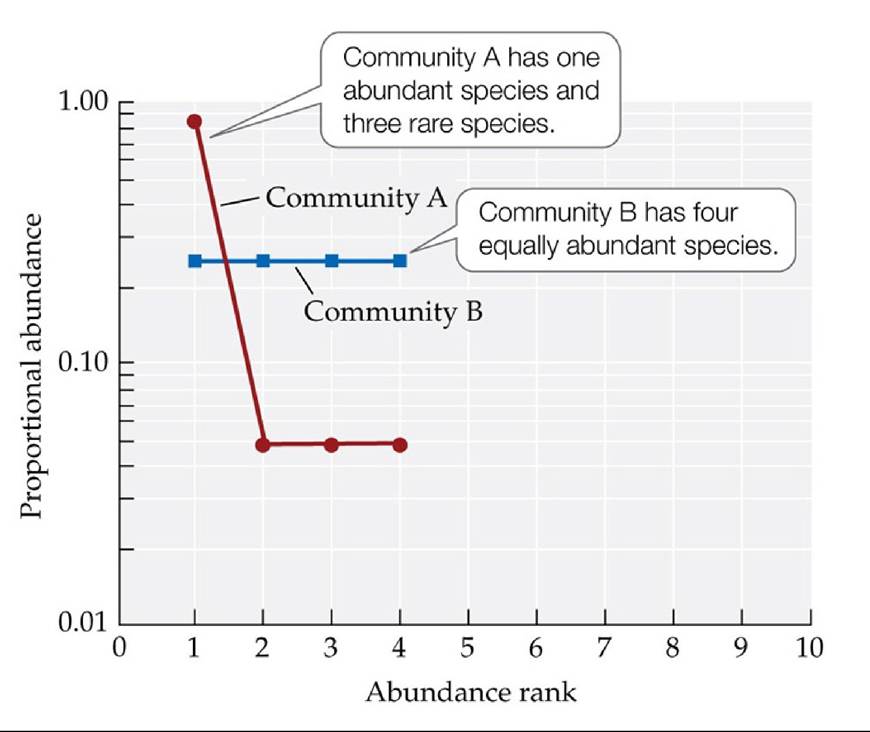
FIGURE 16.8 ArespeciesCommonorRare? Using rank abundance curves, we can see that the two hypothetical butterfly communities in Figure 16.6 differ in the commonness and rarity of the same four species. View larger image
These two patterns could suggest the types of species interactions that might occur in these two communities. For example, the dominance of the blue butterfly in community A might indicate that it has a strong effect on one or more of the other species in the community. In community B, where all the species have the same abundance, their interactions might be fairly equivalent, with no one species dramatically affecting the others. To test these hypotheses, we can design manipulative experiments to explore relationships between species abundances and the types of interactions that occur among the species in a community. As we will see in the next section, experiments of this kind typically involve adding or removing individuals of one species and measuring the responses of individuals of another species in the community to the manipulation.
More on the topic Species within communities differ in their commonness or rarity:
- CONCEPT 19.1 Species diversity differs among communities as a consequence of regional species pools, abiotic conditions, and species interactions.
- Individuals within species differ in their life histories
- In the Case Study at the opening of this chapter, we saw lower hantavirus prevalence in small-mammal communities with higher species diversity than in those with lower species diversity (see Figure 19.2).
- Ecologists may use subsets of species to define communities
- As indicated above, ecologists have long thought that competition between species was important in communities.
- Overexploitation of species has large effects on ecological communities
- 19 Species Diversity in Communities
- CONCEPT 16.1 Communities are groups of interacting species that occur together at the same place and time.
- CONCEPT 13.5 Parasites can alter the outcomes of species interactions, thereby causing communities to change.
- A general theme that runs through this book is that ecological interactions can affect the distributions and abundances of species, affecting communities and ecosystems.
- Invasive species can displace native species and alter ecosystem properties
- CONCEPT 13.1 Parasites typically feed on only one or a few host species, but host species have multiple parasite species.
- Species distribution models can be used to predict a species' geographic range
- Where should we put our focus in preventing species loss—on the species or the habitat?
- The outcome of competition between species can be changed by a broad suite of factors, including features of the physical environment, disturbance, and interactions with other species.
- We have seen in previous chapters that disturbance, stress, and predation can modify species interactions and allow for species coexistence.
- Hunting communities Agricultural communities The "Indo-European" influence The Vedic period The ritual system
- CONCEPT 16.2 Species diversity and species composition are important descriptors of community structure.
- CONCEPT 15.1 In positive interactions, no species is harmed, and the benefits are greater than the costs for at least one species.
- Protection of surrogate species can provide protection for other species with similar habitat requirements