A general theme that runs through this book is that ecological interactions can affect the distributions and abundances of species, affecting communities and ecosystems.
The community-level consequences of predation can be profound, in some cases causing major shifts in the types of organisms found at a given location.
All trophic interactions have the potential to reduce the growth, survival, or reproduction of the organisms that are eaten.
These effects can be dramatic, as demonstrated in the case of a leaf-feeding beetle, Chrysolina quadrigemina, that rapidly reduced the density of Klamath weed, an invasive plant that is poisonous to livestock (FIGURE 12.17). Predators and parasitoids can also have dramatic effects when they are introduced as biological pest controls. In six cases, introductions of wasps that preyed on crop-eating insects decreased the herbivores' densities by more than 95%, thus greatly reducing the economic damage caused by those pests.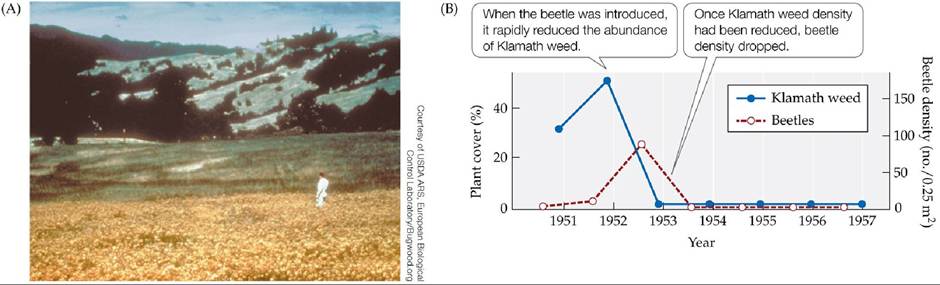
FIGURE 12.17 A Beetle Controls a Noxious Rangeland Weed Klamath weed (Hypericum perforatum), which poisons cattle, once covered about 4 million acres of rangeland in the western United States. (A) This photograph, taken in 1949, shows a field completely covered with flowering Klamath weed. (B) The leaf-feeding beetle Chrysolina quadrigemina was introduced in 1951 in the hope of controlling Klamath weed. This graph tracks densities of beetles and of Klamath weed (as a percentage of plant cover) in plots after the beetle's introduction.
Explain how a plant community might change after C. quadrigemina reduced the density of Klamath weed.
(B after C. Huffaker and C. Kennett. 1959. A ten-year study of vegetational changes associated with biological control of Klamath weed. J Range Manage 12: 69-82. doi:10.2307/3894934. Material used with permission of the publisher.) View larger image
Predators and herbivores can also change the outcome of competition (see Concept 14.4), thereby affecting the distributions or abundances of competitor species. In particular, inferior competitors may increase in abundance when they are in the presence of a predator that decreases the abundance or performance of a dominant competitor. Paine (1974) found such a result: he showed that the removal of a predatory sea star (Pisaster) led to the crowding out of large invertebrate species but one, the California mussel (Mytilus californianus). The mussel was a dominant competitor that, in the absence of the sea star, drove all the other large invertebrates to local extinction.
We turn now to examples of how trophic interactions can affect communities, first for carnivores and second for herbivores.
More on the topic A general theme that runs through this book is that ecological interactions can affect the distributions and abundances of species, affecting communities and ecosystems.:
- CONCEPT 15.3 Positive interactions affect the abundances and distributions of populations as well as the structure of ecological communities.
- Positive interactions influence the abundances and distributions of populations
- Throughout this book, we have emphasized the role that climate plays in ecological processes, including the distributions and physiological performance of organisms, the rates of resource supply, and the outcomes of biological interactions such as competition.
- Positive interactions can alter communities and ecosystems
- CONCEPT 19.1 Species diversity differs among communities as a consequence of regional species pools, abiotic conditions, and species interactions.
- Overexploitation of species has large effects on ecological communities
- CONCEPT 13.5 Parasites can alter the outcomes of species interactions, thereby causing communities to change.
- Evolution can alter ecological interactions
- The outcome of competition between species can be changed by a broad suite of factors, including features of the physical environment, disturbance, and interactions with other species.
- We have seen in previous chapters that disturbance, stress, and predation can modify species interactions and allow for species coexistence.