Carnivores can alter communities in dramatic ways
Anolis lizards are predators that eat a broad range of prey species, including spiders. Thomas Schoener and David Spiller studied the effects of lizard predators on their spider prey in the Bahamas.
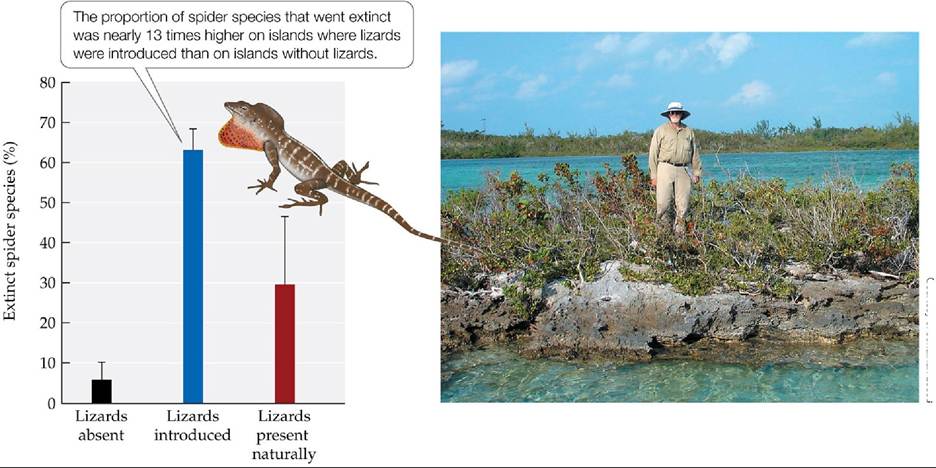
They selected 12 small islands and divided them into four groups of 3 islands each that were similar in size and vegetation. Initially, each group of 3 islands contained an island with lizards and 2 without. One of the latter 2 islands was then chosen at random to have two male and three female adult Anolis sagrei lizards introduced to it; the other island was left as a control where lizards were absent naturally.The introduced lizards greatly reduced the distributions and abundances of their spider prey (Schoener and Spiller 1996). Before the experiment began, the numbers of spider species and the overall densities of spiders were similar among the 8 islands that lacked lizards. By the end of the experiment, however, the introduction of lizards to 4 islands had reduced the numbers and densities of spider species to the levels found on the 4 islands where lizards were present naturally. The proportion of spider species that went extinct was nearly 13 times higher on islands where lizards were introduced than on islands without lizards (FIGURE 12.18). Similarly, the density of spiders was about 6 times higher on islands without lizards than on islands that had lizards (either naturally or
experimentally). The introduction of lizards reduced the densities of both common and rare spider species, and most of the rare species went extinct. Similar experimental results have been obtained for beetles eaten by rodents and grasshoppers eaten by birds.
Courtesy of Jonathan Losos
FIGURE 12.18 Lizard Predators Can Drive Their Spider Prey to Extinction The experimental introduction of lizards to small islands in the Bahamas greatly increased the rate at which their spider prey became extinct. Error bars show one standard error of the mean.
The photograph shows Thomas Schoener on one of the study islands. (After T. W. Schoener and D. A. Spiller. 1996. Nature 381: 691-694.) View larger imageSchoener and Spiller's work on the effects of predatory lizard on spiders shows that the direct effects of a predator can greatly reduce the number of prey species in a community. In other cases, a predator that suppresses a dominant competitor can (indirectly) cause the number of species in a community to increase (as in the sea star and mussel example). Indirect effects of predators can also alter ecological communities by affecting the transfer of nutrients from one ecosystem to another, as the following study on arctic foxes illustrates.
In the late nineteenth and early twentieth centuries, humans introduced arctic foxes (Vulpes lagopus) to some of the Aleutian islands off the coast of Alaska. Other islands remained fox-free, either because foxes were never introduced there or because the introductions failed. Taking advantage of this inadvertent large-scale experiment, Croll et al. (2005) determined that, on average, the introduction of foxes to an island reduced the density of breeding seabird populations nearly 100-fold. The decrease in seabird numbers, in turn, reduced the input of guano (bird feces) to an island from roughly 362 to 6 g per square meter. Seabird guano, which is rich in phosphorus and nitrogen, transfers nutrients from the ocean (where seabirds feed) to the land. By reducing the amount of guano that fertilized the (nutrient-limited) plant communities on the islands, the introduction of foxes caused dwarf shrubs and forbs to increase in abundance at the expense of grasses. As a result, the introduction of foxes had the unexpected effect of transforming the island communities from grasslands to communities characterized by small shrubs and forbs.
More on the topic Carnivores can alter communities in dramatic ways:
- Herbivores can alter communities in dramatic ways
- Positive interactions can alter communities and ecosystems
- CONCEPT 13.5 Parasites can alter the outcomes of species interactions, thereby causing communities to change.
- Many carnivores have broad diets
- Some carnivores move to search for and capture prey, while others sit and wait
- CANINE DISTEMPER IN CARNIVORES
- Hunting communities Agricultural communities The "Indo-European" influence The Vedic period The ritual system
- Escaping carnivores: Physical defenses, toxins, mimicry, and behavior
- Evolution can alter ecological interactions
- 1 Direction to provide or alter fixed equipment
- Individuals often alter their foraging decisions when predators are present
- CONCEPT 12.1 Most carnivores have broad diets, whereas a majority of herbivores have relatively narrow diets.