Individuals often alter their foraging decisions when predators are present
As noted above, optimal foraging behavior may be compromised by the risk of exposure to predators of the foraging animal. An individual that is well fed but does not survive long enough to reproduce will not pass its genes to future generations.
Foragers face trade-offs in which achieving one objective (such as eating) comes at the expense of another (survival). Recall from Concept 4.1 that trade-offs are traits or behaviors that are beneficial for one function but negatively influence traits or behaviors for another function. Trade-offs that affect foraging decisions may be related to predators (an herbivore may avoid an area with ample food if predators are present), environmental conditions (in the desert, a foraging animal may retreat to a burrow or shade when temperatures become too hot), or physiological conditions (a hungry animal may tolerate greater risks when foraging than will a well-fed animal). Our focus here will be on how predators affect foraging decisions.Creel et al. (2005) studied how the presence of wolves affected the foraging
behavior of elk (Cervus elaphus) in the Greater Yellowstone Ecosystem. The researchers used GPS radio collars to track the daily movements of elk. On days when wolves were known to be present in the area, elk moved into wooded regions rather than the nearby grasslands where they usually preferred to forage. The wooded regions offered less food than the grasslands but more protective cover: in the grasslands they were more vulnerable to wolf predation. Results from a statistical analysis of elk movements provided additional evidence that elk moved into forests when wolves arrived and returned to grasslands when wolves departed (FIGURE 8.10).
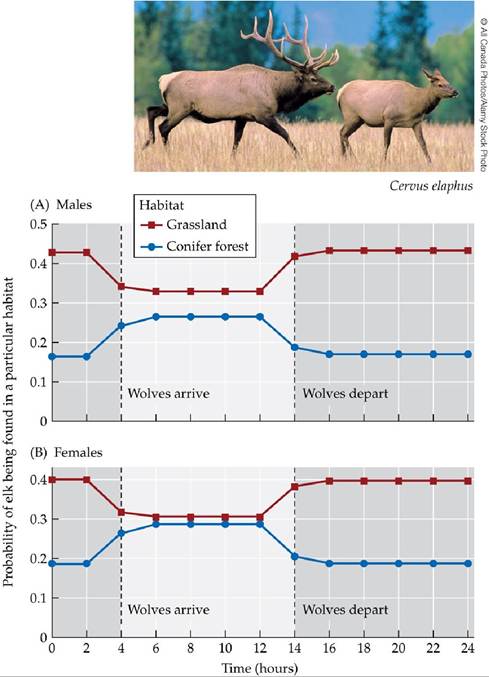
FIGURE 8.10 Movement Responses of Male and Female Elk Resultsfromastatistical analysis of daily movement patterns of male (A) and female (B) elk show that the probability of finding elk in grasslands drops when wolves arrive, then rises when wolves depart.
Compare and contrast how male and female elk respond to the presence of
wolves.
(After S. Creel et al. 2005. Ecology 86: 3387-3397.) View larger image
Similar results have been found in aquatic environments. For example, Werner et al. (1983) examined how the presence of predators affected the foraging decisions of the bluegill sunfish (Lepomis macrochirus). Identical sets of sunfish in three size classes (small, medium, and large) were introduced on both sides of a divided pond; a predatory fish, the largemouth bass (Micropterus salmoides), was also introduced on one side of the pond. The sizes of sunfish and bass were selected such that smallest sunfish would be very vulnerable to the bass predators, while the largest ones would be too large for the bass to eat. Medium and large sunfish foraged in similar ways on both sides of the pond, with their habitat choice and diet matching predictions based on optimal foraging theory. The same was true for the small sunfish in the half of the pond lacking predators. In the presence of predators, however, they increased the time they spent foraging in vegetation, a habitat that provided greater cover from the bass but only one-third the rate of food intake available in more open habitats.
Researchers have also tested whether a perceived risk of predation can alter foraging patterns, even in the absence of actual predation. In one such study, Zanette et al. (2011) exposed the nests of some song sparrows (Melospiza melodia) to recordings of calls and sounds from their predators (such as raccoons, ravens, or hawks), while other nests were exposed to recordings of calls and sounds from nonpredators (such as seals or geese). (The researchers had protected all the nests from actual predators with electric fencing and netting.) Song sparrows exposed to recordings of predators fed their young fewer times per hour than did sparrows that heard recordings of nonpredators (FIGURE 8.11). Song sparrows that heard predators also built their nests in denser, thornier vegetation and spent less time incubating their eggs than did sparrows exposed to recordings of nonpredators.
We'll explore the consequences of such behavioral changes in Connections in Nature at the end of this chapter.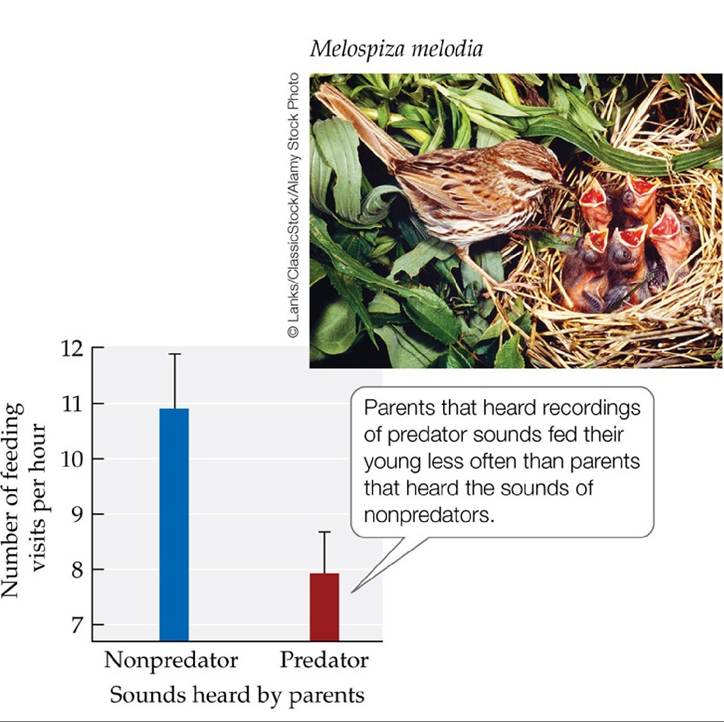
FIGURE 8.11 Young Receive Less Food When Parents Fear Predators Thenumberof times per hour that song sparrow parents feed their offspring drops when the parents are exposed to recordings of sounds made by predators. Error bars show one SE of the mean. (After L. Y.
Zanette et al. 2011. Science 334: 1398-1401.) View larger image
The song sparrow, elk, and sunfish examples are representative of hundreds of other studies showing that prey alter their foraging behavior in the presence of predators (Lima 1998; Verdolin 2006). As we'll see next, when predators are present, prey make other behavioral changes that can reduce their chance of being eaten.
More on the topic Individuals often alter their foraging decisions when predators are present:
- Benefits of group living include access to mates, protection from predators, and improved foraging success
- When individuals or firms make decisions about production, consumption and investment, they generally consider only their own costs and benefits, not the environmental or social consequences (externalities).
- Chapter 3 An Agent-Based Model of Resource Distribution on Hunter-Gatherer Foraging Strategies: Clumped Habitats Favor Lower Mobility, but Result in Higher Foraging Returns
- Financial statement analysis is an essential skill in a variety of occupations including investment management, corporate finance, commercial lending, and the extension of credit. For individuals engaged in such activities, or who analyze financial data in connection with their personal investment decisions, there are two distinct approaches to the task.
- Prey exhibit behaviors that can prevent detection or deter predators
- The Geopolitics of Foraging Bands
- Optimal foraging theory addresses behavioral choices that enhance the rate of energy gain
- Foraging Behavior
- Carnivores can alter communities in dramatic ways
- 1914: decisions for war
- Control Movements and Decisions