Prey exhibit behaviors that can prevent detection or deter predators
Predators can exert strong selection on prey populations. As a result of such selection pressures, prey species have evolved a broad range of defenses against their predators. We'll focus here on antipredator behaviors; in Concept 13.2, we'll discuss other forms of defense, including physical defenses, toxins, and morphological forms of camouflage.
Antipredator behaviors include those that can help prey avoid being seen, detect predators, prevent attack, or escape once attacked (FIGURE 8.12). Behaviors that can help prey avoid being seen include hiding, remaining still when predators are nearby, and performing risky activities (such as foraging) during times of day when predators are not active. Other animals make themselves difficult to see by resembling objects that are less preferred by predators, such as portions of flower petals (in some caterpillars) or feces. With respect to detecting predators, prey often remain highly vigilant for predators, and some birds, lizards, and mammals can remain alert even while sleeping (see Figure 8.12B). There is also a wide variety of ways that prey seek to prevent attack once they are seen. For example, juvenile decorator crabs (Libinia dubia) attach to their bodies bits of an alga that local fishes find unpalatable, an action that was found to increase their rate of survival (Stachowicz and Hay 1999). Older decorator crabs that are too large for the fish to eat do not engage in this behavior. When threatened, some prey make sudden movements or display markings that confuse the predator, as illustrated by the display of eyespots shown in Figure 8.12C. Some prey send predators a signal, in effect conveying, “I see you, I'm faster than you, so don't bother to attack me.” The stotting behavior of antelopes (see Figure 8.12D) is thought to be one such signal. Other examples of prey signaling to prevent attack include lizards that perform “push-ups” (indicating their overall
physical condition) and ground squirrels that deliberately approach rattlesnakes, often within striking distance, while waving their tails from side to side (tailflagging).
Tail-flagging was found to be effective in deterring rattlesnakes from striking, and it increased the chance that a snake would abandon its ambush site (Barbour and Clark 2012).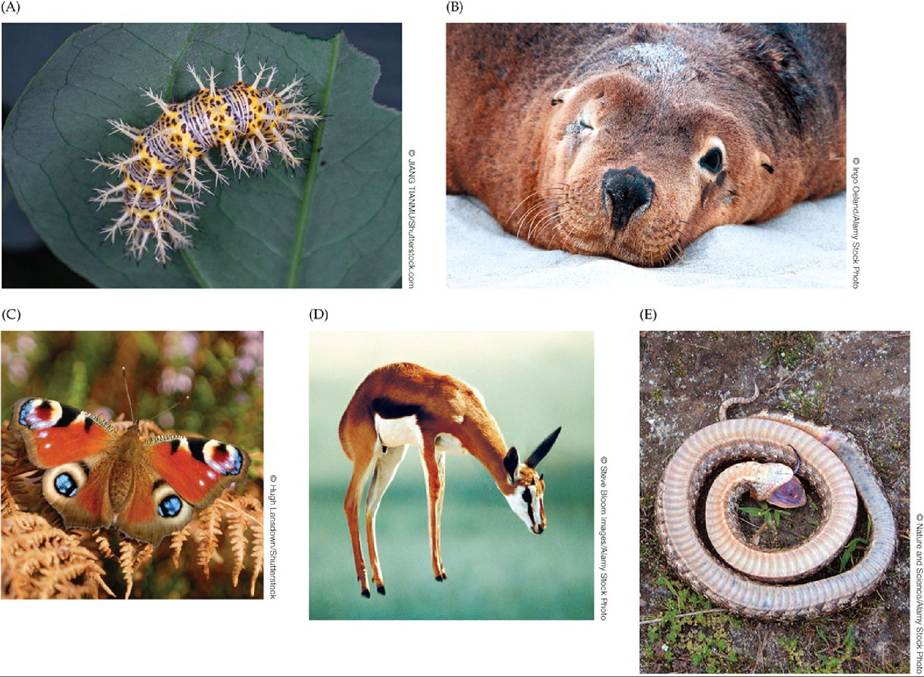
FIGURE 8.12 Examples of Antipredator Behaviors (A) Slug caterpillars (Family
Limacodidae) are covered in protective, stinging hairs, making them unpalatable to predators. (B) Australian sea lions (Neophoca cinerea) can literally sleep with one eye open, with half their brain in a state of sleep while the other half remains alert for danger. (C) When threatened, the peacock butterfly (Aglais io) displays eyespots, a transformation that can startle predators. (D) A springbok (Antidorcas marsupialis) displays a stiff-legged jumping behavior known as stotting or pronking, which is thought to discourage predators from pursuing the small gazelle. (E) When captured, hognose snakes such as this eastern hognose snake (Heterodon platirhinos) play dead and emit an odor that smells like decaying meat; this behavior can deter predators that will not eat carrion. View larger image
If a predator attacks and captures (or is about to capture) its prey, the potential victim may resort to extreme behaviors. A hognose snake, for example, may play dead when captured, extruding its tongue and emitting a foul odor that resembles the smell of decaying meat, all the while keeping a close eye on its attacker (see Figure 8.12E). This behavior may work because many predators will not eat carrion. As a last resort, many prey defecate, urinate, or extrude other unpleasant substances, such as the large amounts of mucus secreted by a hagfish under attack (this mucus sometimes suffocates the predator). Other species detach parts of the body when threatened or grabbed. A gecko, for example, can drop its tail, which wriggles on the ground, distracting the predator. Some sea cucumbers take such evasive maneuvers to a unique level: when captured, they turn themselves partially inside out, startling the attacker and covering it with a tangled mass of internal organs. The sea cucumber then detaches those organs and swims away; later, it regrows the missing organs in a remarkable example of self-regeneration.
Having examined the foraging and antipredator behaviors of animals from an evolutionary perspective, we turn now to another key animal activity: sexual reproduction.