Benefits of group living include access to mates, protection from predators, and improved foraging success
Members of a group can enjoy higher reproductive success than solitary individuals. This is clear for males that hold high-quality territories, and it may also be true for females in such territories because they may gain access to good breeding sites or abundant supplies of food.
Like the females of a lion pride, group members may also share the responsibilities of feeding and protecting the young, which can benefit the parents (who may have more time to obtain food for themselves) as well as the offspring (who may be both better fed and better protected).Living in a group can provide other advantages as well, such as a reduced risk of predation. In some cases, the individuals in the group can band together to discourage attack (FIGURE 8.19). Moreover, predators are often detected sooner when they approach a group than when they approach a single individual. As a result, they are less likely to surprise their prey, which causes the predators' attack success rate to drop. For example, goshawks were successful in killing wood pigeons about 80% of the time when they attacked a single pigeon, but when they attacked pigeons in a large flock, they were detected sooner, and their success rate plunged (FIGURE 8.20).
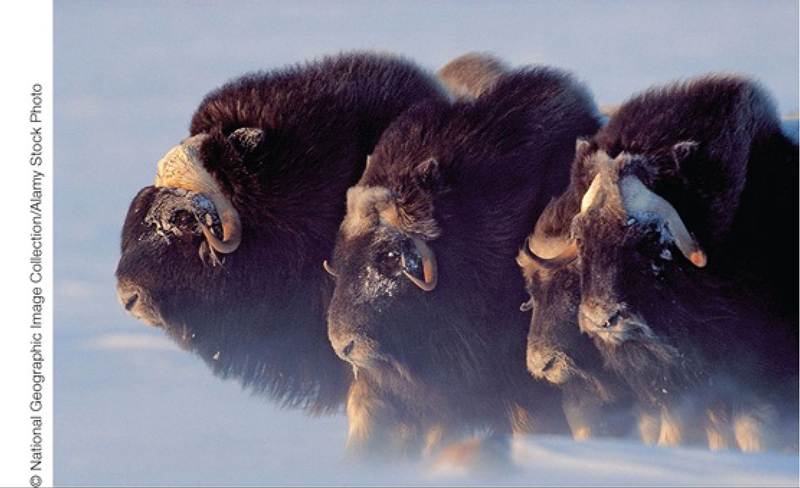
FIGURE 8.19 A Formidable Defense A group of musk oxen that circles is a very difficult target for predators. View larger image
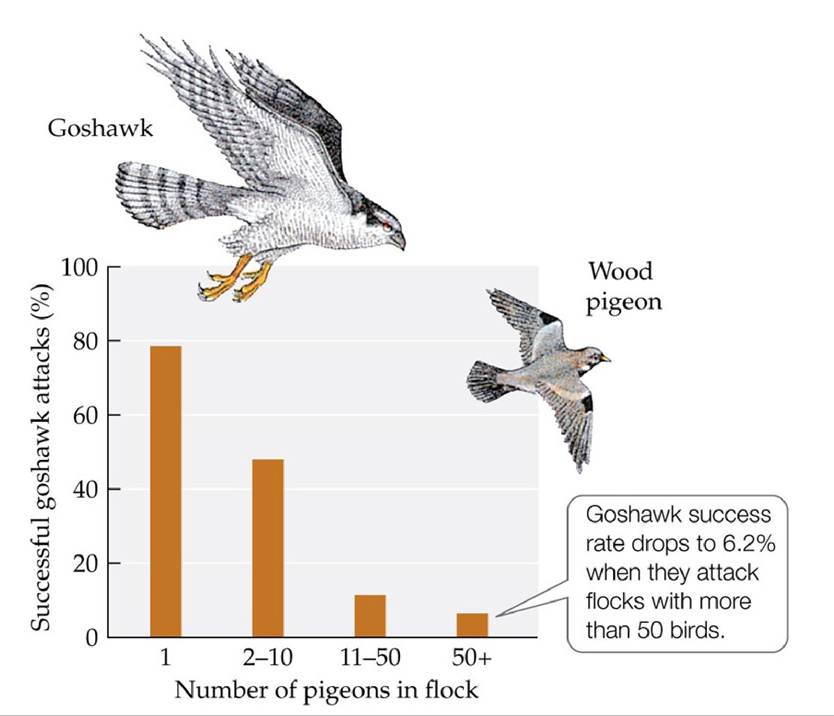
FIGURE 8.20 Safety in Numbers The success rate of a goshawk attacking wood pigeon prey plummets when it attacks a large flock. (After R. E. Kenward. 1978. JAnim Ecol 47: 449-460.) View larger image
In other cases, group members do not cooperate against predators, yet individuals in a group still have a lower risk of predation than they would on their own.
One reason for this is that as the number of individuals in a group increases, the chance of being the one attacked decreases, a phenomenon known as the dilution effect. In ANALYZING DATA 8.1, you can see whether the dilution effect applies to a marine insect attacked by fish predators. Furthermore, if group members respond to a predator by scattering in different directions, they may make it difficult for the predator to select a target, thus causing the predator's attack success rate to drop.ANALYZING DATA 8.1
Does the Dilution Effect Protect Individual Ocean Skaters from Fish Predators?
Individuals in a group may gain protection from predators because of the dilution effect: when a predator attacks, the larger the number of prey individuals in the group, the smaller the chance that any particular member of the group will be the victim.
Foster and Treherne* tested whether the dilution effect occurred when a predatory fish (Sardinops sagax) attacked groups of a marine insect, the ocean skater (Halobates robustus). A subset of their data is presented in the table, which shows the number of predator attacks (per 5 minutes) on ocean skater groups differing in size.
1. Calculate the average number of attacks (per 5 minutes) for each group size. Do the fish predators show a clear preference for attacking small groups over large groups (or vice versa)? Explain.
| No. insects in group | No. groups observed | No. attacks (per 5 minutes per group) |
| 1 | 3 | 15; 6; 10 |
| 4 | 2 | 16; 8 |
| 6 | 3 | 9; 12;7 |
| 15 | 2 | 7; 10 |
| 50 | 2 | 15; 11 |
| 70 | 2 | 14; 7 |
2.
For each group size, convert the average that you calculated for question 1 into the average number of attacks per individual (per 5 minutes). Is there a consistent relationship between the average number of attacks per individual (per 5 minutes) and group size? Explain.3. Are these results consistent with the dilution effect?
*Foster, W. A., and J. E. Treherne. 1981. Evidence for the dilution effect in the selfish herd from fish predation on a marine insect. Nature 293: 466-467.
Group members may also experience improved foraging success. Two or more lions, for example, can bring down much larger prey than a single lion could tackle on its own. Furthermore, lions, killer whales, wolves, and many other predators may coordinate their attacks, such that the actions of one predator drive prey into the waiting jaws of another. Herbivores may also forage more effectively when in groups than when on their own by increasing the probability of finding high-quality patches of food resources.